
Mardi Gras, New Orleans, Source Infrogmation, Author Infrogation of New Orleans (CC BY-SA 4.0 International, 3.0 Unported, 2.5 Generic, 2.0 Generic, 1.0 Generic and GNU Free Documentation License)
Mardi Gras is on February 17th this year. As always, it falls on the last day before Ash Wednesday, the beginning of Lent.
Mardi Gras is French for “Fat Tuesday”, referring to the last day Christians have traditionally been permitted to indulge in rich foods before the Lenten fast [1]. In New Orleans, it stretches from Twelfth Night a/k/a Epiphany on January 6th to Ash Wednesday. Mardi Gras represents a last opportunity for merrymaking.
Few revelers these days plan to adhere to religious obligations in the weeks afterward. Most Christian denominations still do though observe the penitential Lenten season [2].
In contrast with Mardi Gras, the 40 days of Lent are meant to remind us of Christ’s fast in the desert before His public ministry, and turn our thoughts to His Passion. For Christians, it is a time of introspection and repentance. Many churches remove flowers from their altars, and veil the crucifix during Lent.
Lent, of course, culminates in Easter – that most joyous of celebrations commemorating Christ’s Resurrection. No amount of Mardi Gras revelry can compare.
—
[1] Wikipedia, “Mardi Gras”, https://en.wikipedia.org/wiki/Mardi_Gras.
[2] Wikipedia, “Lent”, https://en.wikipedia.org/wiki/Lent.
READERS CAN FIND MY VIEWS ON ABUSE AND ABUSE-RELATED ISSUES AT A Voice Reclaimed, Surviving Child Abuse and More
https://avoicereclaimed.com
The posts in this series are excerpted from an article titled “God on Trial: Applying Modern Legal Standards to Assess Arguments For and Against the Existence of God” by Michael Conklin in the Journal of Christian Legal Thought, Vol. 15, No. 2, 2025.
“Arguments Against the Existence of God
Existence of Evil/Suffering
…This argument generally takes the following form: an omniscient, omnipotent God would not want any evil or suffering on Earth and would have the power to remove evil and suffering; therefore, the presence of evil and suffering proves that there is no God…
The argument fails because the two assumptions required by the premises – that God necessarily desires to eradicate all pain and suffering on Earth and that omniscience, omnipotence, and omnipresence would make such an act possible – are both false…
[W]hile it is true that God could create a world without any evil or suffering, accomplishing this would require stripping every creature of free will. ..
This argument also fails because there is a plethora of valid reasons why a God would permit evil and suffering. The ability of our central nervous system to transmit the feeling of pain serves a valuable function that helps keep us alive, such as when we experience excruciating cold temperatures and seek out warmth…Futhermore, if there were no pain and suffering, there would be no opportunity for humans to be compassionate to others and no opportunity to experience the compassion of others…
The Problem of Divine Hiddenness
…[This] argument presumes that there is some level of overwhelming proof that would compel everyone to believe in God. But as even some atheists have admitted, regardless of how salient God were to make Himself, they would nevertheless refuse to believe…
…One Less God Than Monotheists
One argument that is repeatedly made by atheists is how, in comparison to a monotheist, the atheists believe in one less God…The reason this is a complete non sequitur is that it merely states the definitional difference between a monotheist and an atheist; it has no significance as to whether God does or does not exist…
Negative Effects of Belief in God
Some atheists have attempted to make a case against the existence of God by claiming that belief in God is harmful to humans…[This] would be excluded [in a court of law]…as lacking relevance and likely…for being unfairly prejudicial. The same would be true if the theist attempted to argue that God does exist because of the benefits that come from believing in God. In both instances, the truth value of the proposition – that God either does or does not exist – is completely independent of its social consequences.
Argument from Scale
Some atheists have attempted to point to the vastness of the universe as evidence against the existence of God…There are numerous potential explanations for why God might want to create a large universe, and no reason to believe that God would be obligated to create a smaller universe…
Future Evidence…
Many atheists seem to be relying heavily on an optimistic hope that some future discovery will serve as evidence for atheism…But…merely pointing to the possibility of such future evidence does nothing to support atheism….[T]he theist would be equally justified in positing that, if such evidence for atheism were to be found, some later evidence might then be found refuting the atheist’s future evidence…
Conclusion
As demonstrated throughout this Article, when courtroom standards are applied to this question in an intellectually honest manner, the only logical conclusion is that it is more likely than not that God exists…This conclusion is relevant to nearly every aspect of our lives, as it helps answer profound questions about our origin, moral obligations, and ultimate purpose.”
Parts 1 and 2 in this series were posted 1/18/26 and 1/25/26, respectively
READERS CAN FIND MY VIEWS ON ABUSE AND ABUSE-RELATED ISSUES AT A Voice Reclaimed, Surviving Child Abuse and More
https://avoicereclaimed.com

Gavel, Author Quince Media (CC BY-SA 4.0 International)
The posts in this series are excerpted from an article titled “God on Trial: Applying Modern Legal Standards to Assess Arguments For and Against the Existence of God” by Michael Conklin in the Journal of Christian Legal Thought, Vol. 15, No. 2, 2025.
“Arguments for the Existence of God
Cosmological Argument
…[E]verything that begins to exist has a cause for its existence…[B]ecause the universe contains all space and time, its cause must transcend space and time, thus being timeless, non-physical, and non-material…
[P]ositing that the universe is more likely to be eternal than finite is not a feasible objection…[T]he overwhelming scientific and philosophical evidence strongly rejects this…For example, Einstein’s general theory of relativity is only consistent with a finite universe…
…[S]ome atheists try to avoid the implications of the cosmological argument by simply declaring that the universe needs no explanation…Perhaps this is most analogous to a defendant in a civil case stating, ‘In response to all the evidence presented…I just didn’t do it, and that’s all.’
…[A] similar example…is when atheists claim that the universe somehow caused itself to exist…This would be the intellectual equivalent of a defendant trying to explain the existence of illegal contraband in his possession by positing that it must have caused itself to come into existence…
Moral Argument
…God is necessary for objective morality to exist…[M]ost people will acknowledge that objective morality exists…
While it is true that the moral argument completely fails if objective morality does not exist, this is not an attractive option for the atheist. By claiming that objective morality does not exist, this puts pressing issues such as racism and sexual assault on par with mere faux pas such as wearing white after Labor Day…A moral relativist could make claims such as, ‘I personally would not commit sexual assault’…But they would be unable to state that there is anything morally wrong with one who perpetrates sexual assault…
Some atheists…claim that objective morality can exist apart from God in that whatever helps human flourishing is moral…But such a standard is patently arbitrary, why not instead base morality on whatever helps the flourishing of…dolphins, or pear trees?
…Some atheists attempt to argue against the existence of objective morality by pointing to how different people maintain different opinions regarding morality. While true, this does nothing to refute the moral argument. Objective truth does not necessitate unanimity of agreement. For example, the Earth is objectively spherical even though some people still believe it to be flat…”
This series will conclude next week
READERS CAN FIND MY VIEWS ON ABUSE AND ABUSE-RELATED ISSUES AT ANNA WALDHERR A Voice Reclaimed, Surviving Child Abuse
https://avoicereclaimed.com

Old gavel and court minutes, Author Jonathunder (CC BY-SA 4.0 International, 3.0 Unported, 2.5 Generic, 2.0 Generic, 1.0 Generic and GNU Free Documentation License)
The posts in this series are excerpted from an article titled “God on Trial: Applying Modern Legal Standards to Assess Arguments For and Against the Existence of God” by Michael Conklin in the Journal of Christian Legal Thought, Vol. 15, No. 2, 2025.
“…This Article applies cross-examination, the rules of evidence, and the rules of civil procedure to the question of whether God exists…
Proper Burden of Proof
…In the US criminal justice system, the prosecutor is required to prove guilt ‘beyond a reasonable doubt’…This imposes a high burden…Many atheists attempt to likewise apply a disproportionate burden of proof on the theist, therefore allowing the atheist to simply sit back and say ‘not good enough’ to all the evidence presented for God’s existence…
The reason the burden of proof is so high in criminal cases is that society has established that we should err on the side of acquittal rather than conviction given the deprivation of liberty, and sometimes even life, that are at stake…But these considerations…are not present in the debate of God’s existence…
One method employed by atheists in an effort to impose an unjustifiably high burden of proof on the theist is to claim that ‘extraordinary claims require extraordinary evidence.’ This is followed by the assertion that the existence of God is an extraordinary claim…Throughout history and still to this day, [however,] belief in God is the norm…
Another misguided attempt by the atheist to stack the debate…is to claim that atheism is the default position and, therefore, it is the theist who bears the burden of proof…[O]ne of the most common [ways] is to allege that, because one cannot prove a negative, the burden lies with the theist to prove God’s existence, and an inability to perform this task to the atheist’s satisfaction results in the atheist prevailing…
[But i]n court proceedings, parties routinely present evidence in an effort to prove a negative. A criminal defendant may present credit card statements, video surveillance footage, and eyewitness testimony to prove that he was not within 300 miles of where the murder occurred…
Some atheists attempt to circumvent the burden of proof altogether by…claiming that atheism does not posit that God does not exist; rather, atheism is merely a lack of belief in God. This is then used as a tactic to claim…that no evidence is required of them. This is a highly peculiar framing of atheism by the very atheists who write books and engage in passionate debate promoting the idea that God does not exist…
Relevance
…The Federal Rules of Evidence require the evidence must be ‘relevant’ to be admissible…A piece of evidence meets the relevant standard if it merely ‘has a tendency to make a fact more or less probable’…
It is interesting to note that the very existence of a legal system implies the existence of God. Under atheism, our minds are merely a random assortment of atoms, and our actions merely the products of random chemical interactions. Under such a worldview, there would be no more basis for imposing liability on humans than there would be for imposing liability on some molecules in the atmosphere that caused a chemical reaction harming some other molecules…”
This series continues next week
READERS CAN FIND MY VIEWS ON ABUSE AND ABUSE-RELATED ISSUES AT ANNA WALDHERR A Voice Reclaimed, Surviving Child Abuse
https://avoicereclaimed.com

Homeless tents in Albuquerque, NM, Author Cyanidethistles (CC BY-SA 4.0 International)
Congress in 1999 directed that the US Dept. of Housing and Urban Development (HUD) devote 30% of its budget toward the policy of Housing First to combat homelessness [1]. HUD mandated that homeless service providers across the country adopt the same approach regardless of the specific needs of their communities, in order to qualify for funding.
Around the same time, the US Interagency Council on Homelessness took the view that efforts by local governments to regulate street camping or implement other policies seeking to enforce basic norms “criminalized” homelessness.
The traditional Emergency Response Model had relied on emergency shelters and street outreach to provide immediate basic services (shelter, food, hygiene, health care, and crisis mental health intervention).
These services were provided with low-barrier access, and generally supported by “rapid exit” planning to help the homeless get into stable housing of some kind quickly. With funds limited and homelessness on the increase, that last often included Single Room Occupancy (SRO) hotels, sometimes substandard. A better option was needed.
But Housing First had major flaws. There was no requirement that occupants stop the use of drugs or alcohol and go into treatment. Contrary to 2 Thessalonian 3: 10, there was no requirement of employment by the able-bodied.
“Politicians, homeless advocates, the media and especially academics widely held that the best way to help people living on the street was to give them keys to a subsidized apartment and expect nothing else of them other than to stay inside. This approach simply ignored their addictions, severe mental illnesses and sometimes even criminal activity. This philosophy pervaded strategic plans in every level of government [2]”.
With shelters and other short-term arrangements sidelined, the homeless who declined offers of housing were left living on the street. In Philadelphia alone, 69% did not accept help. Communities were without recourse as homeless encampments swamped parks and neighborhoods.
Nor has an increase in subsidized housing had much effect on homelessness which is now at the highest levels ever [3]. Perhaps even worse than that, the percentage of homeless with mental illness has increased from 39% to 50%, while the percentage of homeless with addictions has increased from 39% to 60%. Read more…
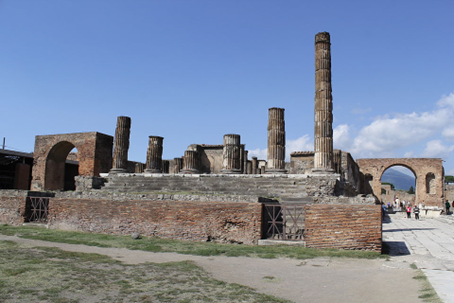
Temple of Jupiter, Pompeii, Author Carla Brain (CC BY-SA 2.0 Generic)
On February 14, 1387 AD Lithuanian Grand Duke Jogaila shut down the last temple to the Roman god Jupiter, so ending state-sponsored paganism in Europe [1]. On October 9, 2025 Latvia reinstated it.
Latvia’s Dievturi Community Law goes further than allowing neo-pagan groups to register their places of worship, operate as charities, and receive state recognition for the marriages they perform (rights several European nations have extended). Though the Latvian constitution does not permit the establishment of religion, the new law proclaims Dievturiba the traditional religion in Latvia, and commends it to the populace as preserving the nation’s spiritual heritage.
Christianity was imposed on Latvia by the Teutonic Knights during the Livonian Crusade in the 12th and 13th Centuries [2]. Their successors then ruled Latvia as a German-speaking noble class for seven centuries.
Dievturiba was actually devised in 1925 by Ernests Brastinş̌ and Kārlis Marovskis-Bregži, as a protest against Christianity. Tragically, it was associated with the ultranationalist Thunder Cross Movement of Gustavs Celmiņš which later collaborated with the Nazis in the Latvian Holocaust [3].
With birthrates in the Baltic states falling, the revival of pagan religion may be a reaction to the marginalization of indigenous culture. Or it may reflect desires for leadership by a strongman who will at least promise (if not deliver) prosperity and safety. Since 1993, emphasizing the need for a strong Latvia and fanning the fear of minorities have been central to the far right agenda of For Homeland and Freedom.
These developments do not bode well either for the Christians of Latvia or the ethnic minorities living there. We can only wait and see what the New Year will bring.
—
[1] The Hill, “The return of the strong gods?” by Francis Young, 10/28/25, https://thecritic.co.uk/the-return-of-the-strong-gods/.
[2] Wikipedia, “Northern Crusades”, https://en.wikipedia.org/wiki/Northern_Crusades.
[3] Wikipedia, “Perkonkrusts”, https://en.wikipedia.org/wiki/P%C4%93rkonkrusts.
[4] Transform! Europe, “The extreme right in the Baltic states: Latvia” by Matgorzata Kulbaczewska-Figat, 6/4/20, https://transform-network.net/blog/analysis/the-extreme-right-in-the-baltic-states-latvia/.
Federal funds have been pulled from Catholic Charities of the Rio Grande Valley for alleged incomplete/inaccurate recordkeeping. While Catholic Charities maintains it provides nothing more than humanitarian aid to migrants, some contend it has contributed to chaos on the Southern border.
See, https://www.ncronline.org/news/federal-funds-pulled-catholic-charities-usmexico-border.
Wishing you all a Happy New Year!
READERS CAN FIND MY VIEWS ON ABUSE AND ABUSE-RELATED ISSUES AT ANNA WALDHERR A Voice Reclaimed, Surviving Child Abuse
https://avoicereclaimed.com
Wishing you all a Merry Christmas!
READERS CAN FIND MY VIEWS ON ABUSE AND ABUSE-RELATED ISSUES AT ANNA WALDHERR A Voice Reclaimed, Surviving Child Abuse
https://avoicereclaimed.com
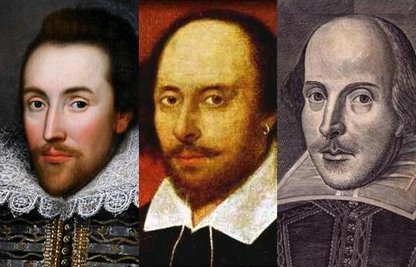
Comparison between Cobbe portrait, Chandos portrait, and Droeshout engraving of William Shakespeare, Source http://shakespeareportrait.freehosting.net/index.html, Author Brice Stratford (PD)
The spiritual will of John Shakespeare – William Shakespeare’s father – has long been among the evidence strongly suggesting that William Shakespeare was raised a Catholic [1][2][3]. Multiple eminent scholars have affirmed this including EK Chambers, GB Harrison, John Henry de Groot, and Edmond Malone [4].
The handwritten will was found in 1757 during renovation of the home in which William Shakespeare was born. It is thought to have been written around 1581, when William Shakespeare was 17 y.o.
The will, itself, is a declaration of faith, expressing the strong desire to receive the Last Rites and die a Catholic in good conscience. It was a crime in Elizabethan England punishable by death to harbor a priest within one’s home. Consequently, there was every likelihood a priest would not be available at the time of a believer’s death.
Charles Borromeo
In 1923, a scholar discovered a comparable spiritual testament attributed to Cardinal Charles Borromeo, a central figure at the Council of Trent (1545-1563) and Counter-Reformation reformer [5][6][7][8]. In fact, the spiritual will of John Shakespeare corresponds phrase for phrase with Borromeo’s Testament of the Soul (Il Testamento dell’Anima ) from the middle of Item 3 to the end.
Borromeo was initially thought to have authored the Testament of the Soul in response to a plague which killed some 17,000 in Milan between 1576-1578. Because of the large number of deaths, priests were not often available to provide Last Rites. The Testament of the Soul would have been a way to circumvent this.
Actually, an earlier version of Barromeo’s Testament of the Soul (dated December 1560 with his own name on it) was listed among his possessions at the time of his death. The same form may have been revised and re-used during the plague in Milan. Read more…

High-resolution, near-infrared image of vertical cloud known as L483 captured by NASA/ESA/CSA James Webb Space Telescope, Source Actively forming star system Lynds 483 (NIRCam image) https://esawebb.org/images/weic2503a, Author NASA, ESA, CSA, STScI (CC Attribution 4.0 International)
“Beauty is truth, truth beauty,” – that is all Ye know on earth, and all ye need to know.”
—Ode on a Grecian Urn, John Keats [1]
In his Ode on a Grecian Urn the poet John Keats examined the relationship of beauty in art, nature, and human experience to truth.
Keat raised the profound question of whether beauty and truth are subjective or objective. Since the Enlightenment and more so in the postmodern world, the belief has been that beauty is merely a matter of taste and objective truth entirely unknowable.
But that has not always been the case.
Plato identified a just community as one living in harmony with objective reality, and in accord with eternal beauty, truth, and goodness.
“He has made everything beautiful in its time. Also He has put eternity in their hearts…” (Eccl. 3: 11).
Many Scriptures demonstrate God’s concern for beauty. That concern is reflected in the creation, the building of the temple, and descriptions of the new heavens and new earth. Moreover, God made mankind to experience and appreciate beauty. We need only look up at the stars to recognize this. Read more…
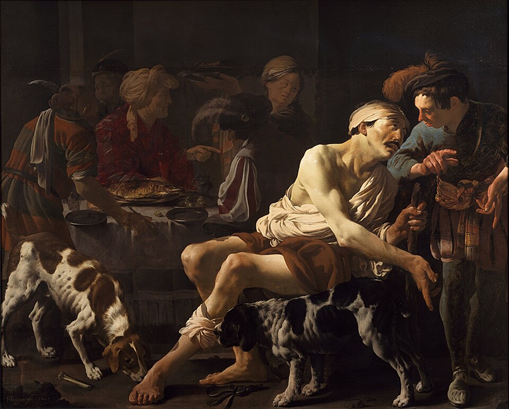
“The Rich Man and the Poor Lazarus” by Henrick ter Brugghen (1625), Centraal Museum (Accession No. 11241), Netherlands, Source/Photographer https://artsandculture.google.com/asset/nwGdfR1Asi9YSQ, (PD)
“There’s a place in the world for the angry young man
With his working class ties and his radical plans
He refuses to bend, he refuses to crawl
And he’s always at home with his back to the wall
And he’s proud of his scars and the battles he’s lost
And he struggles and bleeds as he hangs on his cross
And he likes to be known as the angry young man”— “Angry Young Man”, Billy Joel
The plight of the poor should concern anyone with a conscience. But the means available to alleviate that plight – or purportedly alleviate it – are not all equally valid in the eyes of God.
Conflict
The activist Saul Alinsky has been lionized by the political left (even in Christian circles) as a champion for the poor and disenfranchised [1][2].
Alinsky emphasized community organization and conflict as key strategies for social justice. But he advocated the use of any means necessary to achieve the ends he considered laudable – means which included deceit, fraud, and character assassination, in an effort to motivate the “have-nots” and demonize his adversaries.
Alinsky began his best-known work, Rules for Radicals, with the following statement:
“Lest we forget at least an over-the-shoulder acknowledgment to the very first radical: from all our legends, mythology, and history…the first radical known to man who rebelled against the establishment and did it so effectively that he at least won his own kingdom – Lucifer.”
In an interview with Playboy Magazine, he stated:
“Hell would be heaven for me. All my life I’ve been with the have-nots. Over here, if you’re a have-not, you’re short of dough. If you’re a have-not in hell, you’re short of virtue. Once I get into hell, I’ll start organizing the have-nots over there [3].”
These remarks may sound clever to some, cheeky. But they are extremely revealing.
Satan, the Father of Lies, is motivated by pride and an icy hatred of mankind. Alinsky, too, was motivated by hatred, in his case for all those he viewed as unjust. But it is a lie that we must be motivated by hate to overcome injustice. Read more…

 A Lawyer's Prayers