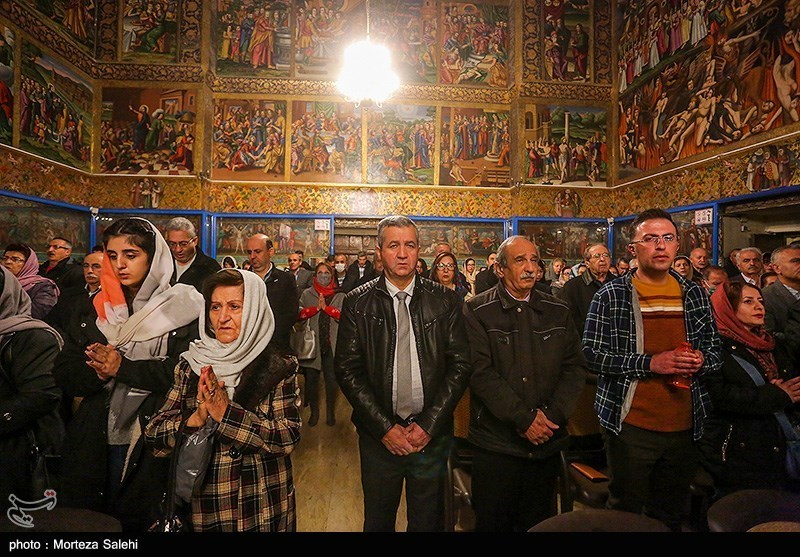
Christians at Vank Cathedral, Isfahan, Iran, Image Source https://www.tasnimnews.ir/fa/media/1401/10/17/2832826/%D9%85%D8%B1%D8%A7%D8%B3%D9%85-%D9%85%DB%8C%D9%84%D8%A7%D8%AF%D8%AD%D8%B6%D8%B1%D8%AA-%D8%B9%DB%8C%D8%B3%DB%8C-%D8%B9-%D8%AF%D8%B1%DA%A9%D9%84%DB%8C%D8%B3%D8%A7%DB%8C-%D9%88%D8%A7%D9%86%DA%A9, Image Author Morteza Salehi, (CC Attribution 4.0 International)
Iran’s Shiite government is focused on the coming of the Mahdi, the Twelfth Imam in a succession of Islamic rulers who will supposedly establish justice by spreading Sharia law throughout the world [1][2][3][4].
Iranian Islamists seek to advance this cause through violent means, a martyrdom ideology, and the brutal persecution of any who choose to leave Islam, including the 500,000 or more Christian converts living in Iran today [5][6].
In recent years, large numbers of Iranians have experienced religious disillusionment, and have lost faith in Allah. Millions more have turned away from Islam due to the repressive policies of the Iranian regime. However, Iranians who convert to Christianity can be charged with apostacy, and face the death penalty.
Despite this, many Christian ministries have developed media strategies using satellite TV and internet platforms to reach the Iranian population. Please, keep these efforts and the persecuted church everywhere in prayer, that the light of Christ may overcome this great darkness.
“…the Dayspring from on high has visited us; to give light to those who sit in darkness and the shadow of death, to guide our feet into the way of peace” (Luke 1: 78-79).
—
[1] Wikipedia, “Iran”, https://en.wikipedia.org/wiki/Iran.
[2] Wikipedia, “Shia Islam”, https://en.wikipedia.org/wiki/Shia_Islam.
[3] Wikipedia, “Mahdi”, https://en.wikipedia.org/wiki/Mahdi.
[4] There are striking parallels which suggest the Mahdi may be the Antichrist. This, however, is highly disputed. See, https://myislam.dk/articles/en/richardson%20r05-comparing-the-biblical-antichrist-and-the-mahdi.php and https://www.christiantoday.com/news/christian-scholar-claims-shocking-similarity-between-biblical-antichrist-and-muslim-messiah-called-the-mahdi.
[5] Voice of the Martyrs Magazine, “Iran”, October 2026.
[6] Voice of the Martyrs, “Iran”, https://vom.com.au/tags_stories/iran/.
READERS CAN FIND MY VIEWS ON ABUSE AND ABUSE-RELATED ISSUES AT A Voice Reclaimed, Surviving Child Abuse and More
https://avoicereclaimed.com

Closeup of the illuminated letter “P” in a Latin Bible (1407 AD), Malmesbury Abbey, Wiltshire, England (Image released to Public Domain by Arpingstone)
“…Your wisdom and your knowledge have warped you; And you have said in your heart, ‘I am, and there is no one else besides me’” (Isa. 47: 10).
“Knowledge matters. Study matters, and wisdom matters. But modern society has confused credentials with omniscience. We no longer treat experts as informed advisors. We treat them as secular priests. Untouchable. Unquestionable. And if you dare ask reasonable questions, suddenly you’re labeled dangerous, ignorant, anti-science.
Now, Christians understand something important about human nature. People are flawed. All people, even intelligent people…
[I]ntelligence without humility often produces arrogance. And arrogance has an amazing ability to survive repeated embarrassment. The bible warns us repeatedly about this. ‘Professing themselves to be wise they became fools.’ Not because education is evil, but because human beings are prone to pride. And pride makes people believe they can manage society, morality, truth, biology, economics, and human nature better than God Himself.
How’s that working out so far? Hmm. We were promised unlimited freedom that would create happiness. Instead, people are lonelier than ever. We were promised technology that would unite humanity. Now families sit silently at dinner scrolling through outrage from strangers. We were promised removing God from public life would make society more enlightened. Instead, we got confusion, anxiety, rage, and people arguing online about whether men can become women because apparently basic biology became controversial sometime around 2018…
And perhaps the deeper problem is not merely that experts are wrong sometimes. Everyone is wrong sometimes. The real issue is this. Modern culture has elevated human opinion above Divine truth. We trust polls more than principles, algorithms more than wisdom, institutions more than Scripture.
And when expert opinion becomes the highest authority, truth itself becomes unstable because experts change constantly. One decade coffee kills you; the next decade coffee saves your life…But God’s truth does not fluctuate. Scripture does not need revision every election cycle. And morality does not evolve according to trending hash tags.
That does not mean Christians reject knowledge. Far from it. But Christians are called to filter human wisdom through biblical truth, not the other way around. Because no matter how advanced society becomes, humanity still wrestles with the same ancient problems: sin, pride, greed, fear, power. And no panel of experts has solved those yet.
Only Christ addresses the human heart.
So, yes, the experts keep being wrong. And perhaps the reason we keep listening is because modern society desperately wants salvation without God. We want someone in a lab coat, in a newsroom, a university or a government office to assure us they can fix humanity.
But history keeps proving the same thing. Human beings make terrible gods.”
–Josh Davis [1]
—
[1] Prophecy in the News TV, Episode 60: “The Opium of the Masses?” with Josh Davis, Dr. Larry Spargimino, Micah Van Huss, 7/26/26, https://prophecyinthenews.tv/prophecy-in-the-news-tv/?sapurl=Lys0dGg0L2xiL21pLys1Z2djYzY4P2VtYmVkPXRydWUmcmVjZW50Um91dGU9YXBwLndlYi1hcHAubGlicmFyeS5tZWRpYS1zZXJpZXMmcmVjZW50Um91dGVTbHVnPSUyQnN3M2hyOHY= .
READERS CAN FIND MY VIEWS ON ABUSE AND ABUSE-RELATED ISSUES AT A Voice Reclaimed, Surviving Child Abuse and More
https://avoicereclaimed.com
Democratic Socialists falsely assert that their goal to replace capitalism with socialism is merely democratic “reform”. But Megan Romer, National Co-Chair of the Democratic Socialists of America, and Gustavo Gordillo, Co-Chair of the New York City Chapter of the Democratic Socialists, freely acknowledge the following goals of the movement [1][2][3][4[][5]:
- Eliminate the US Senate. This is mischaracterized as an attempt to equalize the vote, although the Founding Fathers (who greatly feared mob rule) created the Senate for the very purpose of giving citizens residing in smaller states an equal voice with those in larger, more populous ones.
- Replace the President and the Supreme Court with an executive and judiciary chosen by and subordinate to the Congress. This proposal would do away with the system of checks and balances put in place by the Founding Fathers to prevent any one branch of government from becoming too powerful, and would politicize the federal judiciary (something the Founding Fathers expressly sought to avoid).
- Pass aggressive wealth taxes on the richest individuals and corporations to spend on public goods and infrastructure. This is a vague promise to benefit the population at large, but would likely distress the 1.4 – 1.7 million African-American and 1.57 million Hispanic millionaires whose families worked for generations so that they could achieve that status [8][[9][10]. It ignores the fact that taxes on the ordinary worker would have to increase substantially to support the welfare state socialism proposes to establish. Meanwhile, the public ownership which characterizes communism is clearly part of the plan, something likely to replace small businesses with government monopolies [19]. Never mind that state run economies like this failed massively in the Soviet Union, China, East Germany, and elsewhere [11][12][13][17A].
- Abolish ICE. Provide amnesty for all immigrants with the long-term goal of eliminating national borders. The possibility that even the vast resources of the United States might not be sufficient to sustain all those desiring to come here is casually brushed aside. Who would prevent drug gangs and terrorists from entering the country is not addressed. Instead, the United States is labeled “imperialistic”. Once it has made reparations to all those nations over which it has supposedly exercised unjust control, they will flourish to such an extent no one will want or need to emigrate to the United States. So goes the theory. Of course, decimating the economy through public ownership may have the same effect.
- Defund the Department of War. Enact reparations; recognize all treaties and tribal sovereignty. This would immediately make the United States vulnerable to its enemies on the promise of slavery reparations and the return of tribal lands. Presumably, ownership of all or most of the United States would have to be returned to Native Americans without regard to the millions of others who have lived and died here since 1492 AD. Those immigrants apparently do not warrant amnesty.
- Demilitarize police departments, disempower police unions, and redirect funding to public services as steps toward fully abolishing the police and prison system. That bears repeating: fully abolishing the police and prison system. When pressed about this, Romer puts forward the specious argument that most crime is the result of poverty and poverty would be abolished, thereby eliminating crime and the need to imprison anyone. Indeed, according to her, even the worst criminals – the serial killers, murderers, rapists, child molesters – could be peaceably housed away from the rest of society…presumably where they could prey upon one another. While studies have found that poverty does increase the risk of criminal behavior, there are multiple factors at play, and many more of the poor are victimized by crime than involved with it [6][7]. Billions in poverty worldwide lead law abiding lives. Nor would the elimination of poverty prevent crime. The corrupt Illinois governor Rod Blagojevich, and the corrupt New Orleans mayors Ray Nagin and LaToya Cantrell were not living in poverty. Bernie Madoff, the architect of the largest Ponzi scheme in history, was never a destitute child. Nor, for that matter, were the wealthy young thrill killers Nathan Leopold and Richard Loeb, or the serial killer and real estate heir Robert Durst. Osama bin Laden was the son of a billionaire.
- Until police can be abolished, empower civilian oversight bodies with real authority over the police. This, of course, suggests that civilian oversight bodies have no such authority currently. That is simply not the case. While the authority of civilian review boards varies from one jurisdiction to another, police themselves are subject to the law. They do not operate with impunity outside it. Internal Affairs Divisions exist within police departments across the country for the specific purpose of investigating civilian complaints and alleged corruption.
- Prosecute US and Israeli leaders responsible for the “genocide” in Gaza. There has been no genocide in Gaza, despite propaganda to the contrary. This caters directly, therefore, to antisemitism.
Promises are liberally made by Democratic Socialists of a universal income, universal healthcare, free education, and free childcare. The emphasis, however, is always on class and racial conflict.
An Appeal to Emotion
It is difficult to understand how anyone could seriously believe these promises or find an agenda like this attractive. But the promises and the agenda are not put forward for thoughtful consideration. They are intended to evoke feelings of jealousy and resentment: The world is unfair. I deserve better. Someone must be to blame. The system has to be rigged. Destroy the system.
This smacks of entitlement more than reform.
Why Socialism Fails
Unfortunately, socialism conflicts with self-interest, undermines incentive, and centralizes economic decision making [14]. That leads not only to inefficiency, but economic stagnation [15A][16A]. Worse yet, it leads to corruption, censorship, repression, and authoritarian rule as in the Soviet Union, China, North Korea, Cuba, and Venezuela [15B][16B][17B].
Biblical View
While the Bible does not speak of capitalism as such, it does speak at length about personal responsibility, work, property rights, and wealth. The principles laid out in the Bible are consistent with fair free-market practices [18]. The importance of hard work is emphasized (Prov. 12: 11; Prov. 21: 20; 2 Thess. 3: 10). The rightful ownership of property is recognized; theft is forbidden (Ex. 20: 15). Wealth is coupled with an obligation to care for the less fortunate (Lev. 19: 9-10; Deut. 15: 7-8; Luke 3: 11).
No economic system is untainted by greed, dishonesty, and exploitation. These are evidence of the “sin nature” of mankind. A socialist state may eliminate private property, and enforce conformity. It will not change human nature, reward merit, increase prosperity, or inspire virtue.
—
[1] Social Democrats of America, https://socialists.us/.
[2] Democratic Socialists of America, https://www.dsausa.org/.
[3] Wikipedia, “Social Democrats, USA”, https://en.wikipedia.org/wiki/Social_Democrats,_USA
[4] Wikipedia, “Democratic Socialists of America”, https://en.wikipedia.org/wiki/Democratic_Socialists_of_America.
[5] YouTube, “EXPOSED: Democratic Socialist leaders GRILLED on radical new agenda”, https://www.youtube.com/watch?v=zYjvRM5kuvQ&t=55s.
[6] Independent Institute, “Does Poverty Cause Crime – Or Does Crime Cause Poverty?” by Scott Beyer, 5/18/26, https://www.independent.org/article/2026/05/18/does-poverty-cause-crime-or-does-crime-cause-poverty/.
[7] City Journal, “Poverty and Violent Crime Don’t Go Hand in Hand” by Barry Latzer, 5/25/22, https://www.city-journal.org/article/poverty-and-violent-crime-dont-go-hand-in-hand.
[8] Expert Beacon, “How Many Black Millionaires Are There in America Today?” by Iyanuoluwa Taiwo, 3/19/24, https://expertbeacon.com/how-many-black-millionaires-in-america/.
[9] Balancing Everything, “Millionaire Statistics”, 2/16/24, https://balancingeverything.com/millionaire-statistics/.
[10] The Global Statistics, “Number of American Millionaires Statistics 2026 – Millionaires by Race, Age, City & Year”,https://www.theglobalstatistics.com/number-of-american-millionaires-statistics/.
[11] Investopia, “USSR Economic Collapse: Key Events and Causes” by Matthew Johnston, 2/19/26, https://www.investopedia.com/articles/investing/021716/why-ussr-collapsed-economically.asp.
[12] Social Studies Help, “The Fall of the Soviet Union and Its Economic Aftermath”, https://socialstudieshelp.com/economics/the-fall-of-the-soviet-union-and-its-economic-aftermath/.
[13] Wikipedia, “Great Chinese Famine”, https://en.wikipedia.org/wiki/Great_Chinese_Famine.
[14] Psychology Today, “Why Socialism Fails” by Gary Bernard and Kalman Glantz PhD, 1/15/20, https://www.psychologytoday.com/us/blog/evolution-in-daily-life/202001/why-socialism-fails.
[15A and 15B] Adam Smith Institute, “Why socialism doesn’t work” by Madsen Pirie, https://www.adamsmith.org/blog/why-socialism-doesnt-work.
[16A and 16B] Frederick R. Smith, “Why Socialism Still Fails”, 12/12/25, https://frederickrsmith.substack.com/p/why-socialism-still-fails.
[17A and 17B] Cornell Review, “Yes, Real Socialism Has Been Tried — And It Has Failed Every Time” by Matthew Xiao, 2/17/22, https://www.thecornellreview.org/yes-real-socialism-has-been-tried-and-it-has-failed-every-time/.
[18] BibleHub, “Bible’s View on Capitalism?”, https://biblehub.com/q/bible’s_view_on_capitalism.htm.
[19] Yahoo!, “Bodega owners sue Mamdani over city-run grocery stores plan” by Chris Wade, 8/25/26, https://www.yahoo.com/news/politics/articles/bodega-owners-sue-mamdani-over-135900237.html.
READERS CAN FIND MY VIEWS ON ABUSE AND ABUSE-RELATED ISSUES AT A Voice Reclaimed, Surviving Child Abuse and More
https://avoicereclaimed.com
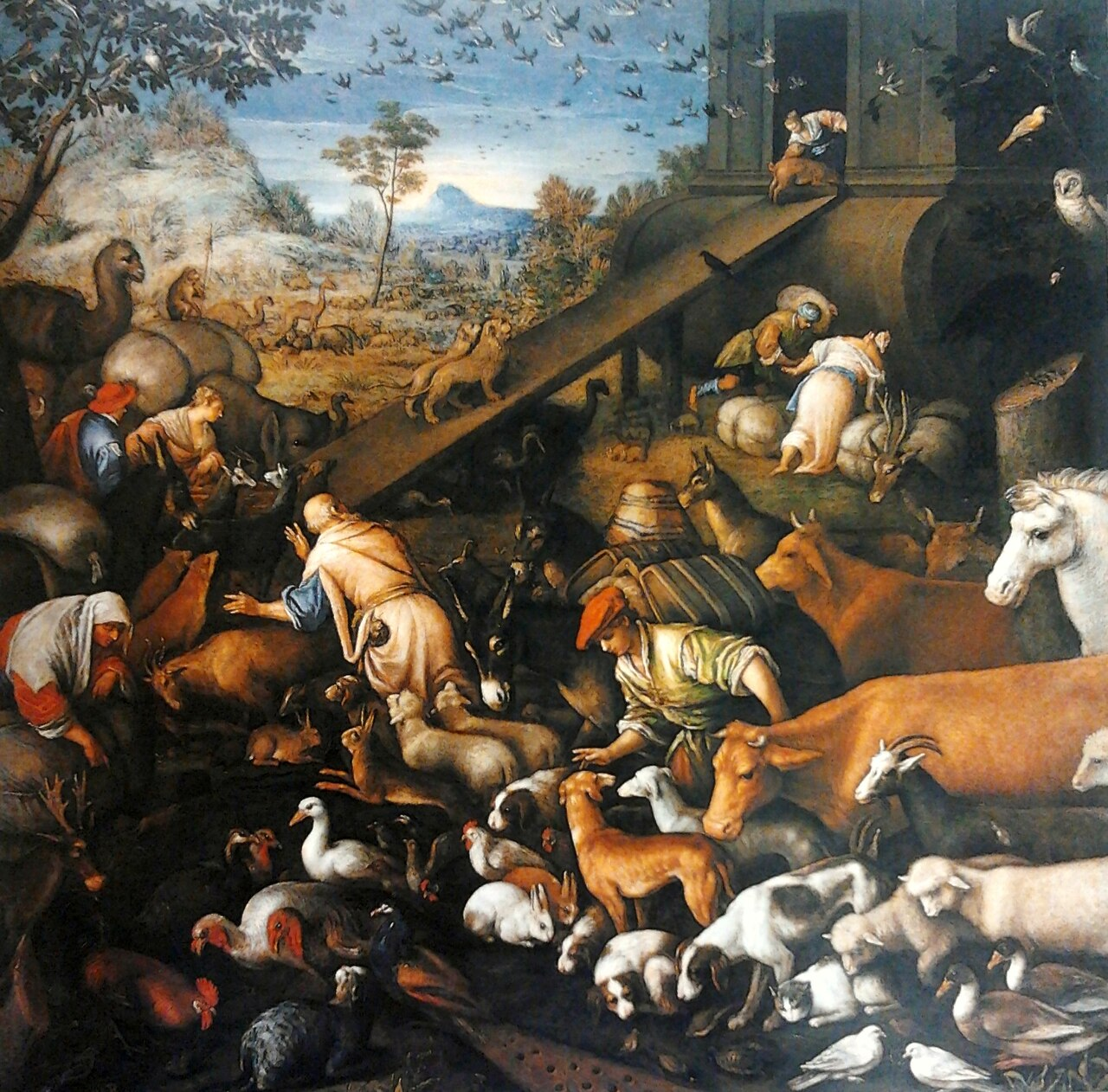
“The Animals Entering Noah’s Ark” by Jacopo Bassano (c. 1570), Wawel Castle (Accession No. ZKWawel 3257)(PD)
Social media has been abuzz with the Seven Laws of Noah or Noahide Laws. Most of us likely never heard of them.
A Ceremonial Resolution
Thirty five years ago, Pres. George H. Bush signed a ceremonial joint resolution (Public Health Law 102-14), acknowledging the historic significance of the Noahide Laws while designating March 26, 1991 as “Education Day” [1].
Terms of the Noahide Laws
The terms of the Noahide Laws are, as follows [2A]:
- Do not deny God or worship idols.
- Do not commit murder.
- Do not steal.
- Do not engage in sexual immorality.
- Do not blaspheme.
- Do not eat flesh taken from a living animal.
- Establish courts and legal systems to enforce these laws.
The Talmud (the collection of Jewish oral law and tradition) indicates that the first six of these precepts were given originally by God to Adam, and the seventh afterward to Noah [3][4A].
False Claims, Hysteria, and Antisemitism
Claims are being circulated online that the Noahide Laws permit the beheading of Christians and Non-Jews [3B]. These are entirely false, and being used to stoke antisemitism.
The Noahide Laws are merely ethical principles from the Torah, traditionally observed by “B’nai Noach” (righteous Gentiles). They do NOT have the force of law which is what all the hysteria has been about.
Capital Punishment and Religious Persecution
The Talmud does call for capital punishment for Gentiles who violate the Noahide Laws [2B][8]. But adherents to Judaism live under the civil authorities.
Jewish opinion is split over whether Trinitarianism is idolatry or not [5]. However, the modern Jewish consensus is that Trinitarianism among Gentiles is acceptable [2C][6].
There are no Jews out hunting Christians. In fact, the reverse has been true throughout most of Christian history [7].
Biblical View
The Bible does not record what laws God may have given Adam, apart from commanding Adam to fill the earth and subdue it; and not eat of the Tree of the Knowledge of Good and Evil (Gen. 1: 28 and 2: 17). According to the Bible, God did instruct Noah not to eat raw meat (Gen. 9: 4).
There is later mention in the Bible of abstaining from meat sacrificed to idols, from blood (ritual defilement), and from sexual immorality (Acts 15: 20-21, 29). This may be a reference to the Noahide Laws as applicable to early converts [2D].
Salvation
Should Christians keep the Noahide Laws? We are not saved by rulekeeping. We are saved by faith in Jesus Christ.
“He who believes in Him is not condemned; but he who does not believe is condemned already, because he has not believed in the name of the only begotten Son of God” (John 3: 18).
—
[1] FedLaws, “Public Health Law 102-14: What It Says, Noahide Reference, and How It Passed”, 9/10/26, https://fedlaws.org/public-law-102-14-what-it-says-noahide-reference-and-how-it-passed/.
[2A, 2B, 2C, and 2D] Got Questions, “What are the Noahide Laws, and are they biblical?”, https://www.gotquestions.org/Noahide-laws.html.
[3] Chabad, “What Is the Talmud?” by Menachem Posner, https://www.chabad.org/library/article_cdo/aid/3347866/jewish/What-Is-the-Talmud.htm.
[4A and 4B] Watchman Willie Martin Archive, “A Law to Allow the Execution of Christians and Non-Jews in America Was Passed in 1991”, https://israelect.com/reference/WillieMartin/P.L.102-14.htm.
[5] Wikipedia, “Shituf”, https://en.wikipedia.org/wiki/Shituf.
[6] Online Library, Modern Theology, “A Jewish View of Contemporary Ideas of the Trinity” by Alan Brill, 10/19/22, https://onlinelibrary.wiley.com/doi/abs/10.1111/moth.12825?msockid=36f5a235063367c5102cb59b07576654.
[7] United States Holocaust Memorial Museum, “Christian Persecution of Jews Over the Centuries” by Prof. Gerard Sloyan, https://www.ushmm.org/m/pdfs/20070119-persecution.pdf.
[8] Yah’s Global Kingdom Ministries, “The Noahide Laws”, https://www.yahsglobalkingdom.org/wp-content/uploads/2025/03/The-Noahide-Laws.pdf.
READERS CAN FIND MY VIEWS ON ABUSE AND ABUSE-RELATED ISSUES AT A Voice Reclaimed, Surviving Child Abuse and More
https://avoicereclaimed.com

NYPD Legal Bureau at NYC Gay Pride Rally, Image Source https://www.flickr.com/photos/perspective/48270690476/, Image Author Elvert Barnes (CC BY-SA 2.0 Generic)
The New York City Police Dept. (NYPD) in January 2026 reported 58 hate crimes, over half targeting Jews [1][2]. This was entirely on trend. For the past two years, the NYPD has reported an average of 28 hate crimes each month targeting Jews. In fact, that number has climbed continuously since 2017.
Overall hate crimes in New York City are up by more than 15%, with 425 incidents year to date compared to 367 this time last year [3]. Antisemitic crimes account for 53.9%. These have ranged from vandalism and harassment to outright violence [3]. They follow on a record-breaking 976 antisemitic incidents in 2024 [4].
This increase is not the fault of the NYPD which is among the world’s best. The police do what they can to maintain law and order in a city that is home to every race, every ethnicity, every political viewpoint, and every belief system on earth.
Insults, Threats, and Violence
Since the brutal Hamas-led attacks against Israel on October 7, 2023, Jews around the world have been progressively demonized.
An assailant shouting “Allahu Akbar” stabbed a 51 y.o. man in Manhattan simply for wearing a yarmulke in public. A former ISIS supporter targeted a Jewish community center in Brooklyn with the goal of slaughtering as many Jews as possible [5]. Another man, claiming to be the reincarnation of Adolf Hitler, threatened to kill worshippers at a synagogue in Manhattan.
The Removal of Legal Protections
New York City’s Muslim mayor does not hide his anti-Zionist and pro-Palestinian views.
As his first official act, Mayor Zohran Mamdani canceled Executive Orders 51, 52, and 61 by his predecessor. These had established the Mayor’s Office for Combating Antisemitism; adopted the International Holocaust Remembrance Alliance definition of antisemitism which recognizes anti-Zionism as modern antisemitism; and regulated protest activity near synagogues and houses of worship [6][7].
Mamdani has, also, called for the arrest of Israeli Prime Minister Benjamin Netanyahu for alleged war crimes [8].
Protests
Extremist anti-Israel groups — frequently linked to terrorist organizations — have played a significant role in all this [9]. Anti-Israel protesters regularly chant the slogans “Globalize the Intifada” and “From the river to the sea”, equating Zionism with Nazism and advocating extermination of the Jews [10]. Colleges and universities are the epicenter of such protests.
The terrorist organization Hamas (which has for nearly two decades governed Gaza, and is still favored by the majority of Palestinians) takes great pains to blame Israel for the poverty there. Yet Hamas has real estate and other assets worth $500 million, and an annual military budget of some $350 million [11]. Few protesters seem aware of this, let alone troubled by it.
The Apple of God’s Eye
Clearly, we have forgotten the Holocaust. Jews who once saw this nation as a beacon of hope are now living in fear in the nation’s largest city, a city they helped build [12][13][14].
Though many would deny the fact, Israel and the Jewish people remain the apple of God’s eye (Deut. 32: 10; Ps. 17: 8; and Zech. 2: 8). Israel is a covenant nation, under God’s protection (Gen. 12: 2-3, 26: 3-4, 28: 13-15; Ex. 19: 5-6; Jer. 31: 31-34) [15].
New York City and America ignore that biblical reality at their peril.
—
[1] Nexus Project, “What Police Stats Really Say about Antisemitism in New York City” by Aryeh Tuchman, 2/6/26, https://nexusproject.us/nexus-resources/what-police-stats-really-say-about-antisemitism-in-new-york-city/.
[2] Yahoo!, “Antisemitism accounts for over half of NYC hate crimes, according to the NYPD” by Ben Mitchell, 9/3/26, https://www.yahoo.com/news/us/articles/antisemitism-accounts-over-half-nyc-141451812.html?guccounter=1&guce_referrer=aHR0cHM6Ly93d3cuYmluZy5jb20v&guce_referrer_sig=AQAAAAbdUcGJA-7MRUmNp977TjnJNs-ugqIFcm1y-vxFzABOLeu7eUyNhrJTL4Hg4UN3MLvdmwwmTUlekxHiQ5QfwCvPmlC3j5V48N-EUXfmpfkfnQx4zYjcoO9A9PGyNwz0SMpSwayHMXFVAp_UXerRnpatPMj-ga2fNOphP-6XeefM.
[3] MSN, “Antisemitic hate crimes on the rise in NYC this year while NYPD touts safest summer on record” by Mark Morales, https://www.msn.com/en-us/news/other/antisemitic-hate-crimes-on-the-rise-in-nyc-this-year-while-nypd-touts-the-safest-summer-on-record/ar-AA2bw5u8?ocid=BingNewsSerp.
[4] Antidefamation League (ADL), “Brazen, Intensified Antisemitic Incidents in NYC Continue in 2025”, 10/22/25, https://www.adl.org/resources/article/brazen-intensified-antisemitic-incidents-nyc-continue-2025.
[5] CBC News, “Former Ontario student pleads guilty in NYC Jewish centre plot” by Thomas Daigle, 4/8/26, https://www.cbc.ca/news/world/khan-guilty-plea-ny-attack-plot-9.7156879.
[6] Israel Hayom, “Mamdani’s first act: scraps order recognizing anti-Zionism as antisemitism” by Or Shaked, 1/2/26, https://www.israelhayom.com/2026/01/02/nyc-mayor-mamdani-deletes-antisemitism-tweets-cancels-jewish-orders/.
[7] Daily News, “NYC Mayor Mamdani defends revoking Adams antisemitism order amid criticism” by Chris Sommerfeldt, 1/2/26, https://www.nydailynews.com/2026/01/02/nyc-mayor-mamdani-defends-revoking-adams-antisemitism-executive-order-amid-criticism/.
[8] Times of Israel, “Mamdani: Netanyahu should be arrested if he visits NYC; I’m discussing it but won’t rewrite laws”, 7/18/26, https://www.timesofisrael.com/mamdani-netanyahu-should-be-arrested-if-he-visits-nyc-but-i-wont-rewrite-laws-to-do-so/.
[9] Jerusalem Post, “New report maps alleged links between US activist groups, terror-designated organizations” by Mathilda Heller, 8/3/26, https://www.jpost.com/diaspora/antisemitism/article-904468.
[10] AOL, “Anti-Israel protesters chant antisemitic slogan ‘From the river to the sea’ in NYC on two-year anniversary of Hamas’ Oct. 7 attack” by Dorian Geiger and Shane Galvin, 10/7/25, https://www.aol.com/news/anti-israel-protesters-chant-antisemitic-212246258.html .
[11] NBC News, “Gaza is plagued by poverty, but Hamas has no shortage of cash. Where does it come from?” by Dan De Luce and Lisa Cavazuti, 10/25/23, https://www.nbcnews.com/news/world/gaza-plagued-poverty-hamas-no-shortage-cash-come-rcna121099.
[12] Religion News, “‘I feel like I’ve lost my home’: Some NYC Jews who hoped Mamdani would lose consider their future” by Michele Chabin and Yonat Shimron, 11/6/25, https://religionnews.com/2025/11/06/i-feel-like-ive-lost-my-home-some-nyc-jews-who-hoped-mamdani-would-lose-consider-their-future/.
[13] Real Clear World, “A Concerning Time for NYC Jews” by Michele Hanash, 6/16/26,
https://www.realclearworld.com/articles/2026/06/16/a_concerning_time_for_nyc_jews_1188909.html.
[14] Wikipedia, “History of the Jews in New York City”, https://en.wikipedia.org/wiki/History_of_the_Jews_in_New_York_City.
[15] BibleHub, “God’s Covenant with Israel”, https://biblehub.com/topical/g/god’s_covenant_with_israel.htm.
READERS CAN FIND MY VIEWS ON ABUSE AND ABUSE-RELATED ISSUES AT A Voice Reclaimed, Surviving Child Abuse and More
https://avoicereclaimed.com
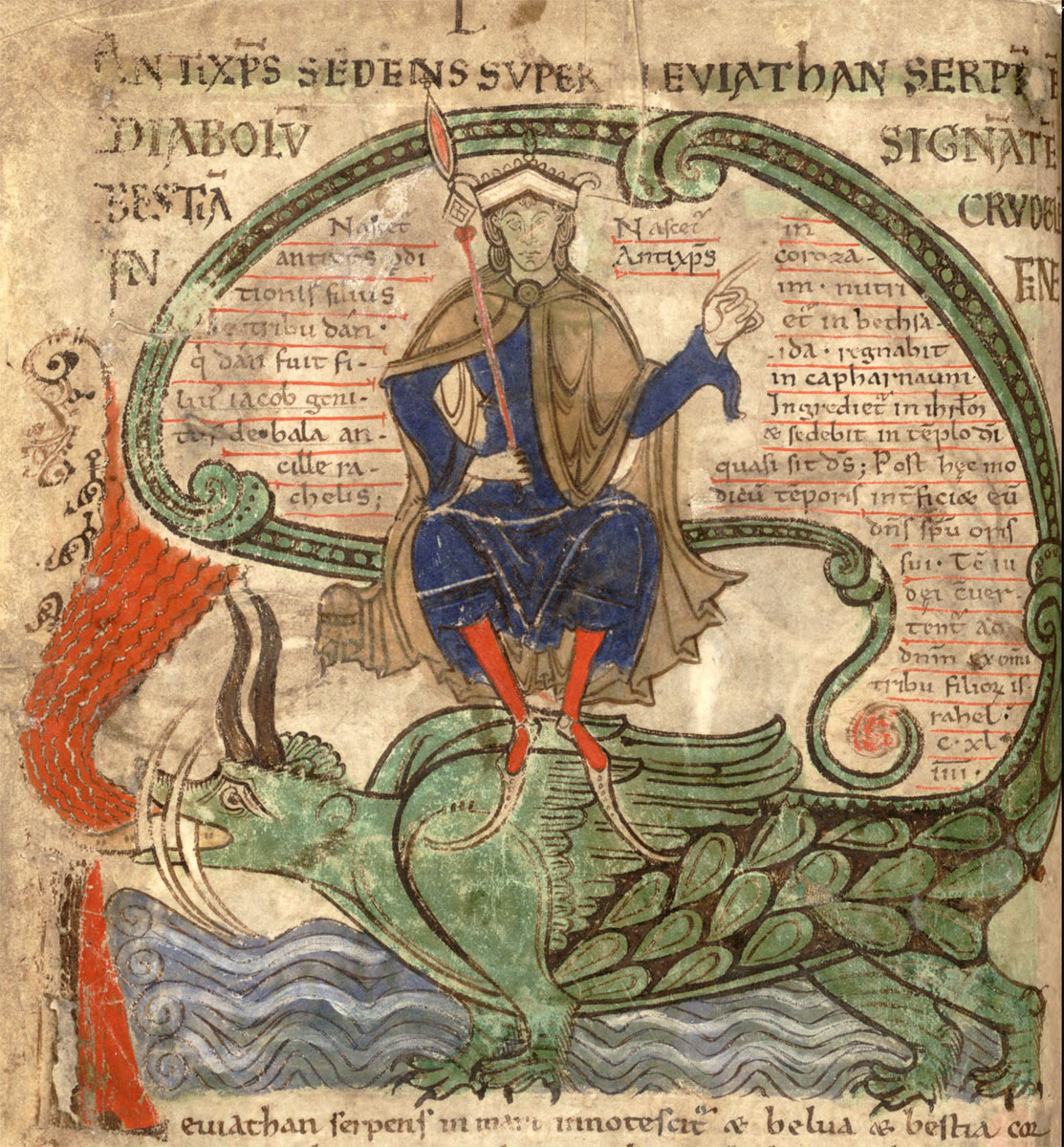
“The Antichrist Riding Leviathan” (c. 1120 AD), Image Source/Image Author Liber Floridus, Ghent University (PD)
We continue our examination of globalism and the New World Order.
Advocates
Among the advocates for globalization and a New World Order these days are the singer/songwriter/dancer/actor Usher Raymond IV, the singer/songwriter/pianist/actor/producer John Legend, the singer/songwriter/producer Nelust Wyclef Jones, the actress/television host/vlogger Liza Koshy, and the singer/actress/producer and former Miss World Priyanka Chopra Jonas – all with significant cultural influence [1].
But these pop icons are merely the tip of the iceberg. Former US Pres. Bill Clinton, former US Pres. Barack Obama, and former UK Prime Minister Tony Blair are globalists, as are many intellectuals [2][3][4]. The list does not stop there.
The author and media mogul Arianna Huffington is the Founder and CEO of Thrive Global [5]. Numerous business leaders are now on board with the idea, including the trillionaire Elon Musk [6][7][8][9]. Opinions differ on whether the philanthropist George Soros, founder of Open Society Foundations, is a globalist [10].
This is not to suggest that all these individuals or organizations are somehow in league with one another. Their motives range from selfish to benign. But there is, without doubt, a consensus building. And the potential for abuse is enormous.
Who Benefits?
Multinational corporations benefit from globalization by way of expanded markets [12]. They can optimize profits by sourcing materials and labor from low cost locations, irrespective of national borders [11A]. Unfortunately, this can result in poor working conditions, since many such locations are unregulated [11B].
Developing countries like Brazil, China, and India have leveraged globalization to drive their economic growth [11C]. However, capital owners and highly skilled workers often reap disproportionate rewards [11D]. Unskilled laborers may face wage stagnation or job losses [11E].
One World Government
“The fourth beast shall be A fourth kingdom on earth, Which shall be different from all other kingdoms, And shall devour the whole earth, Trample it and break it in pieces” (Dan. 7: 23).
Certainly, many problems need coordinated global solutions. The Bible, however, prophecies a one world government during the End Times which the Antichrist will exploit for his own purposes [13][14]. The stage is being set for that.
One World Religion
“Then I saw another beast coming up out of the earth, and he had two horns like a lamb and spoke like a dragon. And he exercises all the authority of the first beast in his presence, and causes the earth and those who dwell in it to worship the first beast…” (Rev. 13: 11-12).
The Bible, also, predicts a one world religion in the End Times led by the False Prophet and characterized by deception and apostacy [15A]. This will unite all the world’s pagan religions, mystical New Age elements, and apostate Christianity into one mega “church”, weaponized to promote the global governing agenda and persecute the saints [15B].
In the face of all this, Christians are called to be spiritually vigilant (Mark 13: 3; 1 Peter 5: 8); to trust that God remains sovereign (Eph. 1: 11); and to endure until Christ returns for us (Rev. 14: 12).
—
[1] Global Citizen, “Meet the Global Citizen Ambassadors and Advocates for Change – And See How They’re Creating a Better World” by Olaolu Odusan, 9/3/25, https://www.globalcitizen.org/en/content/meet-the-global-citizen-ambassadors-and-advocates.
[2] Famous Globalists, http://www.famousglobalists.com/.
[3] YaleGlobal Online, “US Opinion Turns Against the Globalism of Its President”, https://archive-yaleglobal.yale.edu/content/us-opinion-turns-against-globalism-its-president.
[4] Prospect Magazine, “The World Top Thinkers 2024: ideas for a world on the brink”, 12/6/23, https://www.prospectmagazine.co.uk/world/63099/25-thinkers-for-a-world-on-the-brink.
[5] Thrive Global, “Arianna Huffington”, https://thriveglobal.com/team/arianna-huffington.
[6] Entrepreneur Mirror, “Top 10 Business Leaders Driving Global Change”, https://entrepreneurmirror.com/top-10-business-leaders-2025-global-change/.
[7] All Around Worlds, “World’s 20 Influential Leaders Transforming the Future”, https://www.allaroundworlds.com/top-list/influential-leaders-transforming-future/.
[8] Swiss Entrepreneur, “8 Successful International Entrepreneurs to Watch”, 9/5/25, https://www.swisspreneur.org/blog/successful-international-entrepreneurs.
[9] Wikipedia, “Views of Elon Musk”, https://en.wikipedia.org/wiki/Views_of_Elon_Musk.
[10] Factually, “What evidence supports claims that George Soros funds globalist or anti-national agendas?” by 1/10/26, https://factually.co/fact-checks/politics/evidence-claims-george-soros-funds-globalist-anti-national-agendas-cfc212.
[11A through 11E] MASEconomics, “What Is Globalization? A Comprehensive Guide to Its History, Benefits, Challenges, and Future ” by Majid Ali Sanghro, 11/23/22, https://maseconomics.com/what-is-globalization/#google_vignette.
[12] Carlos Barraza, “10 Benefits of Globalization”, 8/7/24, https://barrazacarlos.com/benefits-of-globalization/.
[13] Scripture Savvy, “What Does the Bible Say about One World Government? (25 Bible Verses)” by James Wilson, 4/7/25, https://scripturesavvy.com/one-world-government/.
[14] Bible Repository, “35 Important Bible Verses about One World Government (Explained)” by “Pastor David”, 5/13/26, https://biblerepository.com/bible-verses-about-one-world-government/.
[15A and 15B] Answer the Bible, “What will be the end times one-world religion?” by Richard Curi, 2/1/24, https://www.answerthebible.com/what-will-be-the-end-times-one-world-religion/.
Part 1 in this series was posted 9/13/26
READERS CAN FIND MY VIEWS ON ABUSE AND ABUSE-RELATED ISSUES AT A Voice Reclaimed, Surviving Child Abuse and More
https://avoicereclaimed.com

World Citizen Flag, Image Authors World Service Authority, Mistress Selina Kyle, and KAMiKAZOW (Unrestricted Use)
Globalism is an ideology which emphasizes the need for coordinated global solutions to complex problems like climate change, pandemics, migration, and nuclear disarmament [1][2]. It has been gradually gaining in popularity since 1938, with the aim of establishing a liberal international order or what is more commonly termed a New World Order [3]. Thousands of articles can be found on this topic.
Past Empires
There have been empires which sought to rule the world in the past. These included the Persians under Cyrus, the Greeks under Alexander, the Romans, the Mongols under Genghis Khan, the Ottomans, the Spanish, the British, the Russians under the Tsars, and the French under Napoleon [4].
Not all those who refer to a New World Order, of course, have in mind the establishment of a one world government.
Tragically, however, the history of the world demonstrates that power corrupts, and absolute power corrupts absolutely. Centralized power (no matter how idealistic its original intent) eventually devolves into authoritarian rule. The “sin nature” of mankind is inescapable.
Infrastructure
Historically, the processes which integrated the world politically, economically, and socially were conquest, trade, communication, and cultural exchange [5]. Today though a digital infrastructure is in place to facilitate globalization which did not exist in the past.
This includes central bank digital currencies (allowing for worldwide financial integration); a centralized digital identity framework; biometric payments; massive data centers; electronic surveillance systems, with facial recognition and predictive policing supported by Artificial Intelligence (AI); international regulations with global compliance standards; and coordinated governance across what were once national borders [6].
The World Bank, the International Monetary Fund, the World Economic Forum, the Organization for Economic Cooperation and Development (OECD), the World Trade Organization, the World Health Organization (WHO), and the International Criminal Court all illustrate this, as do the European Union and the United Nations (particularly in its 2030 Agenda) [7][8][9][10][11][12][13][14].
None of these organizations is secretive or the product of a conspiracy theorist’s fevered imagination.
Potential Threat
While it may not at first blush seem that these technologic advances or international organizations pose a threat, they are today capable of unprecedented levels of monitoring and behavioral control. It would require but a small step for a central authority to regulate all purchases of food, fuel, and medicine; limit geographic spending; and force conformity with ideologic mandates by freezing accounts.
—
[1] Wikipedia, “Globalism”, https://en.wikipedia.org/wiki/Globalism.
[2] CounterCurrents, “A Time Has Come to Seriously Consider Alternative Ways of Organizing the World” by Bharat Dogra, 5/18/26, https://countercurrents.org/2026/05/a-time-has-come-to-seriously-consider-alternative-ways-of-organising-the-world/.
[3] Super Summary, “Rise to Globalism: American Foreign Policy Since 1938” by Stephen Ambrose and Douglas Brinkley, https://www.supersummary.com/rise-to-globalism/summary/.
[4] History Collection, “15 of the World’s Largest and Most Intense Empires” by Larry Holzwarth, 11/19/20, https://historycollection.com/15-of-the-worlds-largest-and-intense-empires/.
[5] Political Science Institute, “Understanding Globalisation and Globalism”, 3/1/26, https://polsci.institute/international-relations/understanding-globalisation-and-globalism/#google_vignette.
[6] McKinsey & Company, “What Is Infrastructure?”, 9/17/25, https://www.mckinsey.com/featured-insights/mckinsey-explainers/what-is-infrastructure.
[7] Encyclopedia Britannica, “World Bank”, https://www.britannica.com/topic/World-Bank.
[8] Wikipedia, “International Monetary Fund”, https://en.wikipedia.org/wiki/International_Monetary_Fund.
[9] World Economic Forum,https://www.weforum.org/.
[10] Organization for Economic Cooperation and Development (OECD), https://www.oecd.org/.
[11] World Trade Organization, https://www.wto.org/.
[12] World Health Organization (WHO), https://www.who.int/.
[13] International Criminal Court, https://www.icc-cpi.int/.
[14] United Nations, “Transforming Our World: 2030 Agenda for Sustainable Development”, https://www.un.org/ohrlls/sites/www.un.org.ohrlls/files/2030_agenda_for_sustainable_development_web.pdf.
This series will conclude next week.
READERS CAN FIND MY VIEWS ON ABUSE AND ABUSE-RELATED ISSUES AT A Voice Reclaimed, Surviving Child Abuse and More
https://avoicereclaimed.com
Knights of Columbus emblem symbolizing faith, unity, and authority at Holy Redeemer Catholic Church, Portsmouth, OH, Image Author Nheyob (CC BY-SA 4.0 International)
The Knights of Columbus are a global service order for Catholic men [1]. The group was founded in 1882 by Fr. Michael McGivney with the mission of charity, fraternity (brotherhood), and defense of the Christian faith.
The work of the Knights is outstanding. In 2025 alone, the Knights of Columbus donated over $200 million to charities worldwide, and over 48 million volunteer hours [2A].
These donations by the Knights of Columbus included over 300,000 coats for needy children through the organization’s “Coats for Kids” Program; mental health care for the children traumatized by a school shooting during mass in Minnesota; leading sponsorship of Special Olympics; the purchase of over 2000 ultrasound machines for pregnancy centers; relief to flood victims in Hawaii and earthquake victims in Venezuela; support for the Catholic University of America, Christ in the City urban missionaries, migrant families without a primary breadwinner, remote indigenous communities, an orphanage in Israel, a girls’ vocational training center in Benin, and persecuted Christians throughout the Middle East [2B][3].
From Colorado to the Philippines, the Knights partner with the Arise Foundation to protect women and girls against sex trafficking [2C][4]. They train priests to serve in Nigeria, and provide food and supplies to those on the front lines in Ukraine [2D]. They partner with the Catholic Near East Welfare Association (CNEWA) to feed, educate, and treat the children of Gaza and the region [2E][5].
The Knights host an annual Warriors to Lourdes Pilgrimage for wounded, injured, and ill veterans [6].
In addition, the Knights of Columbus play an active role in public policy issues. They participate regularly in the March for Life in Washington, DC, lobby against abortion at the state level, and stand with the United States and Canadian Catholic Bishops Conferences opposing assisted suicide [2F][7][8][9].
These men strive to live out their faith, to serve others in the Name of Christ. They are an example to us all.
“Pure and undefiled religion before God and the Father is this: to visit orphans and widows in their trouble, and to keep oneself unspotted from the world” (James 1: 27).
—
[1] Wikipedia, “Knights of Columbus”, https://en.wikipedia.org/wiki/Knights_of_Columbus.
[2A through 2F] Knights of Columbus, 144th Supreme Convention, “Supreme Knight’s Report”, https://www.kofc.org/get-involved/events/supreme-conventions/2026/.
[3] Christ in the City, https://christinthecity.org/.
[4] Arise Foundation, https://foundation-arise.com/.
[5] Catholic Near East Welfare Association (CNEWA)/100, https://cnewa.org/ .
[6] Warriors to Lourdes, https://www.warriorstolourdes.com/about/.
[7] Knights of Columbus, “Our Pro-Life Efforts”, https://www2.kofc.org/en/our-pro-life-efforts/index.html.
[8] United States Conference of Catholic Bishops, https://www.usccb.org/ .
[9] Canadian Conference of Catholic Bishops, https://www.cccb.ca/.
[10] Wikipedia, “Charitable activities of the Knights of Columbus”, https://en.wikipedia.org/wiki/Charitable_activities_of_the_Knights_of_Columbus.
READERS CAN FIND MY VIEWS ON ABUSE AND ABUSE-RELATED ISSUES AT A Voice Reclaimed, Surviving Child Abuse and More
https://avoicereclaimed.com
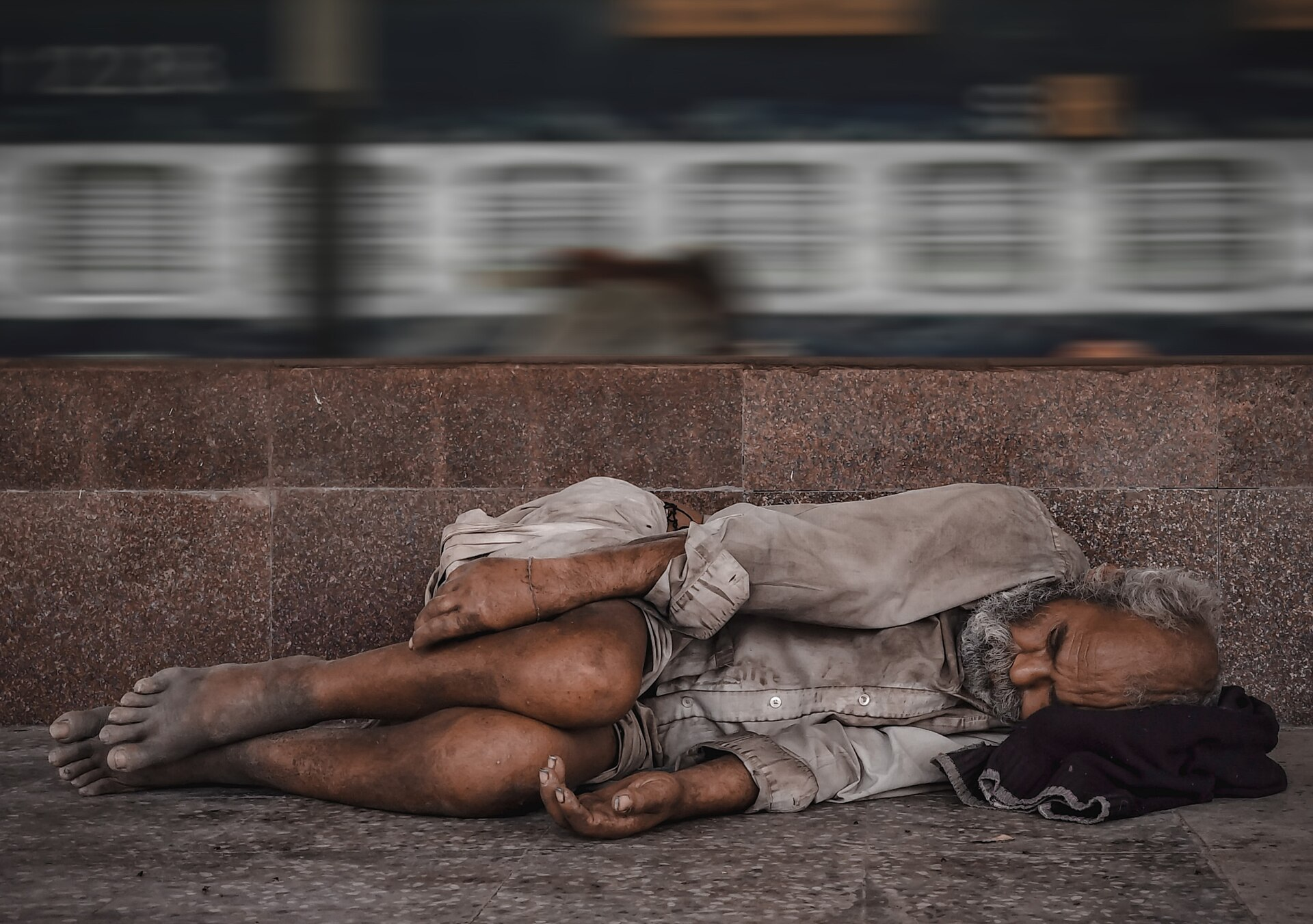
Homeless man, Image Author Raazsingh007, (Creative Commons Attribution-Share Alike 4.0 International)
We tend to shun the homeless. We may pity them, may even refer to them using the politically correct term “unhoused individuals” which supposedly preserves their dignity while doing nothing to improve their condition.
But we are likely to feel disgusted or threatened by them, at the same time.
Admittedly, a majority of the homeless do suffer from mental illness and/or addiction [1]. Yet research has consistently shown that there is strong correlation between childhood abuse and later homelessness [2].
And it should not be overlooked that approximately 1/3 of the homeless are families with children (85% of them single mothers) — some 259,473 men, women, and children among the estimated 770,00 homeless in the United States [7].
There is a link not just to child abuse, but to domestic violence here. Over 92% of homeless mothers with children have experienced severe physical and/or sexual violence during their lifetimes [8]. Moreover, 38% of all domestic violence victims become homeless at some point in their lives [9].
Adverse Childhood Experiences (ACEs)
The highly respected Adverse Childhood Experiences framework — widely used in public health, medicine, education, and social services — arose from a landmark study by the Centers for Disease Control and Kaiser Permanente in the 1990s [3A].
Over 17,000 participants were asked about adverse childhood experiences in three categories: abuse (emotional, physical or sexual); neglect (emotional or physical); and household dysfunction (parental mental illness, parental substance abuse, domestic violence, parental separation or divorce, and parental incarceration).
Among the homeless, 89.8% reported having had 1 or more adverse childhood experiences, and 53.9% reported having had 4 or more [4A]. In the general population, 38-39% reported having had 1 adverse childhood experience, while only 3-5% reported having had 4 or more [4B].
Impact of Childhood Trauma
Childhood trauma creates vulnerabilities that may compound with time [3B]:
- Childhood trauma alters brain structure and function, making it more difficult to manage emotions, and reach sound decisions. This has the potential to undermine stable housing and employment, as an adult.
- Childhood trauma damages children’s trust and disrupts the support systems they need to thrive, interfering with their ability to form healthy relationships. Chaos is normalized. Self-sabotage becomes an unconscious life strategy. This can result in unstable adult relationships and attraction to abusive partners. Social isolation can be a maladaptive means of self-protection, leading to avoidance of services like schools, job programs, or shelters that could be of help.
- Childhood trauma increases the risk of mental illness which, also, has the potential to undermine stable housing and employment. Those with over 4 adverse childhood experiences are at 4.6 times the risk of depression, and 12 times the risk of suicide, compared with the general population.
- Childhood trauma greatly increases the risk of alcoholism and drug addiction. Those with over 4 adverse childhood experience are at over 7 times the risk of alcoholism, and over 10 times the risk of intravenous drug use. Self-medication becomes addiction.
Foster Care
Not only do the children placed in foster care all too often experience further trauma there, but aging out of foster care puts them at extraordinary risk of homelessness. They simply have no support system. Between 20-25% of those aging out of foster care are homeless within 4 years; over 50% are homeless by age 26 [3C].
Runaways
This does not take into account the young people who run away from unsafe homes where violence or sexual abuse is ongoing daily [5A]. These become the children of the streets, the easy prey of pimps and sex traffickers [6].
The Root of Homelessness
Early intervention; trauma-informed services at school; regular monitoring and support, if children are placed in foster care; provision for adequate housing in Safety/Treatment Plans when children are about to age out of foster care; and trauma-informed healthcare are key to addressing the problem of homelessness at its root [5B].
This is the responsibility of a civilized society. Of course, we may not qualify as that.
“Is this not the fast I [your God] have chosen…To undo the heavy burdens, To let the oppressed go free…? Is it not to share your bread with the hungry, And that you bring to your house the poor who are cast out; When you see the naked, that you cover him, And not hide yourself from your own flesh?” (Isa. 58: 6-7).
—
[1] Psychiatric News, “Most People Experiencing Homelessness Have Mental Health Disorders, Study Says”, https://alert.psychnews.org/2024/04/most-people-experiencing-homelessness.html.
[2] Wikipedia, “Youth homelessness”, https://en.wikipedia.org/wiki/Youth_homelessness.
[3A, 3B, and 3C] The Steady Ground, “Childhood Trauma and Adult Homelessness: The ACEs Connection”, January 2025, https://thesteadyground.org/articles/childhood-trauma-homelessness.html.
[4A and 4B] The Lancet, “Adverse childhood experiences and homelessness: advance and aspirations” by Katherine Koh and Ann Montgomery, https://www.thelancet.com/journals/lanpub/article/PIIS2468-2667%2821%2900210-3/fulltext.
[5A and 5B] National Crimes Against Children Investigators Assoc. (NCACIA), “Nowhere to Go: Understanding the Link Between Child Abuse and Homelessness”, https://www.ncacia.org/post/nowhere-to-go-understanding-the-link-between-child-abuse-and-homelessness.
[6] 2026 Calendar-Canada, “What’s the difference between a pimp and a trafficker?”, https://www.calendar-canada.ca/frequently-asked-questions/whats-the-difference-between-a-pimp-and-a-trafficker.
[7] Institute for Children, Poverty, & Homelessness, “The Hidden Homelessness: Families with Children in the US”, August 2025, https://www.icph.org/wp-content/uploads/2025/08/Family-Homelessness-101-National-WEB_8.21.25.pdf.
[8] Green Doors, “Family Homelessness Facts”, https://www.greendoors.org/facts/family-homelessness.php.
[9] American Bar Association, “Five Facts about Domestic and Sexual Violence and Homelessness”, https://www.americanbar.org/groups/domestic_violence/Initiatives/five-for-five/five-facts-homelessness/.
READERS CAN FIND MY VIEWS ON ABUSE AND ABUSE-RELATED ISSUES AT A Voice Reclaimed, Surviving Child Abuse and More
https://avoicereclaimed.com

Mayan Pyramid of Kukulcán at Chichén Itzá, Mexico, Image Author Daniel Schwen, (CC BY-SA 4.0 International)
We are aware that countless civilizations before our own – the Minoans, the Mycenaeans, the Hittites, the Nabataeans, the Khmer, the Olmecs, the Mayans, the Anasazi, and many more – disappeared into oblivion [1][2][3]. We have witnessed with increasing frequency the extinction of animal species in our own day [4].
Despite this, we tend to believe that we are immune, that our advanced technology will somehow save us.
Catastrophic Risks
An informal survey by Oxford University’s Future of Humanity Institute at the Global Catastrophic Risk Conference in 2008 concluded otherwise [5][6][7].
Participants addressed such risks as nanotechnology weapons; Artificial Intelligence (specifically, offensive lethal autonomous machines with programming errors); war; and nuclear terrorism, along with plagues, and cosmic threats from supernovae, comets, and asteroids.
They concluded that there is a 1 in 5 chance that human beings will be extinct globally before the year 2100. The experts were in agreement that the first three of the risks above pose the greatest existential threat to mankind.
Potential Responses
How should we respond to this information? Should we panic? Should we seek frantically for yet more technological solutions? Should we raise our fists in anger? Should we bow our heads in resignation, and go meekly the way of the dinosaurs? Should we despair?
The Christian Perspective
The Christian response is entirely different. None of this, in fact, comes as any great surprise to Christians.
We know human beings are prone to sin. This fallen world is clear evidence of that. Armed conflicts have persisted continuously across the world throughout all documented periods of history [8].
We know that pride – the self-exaltation that challenges God’s authority, and elevates human will above divine law – is the original sin, and the root of all other sins [9][10].
And we know the world will one day end. The Bible tells us so. That is not, however, the end of the story for mankind.
Because of Christ’s sacrificial death on the cross and Resurrection, we are offered eternal life with the loving God who made us. Whether we choose to accept that offer will determine our fate.
—
[1] History Collection, “10 Forgotten Civilizations that Mysteriously Disappeared”, 5/22/25, https://historycollection.com/10-forgotten-civilizations-that-mysteriously-disappeared/.
[2] World Atlas, “11 Civilizations that Disappeared Under Mysterious Circumstances” by Connor Brighton, 10/31/23, https://www.worldatlas.com/history/11-civilizations-that-disappeared-under-mysterious-circumstances.html.
[3] History, “Here’s Why These 6 Ancient Civilizations Mysteriously Collapsed” by Jesse Greenspan, 2/3/17 (updated 5/8/25), https://www.history.com/articles/6-civilizations-that-mysteriously-collapsed.
[4] IFAW, “21 animals that recently went extinct”, 3/9/26, https://www.ifaw.org/journal/18-animals-recently-extinct.
[5] Wikipedia, “Future of Humanity Institute”, https://en.wikipedia.org/wiki/Future_of_Humanity_Institute.
[6] Oxford University/Future of Humanity Institute, “Global Catastrophic Risks”, updated 5/13/25, https://global-catastrophic-risks.com/.
[7] Global Catastrophic Risks Survey, https://global-catastrophic-risks.com/docs/2008-1.pdf#:~:text=At%20the%20Global%20Catastrophic%20Risk%20Conference%20in%20Oxford,will%20be%20disasters%20of%20different%20types%20before%202100.
[8] Grokipedia, “List of years without war”, https://grokipedia.com/page/List_of_years_without_war.
[9] Christian Pure, “Pride: The Original Sin?”, https://christianpure.com/learn/pride-the-original-sin/.
[10] BibleHub, “The Sin of Pride”, https://biblehub.com/topical/t/the_sin_of_pride.htm.
READERS CAN FIND MY VIEWS ON ABUSE AND ABUSE-RELATED ISSUES AT A Voice Reclaimed, Surviving Child Abuse and More
https://avoicereclaimed.com


