Sacred Art
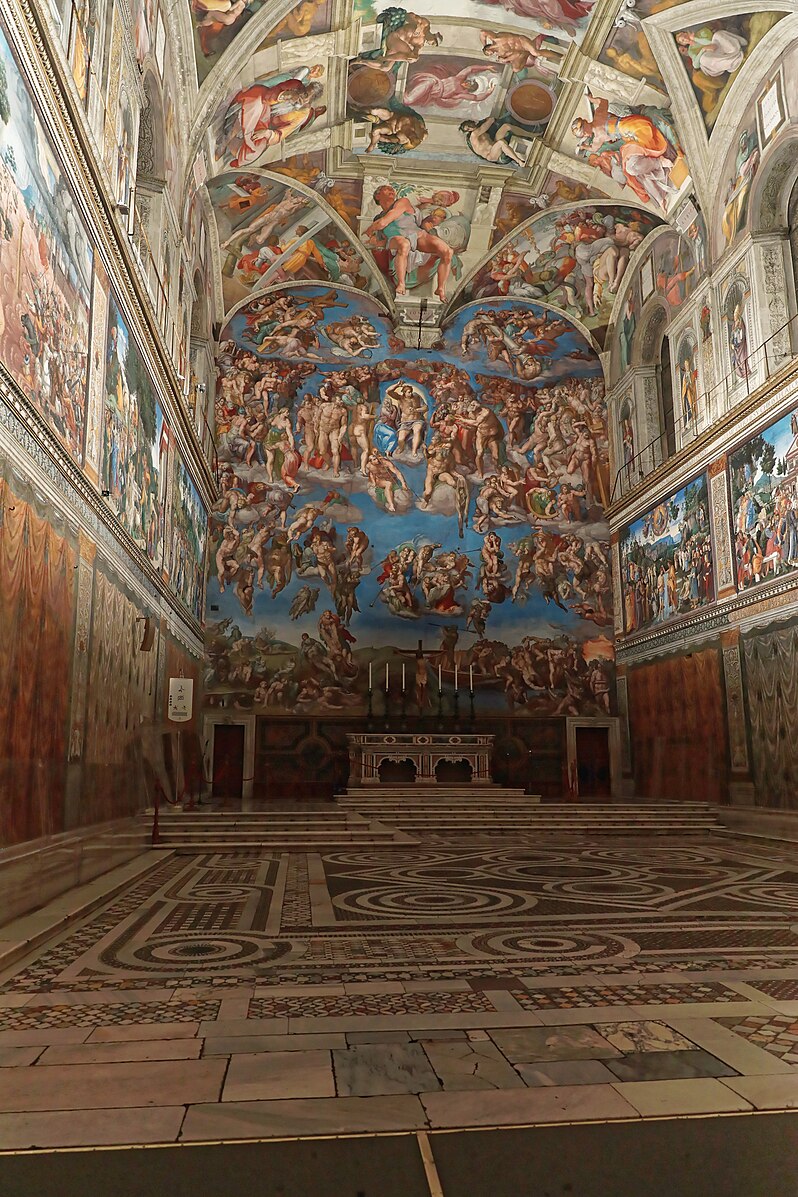
Sistine Chapel (1508 – 1512) by Michelangelo, Author Burkhard Mucke, (CC BY-SA 4.0 International)
“God…has in these last days spoken to us by His Son…who being the brightness of His glory and the express image of His person…when He had by Himself purged our sins, sat down at the right hand of the Majesty on high” (Heb. 1: 1-3).
Sacred art raises the mind and heart to God; draws people to prayer and adoration; and attempts to express the mystery of God through artistic media [1]. Christians who approve such art consider it justified by the Incarnation, through which Christ took on human nature (along with His divine) and was seen in the flesh.
Famous examples of sacred art from the Renaissance and Baroque Periods include the Sistine Chapel by Michelangelo Buonarroti; “The “Annunciation” by Fra Angelico; the “Transfiguration” by Raffaello (“Raphael”) Sanzio da Urbino; “The Taking of Christ” by Michelangelo Merisi da Caravaggio; and “Christ Crucified” by Diego Velazquez.
But artistic styles have varied greatly across the centuries.
During the early Middle Ages, perspective was largely unknown. However, painting played a vital role in educating the faithful [2]. Medieval art was rich in symbolism. Doves symbolized the Holy Spirit; lambs symbolized innocence and purity. Christ was represented by a lion, or by a lamb with an exposed heart, holding a cross. In Byzantine art, in particular, a gold background signified the glory of God and the heavenly realm [3].
Ornate altar screens a/k/a rood screens separated the domain of the clergy (chancel) from the area at church where lay people gathered to worship (nave), and were decorated with pictures of Christ, the Virgin Mary, and the saints [4].
Sacra Conversazione (“sacred conversation”) paintings featuring the Virgin Mary and Child surrounded by saints became popular in 16th century Italy. These were private devotional images, scenes which had no express basis in scripture or doctrine [5][6].
Fearing that such depictions could lead to idolatry, Protestants destroyed much sacred art during the Reformation [7].
The vivid colors, haunting images, and elongated figures of Mannerism used by the Greek artist Doménikos Theotokópoulos (“El Greco”) embodied the spirit of the Catholic Counter-Reformation in Spain [8][9].
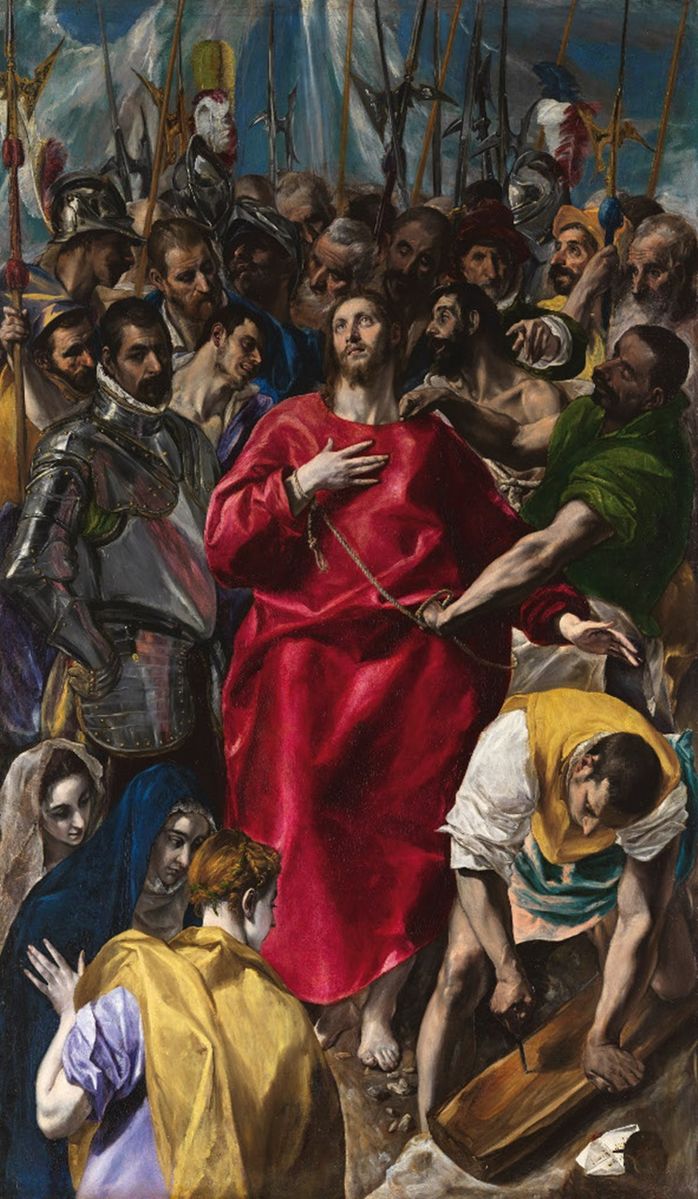
“The Disrobing of Christ” (1577-1579) by El Greco, Toledo Cathedral, Source Pictorpedia (PD)
Artists in the 20th Century were influenced by Modernism and Conceptual art, experimenting with new materials and abstraction, while challenging traditional art forms [10][11]. Noted artists of this time who created sacred art include Pablo Picasso (an atheist) and Salvador Dali (a Catholic) [12][13][14].
Some works of this period have been challenged as not art at all, and are certainly not considered sacred art [15]. For instance, Andres Serrano’s “Piss Christ” (a crucifix suspended in urine) is a controversial photographic work intended to be provocative, rather than inspirational [16].
In whatever age it was created, sacred art is more than decorative (or shocking). It employs the talent of the artist to convey biblical truths and the Gospel message of Christ.
Stephen Auth, author of Pilgrimage to the Museum, in fact, maintains that all art, in a profound sense, reflects the search for God [17]. Some art attempts to deny His existence. But He exists, nonetheless. And it is He who continues to seek us out.
—
[1] Sacred Art Live, https://sacredartlive.org/#:~:text=What%20is%20sacred%20art?%20Sacred%20art%20is,and%20Savior%2C%20the%20Holy%20One%20and%20Sanctifier.
[2] Ars Mundi, “The Art of the Middle Ages: An Epoch of Spiritual Creation”, https://www.arsmundi.de/en/service/our-art-report/the-art-of-the-middle-ages-an-epoch-of-spiritual-creation/.
[3] Gallery Byzantium, “On Byzantine Art & Symbolism”, 1/11/19, https://gallerybyzantium.com/on-byzantine-art-symbolism/#:~:text=Color%20was%20also%20an%20important%20symbol%20in,(these%20robes%20are%20commonly%20outlined%20in%20red).
[4] Wikipedia, “Rood screen”, https://en.wikipedia.org/wiki/Rood_screen.
[5] Columbia Museum of Art, “Sacra Conversazione with Tobias and the Angel” by Todd Herman, https://www.columbiamuseum.org/collection-highlights/sacra-conversazione-tobias-and-angel#:~:text=A%20sacra%20conversazione%20or%20%27sacred,by%20any%20number%20of%20saints.
[6] National Gallery of Art, “The Sacred Made Real: Spanish Painting and Sculpture, (1600 – 1700)”, https://www.nga.gov/features/slideshows/the-sacred-made-real.html.
[7] Deutsches Historiches Museum (DHM), “Iconoclasm and Reformation”, https://www.dhm.de/blog/2017/08/08/iconoclasm-and-reformation/.
[8] Grey Art Museum, New York University, “The Sacred Unveiled: Part 2, El Greco” by Geranne Darbouze, 8/21/20, https://greyartmuseum.nyu.edu/2020/08/the-sacred-unveiled-part-2-el-greco/.
[9] The National Gallery, “El Greco”, https://www.nationalgallery.org.uk/artists/el-greco#:~:text=In%20Venice%20El%20Greco%20worked,deeply%20influenced%20by%20Byzantine%20art.
[10] Wikipedia, “Modernism”, https://en.wikipedia.org/wiki/Modernism.
[11] Wikipedia, “Conceptual art”, https://en.wikipedia.org/wiki/Conceptual_art.
[12] Bellasemplicita, “The Religious Art of Pablo Picasso”, 7/5/16, https://bellasemplicita.wordpress.com/tag/the-religious-art-of-pablo-picasso/.
[13] National Gallery of Art, “Salvador Dali – The Sacrament of the Last Supper, 1955”, https://www.nga.gov/collection/art-object-page.46590.html.
[14] National Gallery of Victoria (NGV), “Dali and Religion”, https://www.ngv.vic.gov.au/dali/salvador/resources/DaliandReligion.pdf.
[15] The Institute for Sacred Architecture, “Sacred Art of Today: Is It Art and Is It Sacred?” by Steen Heidemanm, 2009, https://www.sacredarchitecture.org/articles/sacred_art_of_today_is_it_art_and_is_it_sacred.
[16] Artland Magazine, “Piss Christ by Andres Serrano” by Tori Campbell, https://magazine.artland.com/immersion-piss-christ-stories-of-iconic-artworks/#:~:text=Serrano%20himself%20has%20proclaimed%20that%20the%20work,a%20personal%20and%20serious%20work%20of%20art.
[17] Pilgrimage to the Museum by Stephen Auth, Sophia Institute Press, Copyright © 2022.
READERS CAN FIND MY VIEWS ON ABUSE AND ABUSE-RELATED ISSUES AT ANNA WALDHERR A Voice Reclaimed, Surviving Child Abuse
https://avoicereclaimed.com

 A Lawyer's Prayers
Protestantism and the Reformation had its good, but also got things very wrong at times, think of Calvin and Zwingli and their murderous persecution of their contemporary Anabaptists . Perspective is so important. I always appreciate your ‘fuller picture,’ thanks Anna.
You’re very kind, Erroll. 🙂
Very interesting post. There are many sacred art works throughout the art history, a topic that has always been a source of inspiration for artists.
Excellent post, Anna. It made me wish churches would sponsor and encourage the artists in their midst.
Sacred art helps us connect with His divine mysteries and reminds us of Christ’s ultimate sacrifice. Let us continue to seek His glory through every form of expression. Amen 🙏