Biblical Seal
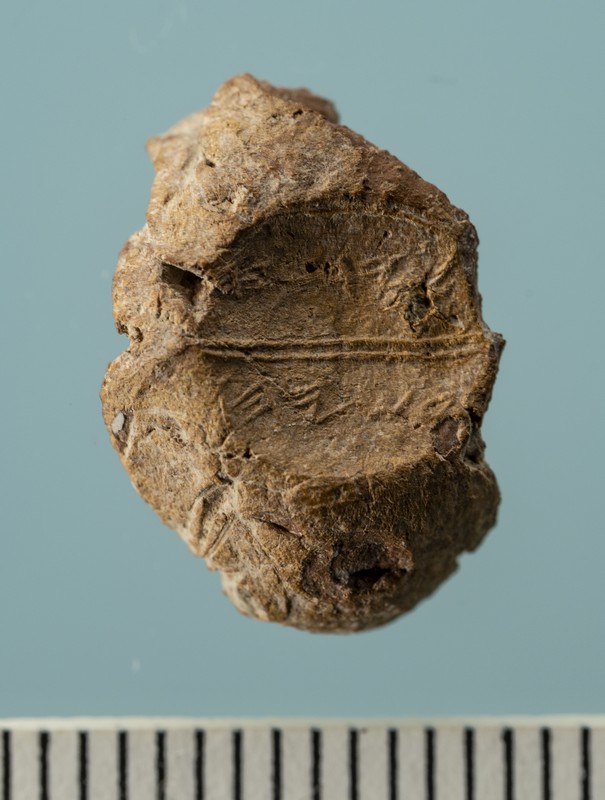
Clay seal from the Temple Mount, image courtesy of Temple Mount Sifting Project https://tmsifting.org/en/2025/07/30/asayahu/
Earlier this year – on the eve of the Jewish fast day of the 17th of Tammuz which commemorates the breach of Jerusalem’s walls by King Nebuchadnezzar, and begins the annual three-week mourning period for the destruction of the First and Second Temples – excavations led by the Temple Mount Sifting Project in Jerusalem uncovered a small clay seal with the name of a biblical figure [1A][2A].
As mentioned elsewhere on this blog, the Temple Mount Sifting Project is an archaeological project to recover and preserve historic artifacts from the 9000 tons of material discarded by the Waqf, the Islamic organization which has control of the Temple Mount [3].
In ancient times, clay seals were used as a means of identification on storage vessels and other items to prevent misappropriation. Such seals were commonly bound to goods like wine, honey, and oil.
The style of writing on this particular seal dates it to the First Temple Period, the late 7th Century BC to early 6th Century BC, directly countering the Islamic allegation (“temple denial”) that no Jewish temple ever stood on the Temple Mount.
Researchers have deciphered the name stamped into the clay which reads: “Belonging to Yed[a‛]yah (son of) Asayahu.” Experts believe the seal belonged to Yeda‛yah, the son of Asayahu, one of King Josiah of Judah’s senior officials. Astoundingly, the clay seal retains a clear fingerprint, presumably left by the individual who once owned it.
The name “Asayahu” or “Asaiah” appears in the Bible at 2 Kings 22: 12 and 14; 2 Chronicles 34: 20, and elsewhere. King Josiah had ordered that repairs be made to the temple. During those repairs, workers discovered a law scroll (likely the Book of Deuteronomy) which warned of punishment from God.
Alarmed by the prophecy, King Josiah sent members of his court to seek counsel from the prophetess Huldah, who foretold Jerusalem’s destruction but assured Josiah that he would not live to see it. One of these trusted men was Asayahu (referred to as “the king’s servant”).
Because of Asayahu’s important position, researchers believe his son, Yeda‛yah, may, also, have served in a prominent role around the same time or shortly after. Other individuals named in similar discoveries from Jerusalem have been directly identified with biblical-era officials [2B].
“Obviously, we are not sure that the Asayahu mentioned on the sealing is the same that appears in the Bible…However, several such artifacts found in the area of the Temple Mount carry biblical names, and it does make sense, because these were not objects used by common people.”
–Temple Mount Researcher, Zachi Dvira [1B]
The fate of the seal’s owner remains unknown. He may have been among those exiled to Babylon.
—
[1A and 1B] Popular Mechanics, “”Archaeologists Found a 2,600-Year-Old Fingerprint of a Biblical Figure”, Emma Frederickson, 8/4/25, https://www.popularmechanics.com/science/archaeology/a65575032/clay-seal-hebrew-bible/?utm_source=firefox-newtab-en-us.
[2A and 2B] Temple Mount Sifting Project, “Has the Name of King Josiah’s Trusted Official Been Found on an Ancient Sealing?”, https://tmsifting.org/en/2025/07/30/asayahu/.
[3] Wikipedia, “Temple Mount Sifting Project”, https://en.wikipedia.org/wiki/Temple_Mount_Sifting_Project.
READERS CAN FIND MY VIEWS ON ABUSE AND ABUSE-RELATED ISSUES AT ANNA WALDHERR A Voice Reclaimed, Surviving Child Abuse
https://avoicereclaimed.com

 A Lawyer's Prayers
I’ve always found it interesting the lengths to which man will go to discredit God and His word. It reminds me of the verse that says be sure that your sins will find you out. Eventually, truth wins out, and nowhere is that more true than our dealings with the Lord. In this case, a simple stone tablet completely refutes the lies meant to deceive an entire people. Thanks for sharing this Anna.
I found the existence of the seal inspiring, most especially b/c it was found discarded in the so called “rubbish” from the Temple Mount.
Intriguing read, Anna.
As for the place where the seal was found, I was reminded of the following Scripture,
“Instead, God chose things the world considers foolish in order to shame those who think they are wise.” (1 Cor 1:27 NLT)
Well said, Susanne.
What an intriguing find! Archaeology fascinates me, a field of historical puzzles taxing the imagination. But so much of archaeological interpretation can be influenced by money and politics. In India right now, an ancient city was discovered in its southern most part and there’s an ongoing struggle between political factions as to its dating because of its implications regarding cultural dominance. *sigh*