“If one of your brethren becomes poor, and falls into poverty…then you shall help him, like a stranger or a sojourner, that he may live with you” (Lev. 25: 35).
Aretha had problems keeping a roof over her head. After leaving the group home, Aretha lived alternately with her sister, at least one aunt, her mother, and in apartments Aretha rented, herself.
There were difficulties with each of these arrangements. Aretha’s sister, Shantice, had since purchased a house in West Philadelphia she shared with her husband. Though the marriage did not last, the two continued to live together. There were, also, now four children.
The real issue was not space or even upheaval in the marriage. Aretha’s brother-in-law had made advances toward her. She kept this to herself, but did not feel entirely safe around him.
Both Aretha’s mother and the aunt on whose couch Aretha slept could be volatile personalities, likely as not to ask her to leave on a moment’s notice. Aretha wanted a stable place to raise her son. The house Aretha’s mother owned when I first met her was later condemned as uninhabitable.
Section 8 Housing
This left Aretha with the option of Section 8 housing, more formally known as the Housing Choice Voucher Program. The term “Section 8” refers to the US Housing Act under which this federal assistance program is authorized.
Administered by the Department of Housing and Urban Development (HUD), the program subsidizes low-income housing, with tenants paying about 30% of their own rent, and federal funds the remainder.
While a state’s Public Housing Authority can link a portion of tenant vouchers to specific apartment complexes (in my day known as “the projects”), the program allows eligible families to lease in privately-held buildings, as well. Participating landlords are subject to a rental cap determined by HUD for Section 8 tenants, and must meet federal housing quality standards.
That, at any rate, is the theory.
In practice, many inner city landlords do not adhere to the mandatory housing standards unless or until taken to court. Some view the resulting fines as a mere cost of doing business. Tenants, also, at times damage these apartments, though they can be evicted for doing so.
Despite this, the waiting list for Section 8 housing in most areas of the country is thousands of families long. The delay for vouchers can easily run three to five years.
Aretha experienced this first-hand. Though she searched hard for livable conditions, Aretha occupied apartments that had serious plumbing and electrical problems, sometimes lacked heat, were all without air conditioning.
Aretha fought cockroaches, rats, mold, garbage accumulation, chronic leaks, and the stench of backed up sewage. She lived with drafty windows in winter, and the sweltering heat of Philadelphia summers.
Finding my way to Aretha’s various addresses was a constant challenge for me. One night, I headed out without directions, sure I would remember the way to her latest apartment, having already been there several times. Instead, I wound up lost in West Philadelphia.
Again, I had no phone on me, and no chance of locating one. I drove haplessly up one deserted street and down another, praying something would look familiar.
Finally, at a total loss, I pulled over and stopped altogether. “Well, God,” I thought, “this is up to You. I can’t find it, for the life of me. Unless Your angels drive, I’m not getting there tonight!”
At that point, for no reason I can explain, I turned the car around and drove directly to Aretha’s door. I guess the angels knew her address, even if I didn’t. Aretha and I laughed about it later, over cake. Read more…

Anterior view of human heart, Source/Author Patrick Lynch, medical illustrator (CC BY-SA 2.5 Generic)
“A good man out of the good treasure of his heart brings forth good; and an evil man out of the evil treasure of his heart brings forth evil” (Luke 6: 45).
Not many are familiar with Wolf-Parkinson-White Syndrome. It is a heart rhythm disorder, effecting fewer than 200,000 people in the US population.
In a normal heart, electrical signals use a single pathway as they move through the heart from its upper to lower chambers. In Wolf-Parkinson-White Syndrome, one or more additional, abnormal pathways exist between the upper chambers (“atria”) and lower chambers (“ventricles”) of the heart, causing the electrical signal to reach the ventricles too soon and be routed back into the atria. Very fast heart rates can develop as the electrical signal ricochets back and forth.
Patients with Wolf-Parkinson-White Syndrome may experience heart palpitations, dizziness, and fainting. The syndrome can lead to cardiac arrest, even death.
Aretha first began experiencing symptoms around age eleven. Her heart would flutter, beating faster and faster, till she had difficulty catching her breath.
Aretha reported these symptoms, but they were initially dismissed, then variously attributed to over-exertion, high blood pressure, and stress.
Since her symptoms persisted, there were several electrocardiograms performed over the years. These were read as normal, though extra electrical pathways should have been visible on EKG. This is not surprising, since poverty is directly correlated with poor health outcomes [1].
Finally, after Aretha had fainted repeatedly in high school, the disorder was diagnosed. When medication did not relieve her rapid heartbeat, Aretha was scheduled for surgery. A flexible tube would be guided into place in her heart, and portions of tissue destroyed by radio frequency, eliminating the abnormal electrical pathways.
Aretha did not place great faith in this surgery. She had been told it would correct her condition. But Aretha had been so often unheard or disbelieved – and so often misdiagnosed – that the surgery seemed just another venture. Read more…
:max_bytes(150000):strip_icc():format(webp)/Parents-GettyImages-1369926465-8b27f61d03cc4cc1889d6d8919c37c16.jpg)
Mother with sick child,
Copyright © Good Boy Picture Company/Getty Image,
Courtesy of Parents Magazine https://www.parents.com
“I will lift up my eyes to the hills — From whence comes my help?” (Ps. 121: 1).
Jonathan lay listlessly on the bed, his skin hot and dry to the touch. Aretha and I sat concerned on either side of the baby boy, the bedspread rumpled, the bed virtually the only piece of furniture in the small, third floor walk-up.
“I think you should call the doctor, Aretha. He’s very hot.”
“I called the docta’ befo’.”
“What did he say?”
“Babies can get high temp’achu’s.”
“Maybe you should try bathing him in some cool water to bring the temperature down.”
No response.
“Didn’t the doctor prescribe anything?”
“No.”
“Can you give Jonathan something over the counter for babies?”
“I aw’ ready did.”
“I think you should try calling again. Or take him to an emergency room.”
Aretha found her cell phone, and redialed. Thankfully, Jonathan recovered.
Racial bias can play a role in the evaluation and treatment of medical conditions among the poor [1]. Whether that was the case here, I do not know. But the evidence for such bias existed long before the distorted views of critical race theory or Woke ideology were ever popularized [2][3A].
A Good Mother Without Support
Aretha did not need me to tell her how to be a good mother. She held the baby, and rocked him. She nursed him when he was hungry. She took him for his shots, and comforted him afterwards. She read and sang to him.
She sat alone in the apartment with him for endless hours, gazing out into the street.
What Aretha needed was a support system. Her own mother, drawn to the excitement and volatility of street life, would disappear for days, and could not be relied on for child care in these early years of Jonathan’s life.
Aretha was, as a result, trapped. She might take the baby to the grocery store with her, but could not leave him to attend classes or find work.
Some mothers in the same position would party through the night, in search of escape, leaving their children alone or handing them off to any willing neighbor. Aretha refused to do that.
Unable to afford a vehicle, Aretha had to take public transportation. That could mean waiting an hour for the next street car, if she missed her intended one, all the while huddling against the cold, holding the baby in a carrier in her arms.
I tried to help Aretha find child care. Several Christian organizations had put together a directory of community services. Aretha found these still beyond her means, to the extent she had the energy to inquire.
The situation drained Aretha. She was no longer the girl I had known, full of sparkle and life. A photo of Aretha in yellow cap and gown, still stood on my desk. But I rarely saw that smile any more. Read more…

Shofuso Japanese House and Garden, Philadelphia, PA, Author 松風荘 (CC BY-SA 4.0 International)
“Teach me to do Your will, For You are my God…” (Ps. 143: 10).
“May education and learning be central to their lives and work, and move them forward to lives of personal and academic fulfillment.”
–Rae Alexander-Minter, EdD, at the dedication of Penn Alexander School
A new grammar school has been built in West Philadelphia since Aretha’s day. Named for African American lawyer and civil rights pioneer, Sadie Tanner Mossell Alexander, the $19 million building perches like a great white bird amid the rubble of its surroundings.
Regrettably, the school was built too late for Aretha. She spent her last matriculated year at West Philadelphia High School, without text books the entire time.
Situated at 48th Street and Locust Avenue, West Philadelphia High School is overwhelmingly African American with approximately 86% of its over 1700 pupils from low-income families. The school when last reported had two guidance counselors, fewer than ten teacher’s aides. Some 30% of students are absent on any given day.
Truancy
In Philadelphia as a whole, there are over 12,000 children truant on any given day. Single mothers battle the streets for their children’s souls.
Though young people are required to attend school through age 17, truancy officers in West Philadelphia rarely stop those on the street during school hours. Perhaps the volume is overwhelming. Either that or the lives of these children are already viewed as expendable.
West Philadelphia High School, in fact, boasts an Electric Vehicle Team which builds functional and award winning hybrid electric cars getting 50-60 miles per gallon. But verbal and math college board test scores have averaged 600, out of a possible 1600. The dropout rate has been as high as 18%.
In 2006, there were 74 incidents at the school characterized as “serious” (89 incidents, the last year Aretha attended there). These included disorderly conduct, drug and alcohol offenses, altercations between students, vandalism, weapons charges, thefts, and assaults on teachers. One teacher had his jaw broken.
It is not unusual for arson fires to be set in student lockers, further disrupting classroom time. Read more…

Pregnant woman, Image courtesy of Adobe
“Then she called the name of the Lord who spoke to her, You-Are-the-God-Who-Sees; for she said, ‘Have I also here seen Him who sees me?‘” (Gen. 16: 13).
I had parked outside Aretha’s West Philadelphia apartment (her aunt’s actually). The windshield wipers swept rhythmically back and forth, the streetlight casting its thin rays out into the wet street. Cars passed by, raising a spray against the door, without regard to us.
Aretha sat beside me on the front seat. Hands clasped in her lap, she squeezed out a few halting words at a time, tears in her voice.
“I don’ know what to do.”
“About what? What’s happened, honey?”
“They’re all yellin’ at me.”
“Who’s yelling at you? Why?”
“Ever’body has an opinion. No one’ll listen to me.”
“Tell me what’s happened. Maybe I can help.”
“Well, I’m expectin’ now. My aunt wants me to get rid of the baby.”
I caught my breath. A baby.
“Is that what you want?”
“I wanna keep it. I thought…I thought about, you know, ending things.”
I struggled to remain calm.
“You mean suicide? Oh, honey, you can’t do that! Don’t even think that.”
“I can’ go on like this, bein’ pulled in all differen’ directions.”
“We’ll find a way. Whatever it is you want to do, we’ll find a way.”
“I knew you’d un’erstan’.”
I did not, however, understand.
Oh, I understood why Aretha wanted the child – someone all her own to love her unconditionally. But I had heard Aretha say a thousand times she did not want children. I had heard her deplore the fact that so many young women she knew were becoming mothers at a tender age.
I had worried she might forego the great pleasure of motherhood entirely, in a misguided effort to further her career.
Aretha had never been “boy crazy.” She had dated little. Now, there was another life in the mix. Aretha’s life was no longer entirely her own. Read more…

Friendship bracelets, Image courtesy of Cultural Fashion or Adornment, Tanzania, Author Maryam Mgonja, (CC BY-SA 4.0 International)
“And above all things have fervent love for one another, for ‘love will cover a multitude of sins‘” (1 Peter 4: 8).
I could have ended our relationship when Aretha left the program. Since she was a ward of the state, not yet emancipated, her status was now technically that of an unsupervised minor. I did not, in fact, know how to reach her.
Aretha had spoken of other girls leaving the group home. She kept to herself, so as not to make attachments that would not last.
Ruth had warned me that a high proportion of girls leave the program early, that the gravitational pull of their old lives is simply too great. The chaos to which they have been accustomed leaves them so scarred it is not possible for them to accept the schedules, the rules and regulations, that provide the structure for an ordinary life [1].
Though essential, love alone is not enough. Self-discipline (and patience) are two critical characteristics the girls lack. Structure helps teach these things, but only for those willing to stay with the program.
While Aretha had been discontented, I had not expected this. I wrestled with what I would say, if she called. My first concern was for her welfare. However, by leaving the program, Aretha had, also, foregone the tremendous educational opportunities associated with it. Not only would she be back at an inner city high school. She would now have to finance college on her own.
In situations such as this one, the relief organization encouraged its volunteers to continue mentor relationships – albeit without formal guidance – if the child expressed an interest.
When Aretha did call from her aunt’s, I offered to go on with her as we had before. Aretha took for granted that our relationship would continue.
We were, after all, friends.
—
[1] National Institutes of Health (NIH), National Library of Medicine, “The role of chaos in poverty and children’s socioemotional adjustment” by Gary Evans, et al, July 2005, https://pubmed.ncbi.nlm.nih.gov/16008790/.
Copyright © 2010 – Present Anna Waldherr. All rights reserved.
READERS CAN FIND MY VIEWS ON ABUSE AND ABUSE-RELATED ISSUES AT A Voice Reclaimed, Surviving Child Abuse and More
https://avoicereclaimed.com

Tug of War at Pep Rally, Author LemonLad1111111, (CC0 1.o Universal Public Dedication)
“For we do not wrestle against flesh and blood, but against principalities, against powers, against the rulers of the darkness of this age, against spiritual hosts of wickedness in the heavenly places” (Eph. 6: 12).
A tug of war began for Aretha’s future. Really, it had been going on from the start. The staff at the group home, Aretha’s school counselors, her social worker, and I, all tried to get her to stay in Lansdale. Aretha, who professed to hate West Philadelphia, ached to return there.
Oh, Aretha denied this, talked about making an idyllic life in the suburbs someday. She could conjure up the vision of a rosy, if distant, future as a business lawyer – a big house with room enough for her entire family. But she chafed at every restriction, fought every measure designed to help her adjust.
Divided Loyalties
Ruth understood. She had seen this many times before. Aretha’s loyalties were divided.
Much as Aretha scorned the area, some part of her felt that West Philadelphia was home.
She was not ungrateful, not unaware that the people around her were trying to help. But Aretha did not feel a part of the white suburb, felt herself floundering at school, longed to return to familiar streets, familiar sights and sounds. The very crickets were foreign to her.
She feared that she had abandoned her family and, in a sense, her cultural roots.
And Aretha worried, I think, that she would not be able to succeed in a white world. To pursue the dream was to place it at risk of being destroyed. Rather than that, Aretha would undermine her own progress.
She was not conscious of doing that, resisted taking responsibility for her actions, much as she might regret them in retrospect. This caused erratic behavior. Read more…
 Penn’s Landing, Philadelphia, PA, Author ajay_suresh, (Creative Commons Attribution 2.0 Generic)
“Open your mouth for the mute, for the rights of all who are destitute. Open your mouth, judge righteously, defend the rights of the poor and needy“ (Prov. 31: 8-9).
Aretha and I were in high spirits as we headed across I-95, toward Penn’s Landing. The day was fine. From the overpass, we could see colorful flags in the distance, off to our right.
Just across from Old City, along the Delaware River, Philadelphia’s Penn’s Landing is an entertainment pier which offers a skating rink and maritime museum, access to historic ships, restaurants and sidewalk vendors, along with a variety of ethnic music festivals.
We were laughing and joking. Aretha had promised to introduce me to the Pennsylvania Dutch delicacy known as funnel cake. Funnel cakes are made by pouring batter in a circular pattern into hot oil, then deep frying the batter to a golden brown. They are served hot with powdered sugar.
I did not at first notice the large fountain several hundred yards off to our left. From the corner of my eye, I caught sight of what seemed to be two people in the fountain. It soon became obvious the two were having sex in the open.
Aretha had seen the same thing. We grew silent, both at a loss for what to say. Aretha, I think, was mortified that the couple was African American. I was distressed that she should be exposed to something like this in a public place.
The incident illustrates for me the powerful forces to which Aretha’s life was subject, forces both positive and negative.
Zahra
There was Zahra, the house mother I came to know best.
Zahra was an African American woman in her early forties who wore dignity like a mantle. When younger, she had started a child care facility to ensure that African American children were provided a safe place to play, and prepared for the rigors of school.
A Loving Brother
There was, also, Aretha’s older brother.
I sat on the floor at Shantice’s and watched one evening, while he lovingly cut and colored Aretha’s hair. Wielding the scissors with great care, he drew closer to Aretha then backed away again, scanning for the slightest imperfection. With an electric razor, he trimmed the hair at the nape of her neck, then applied a rinse to add luster to the hair.
The process took a full two hours, though her hair at the time was shorter than mine. Read more…

Rain on tarpaper roof, Author W.carter, (CC0 1.0 Universal Public Domain Dedication)
“…’Let the little children come to Me, and do not forbid them; for of such is the kingdom of heaven‘” (Matt. 19: 14).
In December of 2000, I learned that Aretha would be spending Christmas at her older sister’s home in West Philadelphia, but essentially alone because of Shantice’s employment situation. I offered to take Aretha out on the 23rd, and we made plans for that.
Directions in hand, I drove with some trepidation to Shantice’s place in West Philadelphia around 1 PM, expecting to take Aretha to a late lunch or matinee. The address was a row house, across from a vacant lot. I passed it twice, since not all houses in the area had their numbers displayed.
Standing on the small cement stoop, I knocked on the door, and waited. There was no answer. I knocked again, a little louder. Still, no answer.
A passerby, an African American man in his early twenties, hands in the pockets of a hooded sweatshirt, cast me a suspicious, sidelong glance. I began to grow nervous, as well as chilled, checked my watch, and knocked a third time.
This at last evoked a response. Aretha called from an overhead window that she had been asleep, would be down directly. My heart slowed to a normal pace.
Aretha opened the door in her pajamas, rubbing sleep from her eyes. “Come on in, outta the cold,” she said, waving me through the door into a dim front room devoid of either furniture or warmth. “We were asleep.”
Tyrell
I noticed for the first time a boy of about four years standing shyly behind Aretha.
“I’ll go get dressed,” Aretha said. She disappeared up a rickety staircase, leaving me in the cold and unlit room with the boy, the blinds drawn.
“Hi,” I said. “My name’s Anna.”
“Hullo,” he volunteered.
“What’s your name?”
“Tyrell.”
“Tyrell. That’s a good name. Are you related to Aretha?”
No answer.
“Is she maybe your aunt?”
“My aunt,” he nodded.
“Is this your house? Do you live here?”
“Yes.”
“It’s a nice house. Do you have your own room?”
“I share,” he almost whispered, using his right foot to draw circles on the floor, all the while gazing up at me, his little brow furrowed in thought. Then, as if he had made a decision, “Would you like to see my truck?”
“Su-u-re,” I replied.
Tyrell pattered off into the darkness, the soles of his pajama-clad feet making a slapping sound on the hard wood floors. In a moment, he returned with a small plastic truck, and began explaining its operation to me. I knelt down beside the boy, the better to see the truck and hear his explanation.
Aretha returned and began her own explanation. She had been left to watch the child, but was under instruction to take him to relatives in North Philadelphia. Aware that I was on my way, the family had told her to ask me to drop the boy off.
I had not expected to assume responsibility for a minor child whose mother I had not yet met, on the word of a teenage girl I was only starting to know.
It was not that this was an inconvenience. I simply could not think what the best thing to do was. I had no car seat for Tyrell. What if I had an accident? What if his mother accused me of kidnap?
There was no phone in the apartment. There were no public phones on the deserted street, no shops nearby that might have a phone.
I had no cell phone in those days, so no way to reach Shantice for confirmation as to her wishes, and no way to reach the aid organization for guidance. There was no one nearby with whom to leave the boy. We three seemed all alone in the world.
I wondered if there was any food in the house for the children. Read more…
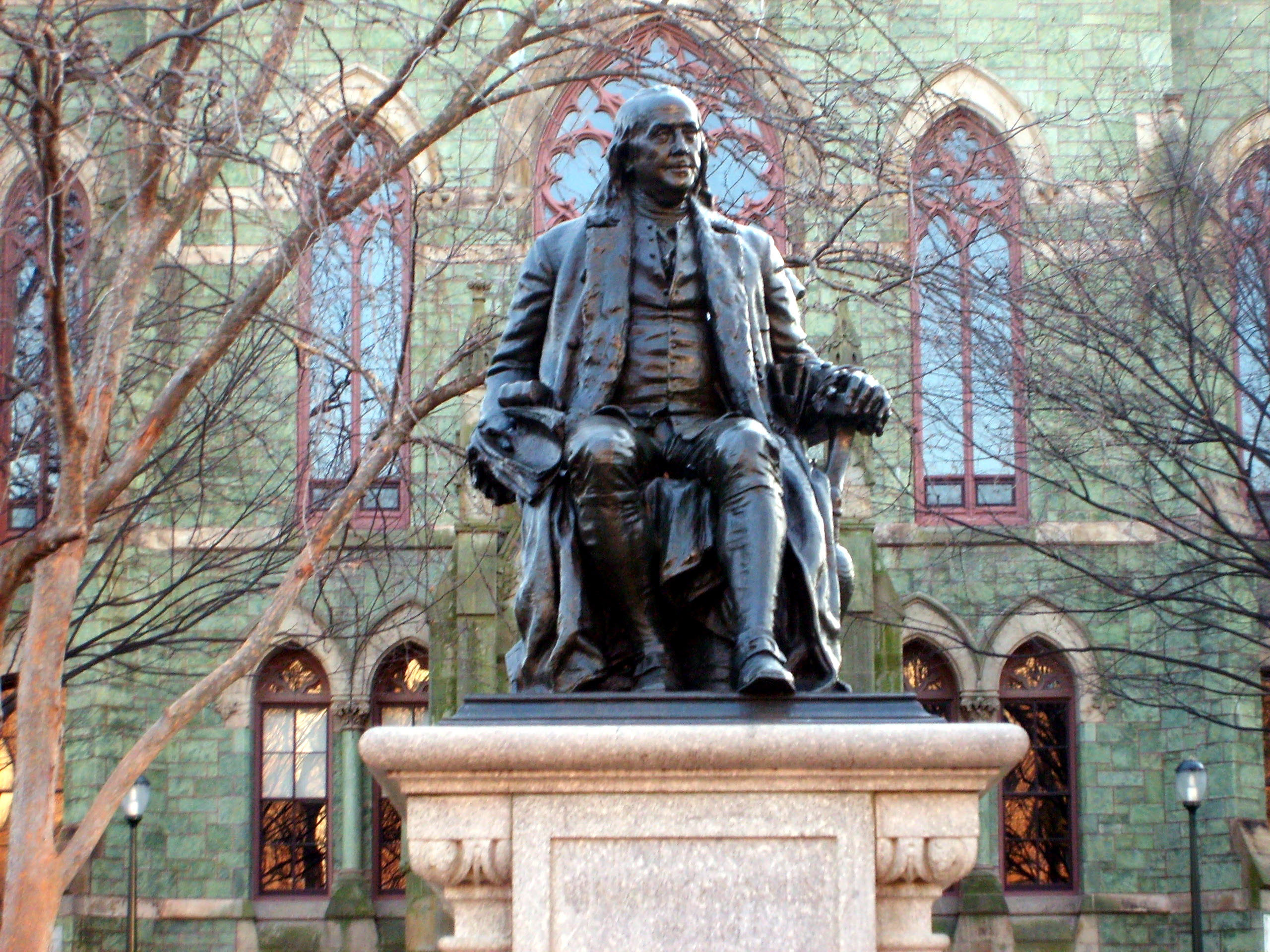
Statue of Benjamin Franklin on campus of University of Pennsylvania, Author MatthewMarcucci, (PD)
“For we walk by faith, not by sight” (2 Cor. 5: 7).
“Which is best?” That was Aretha’s constant inquiry – whether as to books, magazines, housing, clothing, schools, or cities.
I tried to explain that “best” was, for many things, a relative term, dependent on the criteria of the individual making the comparison. Aretha would not be satisfied with so mealy-mouthed a response.
For Aretha, the ivy league University of Pennsylvania was the penultimate, her symbol of excellence.
America’s first university, this venerable Philadelphia institution traces its history to a trust established in 1740. Since first purchased by a group which counted among its members Benjamin Franklin, the school grounds have given rise to a highly reputed business school, medical school, and teaching hospital.
Aretha’s goal, often repeated to me, was to attend Penn. Meanwhile, she struggled with high school math and biology.
Aretha’s school difficulties were not at first apparent to me. Aretha did her best to gloss over these, displaying with great pride the English papers on which she did well, carefully omitting mention of the tests she had failed.
The fault was not Aretha’s. Until removed from her mother’s custody, she had attended (when at all) inner city schools plagued by violence, teen pregnancy, and lack of resources. As Aretha said, “You got an ‘A’ just for bein’ present.” It was a reflection of the generation gap that I should be astonished her inner city school had a nursery.
Now in a suburban school, with a stiffer curriculum, Aretha found her grades plummeting. This produced panic in her. Aretha wanted with all her heart to be someone, to do something that mattered to the world. That possibility was rapidly fading before her eyes.
Gently, I suggested tutoring to her. The house mother suggested tutoring to her. Counselors at her school, I am sure, suggested tutoring to her. Aretha resisted. Alone in her room, she would wrestle with the materials, finally throwing her books against the wall in frustration.
This was a girl teased for reading too much. This was a girl articulate in defending others. This was a girl who preferred business magazines to gossip rags. This was a girl who could imagine becoming a lawyer.
It slowly became clear that Aretha had as much chance of attending Penn as she did of walking on the moon. What preyed on my mind was the thought that there were hundreds of thousands like her, if not more. Read more…


