
South facade and nave of Notre Dame Cathedral, two years before the fire, Source Flickr, Author Ali Sabbagh
(Creative Commons CC0 1.0 Universal Public Domain)
Begun in 1163 on the Ile de la Cite in the heart of Paris, Notre Dame Cathedral is an artistic and architectural masterpiece dating from the Gothic period [1]. The fire which occurred there on April 15, 2019 — though it, thankfully, claimed no lives — was a tragedy for the entire world [2][3]. The spire was totally destroyed, along with 2/3 of the roof.
Reconstruction
Reconstruction is underway with a commitment not only to restore the structure, but maintain its original integrity [4A]. This has required extensive research into medieval building methods. Rebuilding in the old style is necessary to assure that the new roof will behave the same way the old one did [4B].
Perfectly Straight
Some 13,000 wooden beams which supported the roof must be replaced. Oaks of the appropriate height and dimension have been sourced throughout France.
Because twisted fibers from damage during growth will weaken a tree, trees are inspected from every angle to identify defects before being harvested. The timber that is cut must be of top quality, and perfectly straight.
Highest Standards
“What I enjoy most is discovering the wood. Each tree is unique.”
-Francois Feillet, French sawmill owner [4C]
The forty five sawmills processing this timber adhere to extremely rigorous rules, the highest standards in carpentry.
The timber is first stripped of its outermost layer. Next, a slabber shreds away the remaining bark. Finally, a high speed bandsaw trims the lumber down to the beam specifications needed.
A House of Worship Defiled
Notre Dame Cathedral is today a house of worship, a symbol of French pride, and a tourist attraction. Its creation was an act of faith on the part of countless craftsmen — carpenters, stonemasons, blacksmiths, glassmakers — and the communities which supported them.
But during the French Revolution the cathedral was defiled and abandoned. Public worship was banned. The cathedral was looted and vandalized, its west facade torn down [5]. A prostitute was installed on the altar as the “goddess of reason” [6]. Read more…

JP Morgan Chase Tower, Author Krzykol (CC BY-SA 3.0 Unported)
“I have set the Lord always before me; Because He is at my right hand I shall not be moved” (Ps. 16: 8).
Debanking is the closure by a bank of the accounts of an individual or organization based on the perception that the account holder poses increased legal, regulatory, financial, or reputational risk to the bank [1A].
Examples include the enforcement of anti-corruption and anti-money-laundering laws, and the closure of the bank accounts of so called “politically exposed persons”, i.e. those entrusted with a prominent public function and, therefore, potentially at risk for bribery [1B].
At first, all this seems above board. However, the process does not require the disclosure of a reason, and does not generally provide for an appeal [1C]. The practice is, for that reason, considered a threat to freedom of speech. It is now a growing threat to freedom of religion, as well.
JP Morgan Chase
Earlier this year, JP Morgan Chase summarily closed the checking account of the National Committee for Religious Freedom (NCRF), a legal 501(c)(4) non-profit led by former US Ambassador Sam Brownbeck [2A][3].
NCRF exists to defend religious freedom. Its board members include Michael Farris of the Alliance Defending Freedom, Tony Perkins of the Family Research Council, New York’s Roman Catholic Cardinal Timothy Nolan, Jewish/Muslim/Hindu religious activists, and former members of Congress [4][5]. Read more…
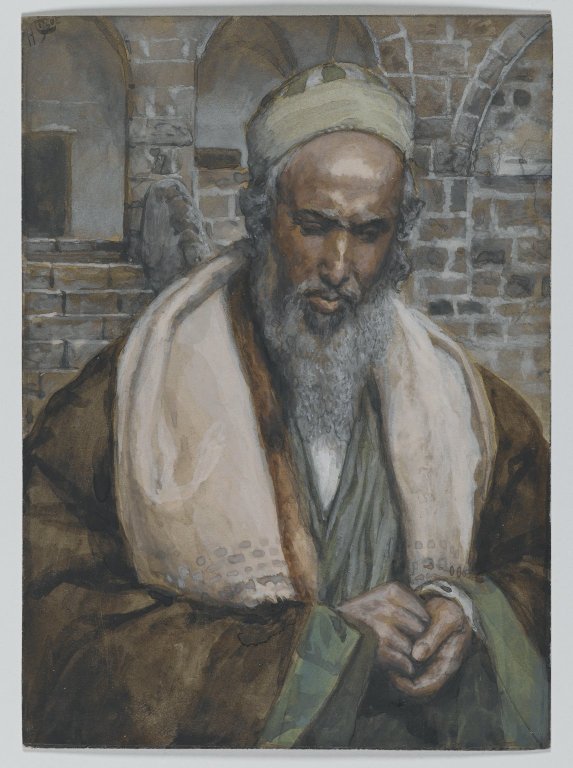
“St. Luke” by James Tissot (1886-1894), Brooklyn Museum (Accession No. 00.159.207), (PD)
St. Luke is the author of one of the canonical gospels, as well as the Book of Acts [1A]. Many consider Luke’s gospel, which focuses on social justice and the poor, the most poetic of the four.
Background
It is widely accepted that St. Luke was a Gentile convert to Christianity, addressing a Gentile audience [1B]. Christian tradition has it that he wrote his gospel in Greece.
St. Luke is thought to have been unmarried, and to have lived originally in Antioch [1C]. DNA testing on what tradition holds to be St. Luke’s body in the Basilica of Santa Giustina in Padua has revealed that he was of Syrian ancestry [1D][2]. He was martyred in Thebes.
Medicine
A faithful companion to the Apostle Paul, Luke is described by the Epistle to the Colossians as a physician, and believed by many scholars to have practiced medicine.
Art
Medieval tradition held that Luke was, also, an artist — the first icon painter.
A number of paintings of the mother of Christ are popularly attributed to Luke. These include the Black Madonna of Częstochowa and Madonna del Rosario a/k/a Maria Advocata or Advocata Nostra, said to be the first depiction of the Virgin Mary [3][4][5].

“Madonna del Rosario” a/k/a “Maria Advocata” or “Advocata Nostra” (c. 6th Century or earlier), Author Asia (CC BY-SA 4.0 International)
Patron Saint
The Catholic Church and other major Christian denominations venerate St. Luke. His symbol is the winged ox, representing the sacrificial aspect of Christ’s ministry and the spread of the gospel throughout the world.
St. Luke is the viewed as the patron saint of physicians/surgeons, medical students, artists/painters/sculptors, crafts workers, lacemakers, bachelors, and butchers [6].
His feast day is celebrated on October 18.
—
[1A and 1B] Wikipedia, “Luke the Evangelist”, https://en.wikipedia.org/wiki/Luke_the_Evangelist#As_an_artist.
[2] Britannica, “Where is St. Luke buried?”, https://www.britannica.com/question/Where-is-St-Luke-buried.
[3] Wikipedia, “Black Madonna of Cęstochowa”, https://en.wikipedia.org/wiki/Black_Madonna_of_Cz%C4%99stochowa.
[4] Wikipedia, “Maria Advocata (Madonna del Rosario)”, https://en.wikipedia.org/wiki/Maria_Advocata_(Madonna_del_Rosario).
[5] The Marian Room, “A Hidden Icon of Mary, The Advocata Nostra” by Patrician Enk, 6/9/20, https://themarianroom.com/a-hidden-icon-of-mary-the-advocata-nostra/.
[6] Saint Luke Catholic Church, “Our Patron, Saint Luke”, https://slparish.com/history-of-our-patron-st-luke.
READERS CAN FIND MY VIEWS ON ABUSE AND ABUSE-RELATED ISSUES AT ANNA WALDHERR A Voice Reclaimed, Surviving Child Abuse
https://avoicereclaimed.com
“The Left has decided that Jews who are not victims are not true Jews…”
-Rabbi Dr. Gerald Meister, former advisor to Israel’s Ministry of Foreign Affairs [1A]
There was a time that the political Left supported Jews and the idea of a Jewish homeland [2]. But that has since changed.
While strident antisemitism was always prominent on the communist far Left, it has now spread to the liberal mainstream [3].
Media Bias
Liberal bias is most obvious in the media. The Israeli-Palestinian conflict is generally mischaracterized as Western colonialism. Reporting invariably takes a sympathetic view of the Palestinians, a supposedly oppressed people.
This slanted approach not only ignores the true history of the area, but miscasts the current reality.
History
From 1517 to 1917, the West Bank was part of the Ottoman Empire [4]. From 1917 to 1967, the territory was administered first by Britain, then Jordan.
Israel acquired that territory in the defensive Six-Day War the nation fought in 1967 against a coalition of larger Arab states which included Egypt, Syria, and Jordan [5]. Read more…

Carnival in Xiloxochitla, Mexico, Author YLinaresB
(CC BY-SA 4.0 International)
The following is excerpted from an article by Cole Richards, president of The Voice of the Martyrs.
“The persecution of Christians in rural Mexico is severe, widespread and persistent. Rural Mexican Christians face fierce opposition from varied sources, and their stories remain largely untold…
Mexico City is one of the world’s largest and most prosperous cities, and much of Mexico is beautiful, stable and free. Since these are the parts of Mexico experienced by…nearly all outsiders, the stories of rural Christians are unknown…The persecutors, and ultimately our spiritual enemy, work to prevent the larger body of Christ from knowing about their wicked acts. We must never be unaware of Satan’s scheme to divide, isolate and destroy the church (2 Corinthians 2: 11).”
Marxism
“Marxism — atheistic communist ideology — continues to be one source of persecution in Mexico. Many are surprised to learn that today, decades after the fall of the Soviet Union, this ideology is on the rise in Central and South America. But even those who are aware of communism’s growth in places like Venezuela and Bolivia rarely know that Marxist groups have semi-autonomy in parts of southern Mexico and that they severely persecute Christians.”

“The Destruction of the Temple of Jerusalem” by Francesco Hayez (1867), Gallerie dell’Accademia (Accession No. 757), Venice, Italy, Author Didier Descouens, (PD)
“Remember, O Lord, what has come upon us;
Look, and behold our reproach!” (Lam. 5: 1).
Tisha B’Av is an annual fast day in the Jewish calendar which commemorates the destruction of the First Temple and other tragedies which have befallen the Jewish people on or near the 9th day of the Hebrew month of Av [1A].
The list of these tragedies is long. According to the Mishnah (the first major collection of Jewish oral tradition), the five which justify fasting are these [1B]:
- Israelite fearful refusal to enter the Promised Land (Deut. 1: 26). The Numbers Rabbah (a collection of rabbinical sermons on the Book of Numbers) quotes God as saying, “You cried before me pointlessly, I will fix for you [this day as a day of] crying for the generations.”
- Destruction of the First Temple by King Nebuchadnezzar in 586 BC, and subsequent Babylonian Captivity [2]. According to the Bible, the destruction of Solomon’s Temple began on the 7th day of Av (2 Kings 25:8), and continued until the 10th day (Jer. 52:12). According to the Talmud, destruction actually began on the 9th of Av. The Temple continued to burn through the 10th.
- Destruction of the Second Temple by the Romans in 70 AD during the First Jewish Revolt, and subsequent exile of the Jews from the Holy Land.
- Plowing up of the Temple grounds by Roman Commander Terentius Rufus, after the city of Jerusalem was sacked. According to the Jewish historian Josephus, this was done in the hope that buried treasure might be found there [3].
- Killing of 580,000 Jews by the Romans on August 4, 135 AD, during Bar Kokhba rebellion. Those who survived were sold into slavery. The scrolls of the Temple were later ceremonially burned at the pagan complex for the god Jupiter built on the Temple Mount [4].

Beggar in Amritsar, India (2009), Source Flickr.com, Author MM of Switzerland (CC BY-SA 2.0 Generic)
The G20 Summit is being held in India this weekend.
Along with the United States, the United Kingdom, and the European Union, the members of the G20 include Mexico, Canada, Australia, France, Italy, Spain, Russia, China, Brazil, Argentina, India, Indonesia, Japan, South Korea, Turkey, Saudi Arabia, and South Africa.
These nations have a major impact on the world’s economy, together comprising 85% of global GDP and 75% of global trade [1].
The G20 meet annually to discuss solutions for global issues from climate change to finance, their goal being to assure worldwide economic stability.
Strangely enough, the poverty so evident in India does not appear to be on the agenda. Indeed, India has gone to great lengths to hide or disguise the destitute status of its citizenry from G20 leaders. The article here https://www.theguardian.com/world/2023/sep/08/ashamed-of-our-presence-delhi-glosses-over-plight-of-poor-as-it-rolls-out-g20-red-carpet?CMP=oth_b-aplnews_d-1 describes those lengths. Read more…

Before and After: Due to malnutrition, Omar was admitted to Feed My Starving Children, El Salvador, at 8 y.o. weighing only 19 pounds (the weight of an average 10-month old American child). The second photo was taken 6 months later.
Source https://www.flickr.com/, Author Feed My Starving Children https://www.fmsc.org/, (CC BY-SA 2.0 Generic).
The CBS game show “Survivor” — about to begin its 45th season — has become a staple. The program isolates a group of men and women in a tropical locale, who then compete for cash and prizes. The show has been nominated for several Emmy Awards. Potential contestants vie to be on.
The Discovery Channel has a program entitled “Naked and Afraid”. An unclothed couple attempts to locate food and craft shelter. Viewers are offered titillation in the guise of “adventure” and scientific inquiry.
Meanwhile, the History Channel has a program entitled “Alone”. Survivalists live on their own in a wilderness area with limited equipment.
This is so called “reality” television. Apparently, Americans have become so bored (and disconnected from genuine risk) that we must take vicarious pleasure in the artificial challenges set for strangers in quasi-scripted settings.
While we entertain ourselves, there are those in the world who must deal with real challenges.
- Very nearly half the people on earth live on less than $2.50 per day [1].
- 21,000 children worldwide die each day from a combination of poverty, malnutrition, and easily treatable disease [2]. That is one child every four seconds [3]. Some 1.8 million children die each year of diarrhea alone [4].
- More people have access to a cell phone than a toilet [5].
These figures do not take into full account the casualties of war, or the suffering of those made refugees by war.
Greatly blessed, we are numbing ourselves to the needs of the world, to the grim reality others face daily. But that cannot last. Moses warned Israel, too, of approaching judgment.
“For they are a nation void of counsel, Nor is there any understanding in them” (Deut. 32: 28).
—
[1][2][4] Global Issues, “Poverty Facts and Stats” by Anup Shah, 1/7/13, http://www.globalissues.org/article/26/poverty-facts-and-stats.
[3] Global Issues, “Today Around 21,000 children died around the world” by Anup Shah, 9/24/11, http://www.globalissues.org/article/715/today-21000-children-died-around-the-world.
[5] Time, “More People Have Cell Phones than Toilets, UN Study Shows” by Yue Wang, 3/25/13, http://newsfeed.time.com/2013/03/25/more-people-have-cell-phones-than-toilets-u-n-study-shows/.
Originally posted 8/16/15
READERS CAN FIND MY VIEWS ON ABUSE AND ABUSE-RELATED ISSUES AT ANNA WALDHERR A Voice Reclaimed, Surviving Child Abuse
https://avoicereclaimed.com

Eucharistic stained glass window depicting bread and wine, St. Michael the Archangel Catholic Church, Findlay, OH, Author Nheyob, (CC BY-SA 3.0 Unported)
Transubstantiation — a fundamental belief of the Roman Catholic Church — holds that the Eucharistic elements are sacramentally transformed into the body and blood of Christ at consecration [1]. The substance of the bread and wine changes, though the appearance remains.
The 4th Century martyr Tarcisius is among those who died to prevent desecration of the Eucharist [2]. Cistercian monks Fr. Dominik Zavrel and Fr. Albertin Maisonade died doing this in 1799.
Methodists likewise believe in the real presence of Christ in the bread and wine. However, Anglicans, Presbyterians, and Lutherans do not. The Eastern Orthodox Church has not taken a formal stand.
Origin
“And He took bread, gave thanks and broke it, and gave it to them, saying, ‘This is My body which is given for you;do this in remembrance of Me’” (Luke 22: 19).
Christ instituted the sacrament of the Eucharist at the Last Supper. However, He, also, referred to Himself as the bread of life (John 6: 48).
“I am the living bread which came down from heaven. If anyone eats of this bread, he will live forever; and the bread that I shall give is My flesh, which I shall give for the life of the world” (John 6: 51).
“For My flesh is food indeed, and My blood is drink indeed. He who eats My flesh and drinks My blood abides in Me, and I in him” (John 6: 55-56).
Symbolism and Physicality
Though He did use metaphors in the parables, Christ never said that He was speaking symbolically on this issue. He did clarify that He was not speaking about mere physicality.
“It is the Spirit who gives life; the flesh profits nothing. The words that I speak to you are spirit, and they are life” (John 6: 63).
The Catholic Church interprets this to mean that the presence of Christ in the bread and wine is a sacred mystery. Read more…
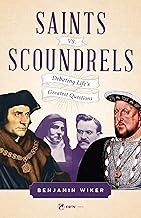
Saints vs. Scoundrels by Dr. Benjamin Wiker examines the impact key ideas have had on history. The author does this by crafting a series of lively dialogs between historic figures — one always Christian, the other always atheistic.
Dr. Wiker holds an MA in religion and a PhD in theological ethics from Vanderbilt University. He is a Senior Fellow at the Veritas Center for Ethics and Public Life at Franciscan University, having taught at multiple Catholic colleges and universities during his long career.
The historic figures Dr. Wiker has chosen to pair with one another are:
- St. Augustine and Jean-Jacques Rousseau;
- St. Francis of Assisi and Niccolo Machiavelli;
- Flannery O’Connor and Ayn Rand;
- St. Thomas More and England’s King Henry VIII; and
- Edith Stein (St. Teresa Benedicta of the Cross) and Friedrich Nietzsche.
In each instance, Dr. Wiker provides insight into the influence which the backgrounds and life choices of these historic figures had on their ideas. More than that, he cuts to the heart of the worldly philosophies espoused and the flaws inherent in them.

 A Lawyer's Prayers