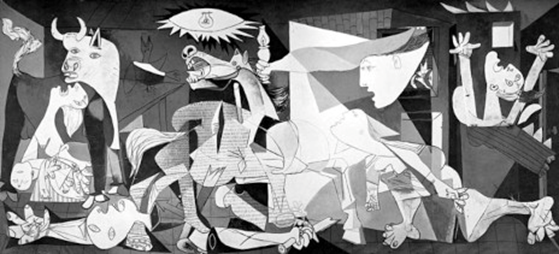
“Guernica” by Pablo Picasso (1937), Museo Reina Sofia, Madrid, Spain, Source https://www.wikiart.org, Copyright © Pablo Picasso
Pablo Picasso painted “Guernica” both to memorialize civilians massacred by German Nazis and Italian Fascists during the strafing and bombing which destroyed a small town by that name during the Spanish Civil War, and to protest the atrocities of war [1][2]. Sadly, Guernica was far from the last such destruction.
Indeed, another genocide is in progress in Sudan…the second there in our lifetimes [3][4A].
Background
A military coup in 1989 destroyed democracy in Sudan, with dictator Omar al-Bashir suspending the constitution and dissolving parliament [4B]. A 30 year reign under strict Sharia Law, countless human rights abuses, and a 22 year civil war followed.
Infrastructure (including the country’s critical oil pipeline) was decimated by scorched earth tactics on all sides during this time. As a result, the country’s economy cratered. All the while, safe haven was given to terrorist organizations like Al-Queda and ISIS.
After the bloodless removal of al-Bashir by the military in 2019, inflation increased by 300%. Another coup followed in 2021. However, the authoritarian structures al-Bashir had put in place remained. A second civil war then broke out in 2023 after a power struggle within the military government.
Humanitarian Crisis and War Crimes
Millions are helpless victims of the world’s largest humanitarian crisis, as the Sudanese Armed Forces (SAF) and paramilitary Rapid Support Forces (RSF) now wrestle over territory. The RSF, it should be noted, is linked to human rights violations such as the systematic murder of men and boys (including infants) on an ethnic basis, and the use of rape as a weapon of war [4C][5]. These are nothing less than war crimes.
Some 24.6 million face starvation; 19 million lack safe water; 12 million have been displaced [6][7A]. The horrors being perpetrated parallel the pattern in Darfur 20 years ago [7B]. As many as 150,000 have already been killed in this second brutal civil war [4D]. Some believe that total may be as high as 400,000 [8]. Read more…

Architectural model of Abrahamic Family House, Abu Dhabi, Author US Embassy Jerusalem, (Creative Commons Attribution 2.0 Generic)
Chrislam is a syncretic religion which combines the teachings and practices of the Abrahamic faiths of Christianity and Islam [1][2A].
Chrislam represents an attempt to bridge the gap between Christianity and Islam. The goal (laudable on its face, but misleading) is to build tolerance, trust, and mutual understanding, in order to foster peace and justice [3].
Historically, Chrislam arose in Nigeria in the 1970s. The God of the Judeo-Christian Bible and the Allah of the Quran are considered to be the same deity by Chrislam.
Consequently, Chrislam recognizes both the Bible and Quran as holy books, and reads from both during services. Both Christian and Muslim holidays are celebrated equally, including Eid al-Adha, a feast commemorating Abraham’s supposed sacrifice of his son Ishmael at Allah’s command (a false claim) [4A].
Syncretic Religions
Other examples of syncretic religions include Santeria which blends West African Yoruba traditions with Catholicism; Rastafarianism which combines Christianity with Ethiopianism and pan-Africanism; and Unitarian Universalism which combines elements of Christianity, Judaism, Buddhism, paganism, humanism, and other belief systems.
The House of One in Berlin has three separate sections under a single roof where worshipers can pray (a church, a mosque, and a synagogue) [4B]. These are linked by a communal room where worshipers and members of the public can come together, and learn more about one another.
The Abrahamic Family House in Abu Dhabi has a comparable arrangement, with a courtyard between buildings. Read more…

Prison Bars, Author Michael Coghlan of Adelaide Australia, (CC BY-SA 2.0 Generic)
The Marshall Project is a non-profit news organization covering the US criminal justice system [1]. Its purpose is to raise awareness about the system’s failings, and promote a more fair, effective, and humane system through journalism.
Death in Custody Data
The Death in Custody Reporting Act (DCRA) mandates that the Dept. of Justice collect information from the states about everyone who dies in law enforcement custody. Before 2000, such data was not systematically tracked by the federal government.
Unfortunately, there are still flaws in the system.
The Marshall Project earlier this year identified by name 681 individuals who died in law enforcement custody, but were not present in the database [2A]. Read more…

“The Witch of Endor – Ghost of Samuel Appearing to Saul” by William Blake (c. 1800), National Gallery of Art, Source https://www.nga.gov/artworks/11498-ghost-samuel-appearing-saul#inscription, (PD)
With Halloween approaching, our thoughts are likely to turn to candied apples, witches, ghosts, and goblins. But the Bible takes witchcraft very seriously as a dark art, a means of contacting the spirit world that unleashes demonic forces.
“You shall not permit a sorceress to live” (Ex. 22: 18).
“‘You shall not eat anything with the blood, nor shall you practice divination or soothsaying’” (Lev. 19: 26).
“‘A man or a woman who is a medium, or who has familiar spirits, shall surely be put to death; they shall stone them with stones. Their blood shall be upon them’” (Lev. 20: 27).
“There shall not be found among you anyone who makes his son or his daughter pass through the fire, or practices witchcraft, or a soothsayer, or one who interprets omens, or a sorcerer” (Deut. 18: 10).
“Now the works of the flesh are evident, which are: adultery, fornication, uncleanness, lewdness, idolatry, sorcery, hatred…and the like; of which I tell you beforehand, just as I also told you in time past, that those who practice such things will not inherit the kingdom of God” (Gal. 5: 19-21).
“But the cowardly, unbelieving, abominable, murderers, sexually immoral, sorcerers, idolaters, and all liars shall have their part in the lake which burns with fire and brimstone, which is the second death” (Rev. 21: 8).
Witchcraft is condemned in both the Old and New Testaments. It was considered on a par with the sin of sacrificing a child to the god Molech in a gruesome ceremony during which the child was burned alive. That correlation has not changed. Read more…
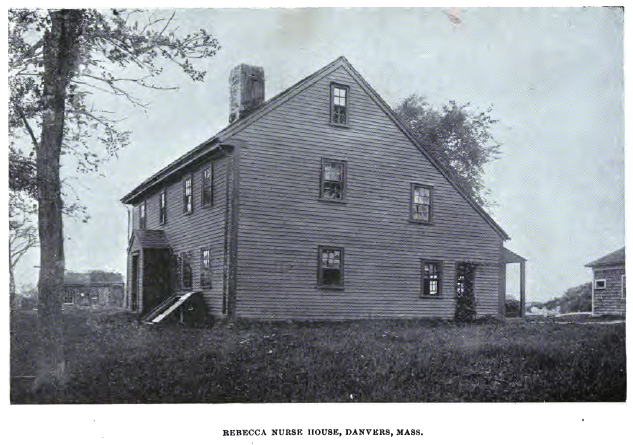
Rebecca Nurse House, Danvers, MA, Source “Witchcraft Illustrated” by Henrietta D. Kimball, Geo. A. Kimball, Publisher, Boston, 1892, Author Henrietta D. Kimball (PD)
WARNING: Graphic Images
Historically speaking, widespread witch hunts took place between 1500 AD and 1650 AD [1A][2][3]. Across Europe, an estimated 100,000 people (the vast majority of them women, most over the age of 40) were tried for the crime of witchcraft, with some 50,000 convicted and brutally executed [1B][4]. Common methods included hanging, burning at the stake, drowning, and pressing to death with heavy stones [5].
Fortune Telling and Herbal Medicine
A belief in the occult had existed since antiquity. Magic was an attempt to harness unseen forces. Astrology, palm reading, and divination were popular in the Middle Ages [1D]. Fortune telling was common as were binding spells dealing with relationships [1E].
At a time when medicine was in its infancy, charms were often combined with prayers and herbal remedies, in a genuine (if misguided) attempt to help the sick or infertile.
The Little Ice Age
“Social and economic problems, changes to the legal system, and religious upheaval all served as necessary preconditions for the age of witch-hunts [1C].”
Perhaps not coincidentally, the witch hunts occurred during the heart of what is known as the “Little Ice Age” (c. 1300 AD – 1850 AD), when cooling temperatures in Europe and elsewhere impacted crops, resulting in famines, food riots, social upheaval, and mass migrations [6].
Confessions by Torture
In the face of these challenges, concern developed that Satan might recruit individuals to undermine society. Witchcraft was consequently outlawed.
Tragically, that occurred just as the secular legal system was placing greater emphasis on confessions, often gained through torture [1F]. The illicit motives of informers (revenge, jealousy, greed, etc.) and misogynistic tendencies of judges were rarely taken into account. Read more…
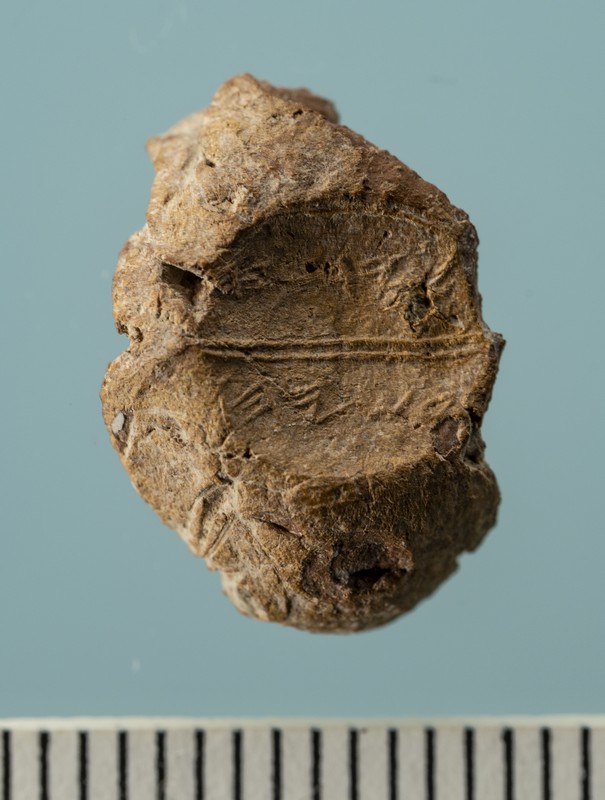
Clay seal from the Temple Mount, image courtesy of Temple Mount Sifting Project https://tmsifting.org/en/2025/07/30/asayahu/
Earlier this year – on the eve of the Jewish fast day of the 17th of Tammuz which commemorates the breach of Jerusalem’s walls by King Nebuchadnezzar, and begins the annual three-week mourning period for the destruction of the First and Second Temples – excavations led by the Temple Mount Sifting Project in Jerusalem uncovered a small clay seal with the name of a biblical figure [1A][2A].
As mentioned elsewhere on this blog, the Temple Mount Sifting Project is an archaeological project to recover and preserve historic artifacts from the 9000 tons of material discarded by the Waqf, the Islamic organization which has control of the Temple Mount [3].
In ancient times, clay seals were used as a means of identification on storage vessels and other items to prevent misappropriation. Such seals were commonly bound to goods like wine, honey, and oil.
The style of writing on this particular seal dates it to the First Temple Period, the late 7th Century BC to early 6th Century BC, directly countering the Islamic allegation (“temple denial”) that no Jewish temple ever stood on the Temple Mount.
Researchers have deciphered the name stamped into the clay which reads: “Belonging to Yed[a‛]yah (son of) Asayahu.” Experts believe the seal belonged to Yeda‛yah, the son of Asayahu, one of King Josiah of Judah’s senior officials. Astoundingly, the clay seal retains a clear fingerprint, presumably left by the individual who once owned it. Read more…

Cross in Silhouette, Photograph taken in Sri Lanka by AntanO, (CC BY-SA 3.0 Unported)
“We can ignore even pleasure. But pain insists upon being attended to. God whispers to us in our pleasures, speaks in our conscience, but shouts in our pains: it is His megaphone to rouse a deaf world.”
–CS Lewis in “The Problem of Pain”
Our pain and suffering may be so great that they change our lives forever. We may be forced to abandon a career we valued highly, may no longer be able to complete household tasks that once came easily. We may lose a loved one who was dearer to us than life.
Hope
“When we become aware that we do not have to escape our pains, but that we can mobilize them into a common search for life, those very pains are transformed from expressions of despair into signs of hope.”
–Henri Nouwen in “The Wounded Healer”
Though Christians may grieve such eventualities, we do not grieve as the world does without hope. We know that our life is in Christ. Our identity, our purpose, and our Salvation derive from our relationship with Him. And Christ never abandons us (Phil. 4: 19). Read more…

Detail from “The Last Judgment” by Michelangelo Buonarroti (1535-1541), Sistine Chapel, Rome, Source/Photographer The Yorck Project (2002) 10.000 Meisterwerke der Malerei (DVD-ROM), distributed by DIRECTMEDIA Publishing GmbH. ISBN: 3936122202 (PD)
“…For we shall all stand before the judgment seat of Christ…So then each of us shall give account of himself to God” (Rom 14: 10, 12).
Pain, suffering, and the possibility of death are sobering. Both believers and non-believers will face judgment. Not, however, in the same way. Christians will be judged by Christ with their works evaluated for rewards, rather than condemnation (John 3: 16).
Sin and Death
Nonetheless, contemplating the finality of life – the fact our days here are numbered – is a key to wisdom (Ps. 90: 12). Has our time been well spent? Do we need to reorder our priorities?
Such a review of our lives is bound to identify areas where we have failed to live up to God’s standards. Pain and suffering can actually help us focus, in this regard.
“Cancer is designed to destroy the appetite for sin. Pride, greed, lust, hatred, unforgiveness, impatience, laziness, procrastination — all these are the adversaries that cancer is meant to attack…All these things are worse enemies than cancer…Let the presence of eternity make the sins of time look as futile as they really are.”
–John Piper from “Don’t Waste Your Cancer” https://www.desiringgod.org/articles/dont-waste-your-cancer
Loss v. Triumph
We are likely to feel enormous relief when our pain abates or we recover from a long illness. Triumphant perhaps. But Paul was able to write:
“Yet indeed I also count all things loss for the excellence of the knowledge of Christ Jesus my Lord, for whom I have suffered the loss of all things, and count them as rubbish, that I may gain” (Phil. 3: 8).
The “all things” referred to include health and earthly happiness. For Paul, triumph was found in Christ. So, too, it must be for us.
“Cancer does not win if you die. It wins if you fail to cherish Christ. God’s design is to wean you off the breast of the world and feast you on the sufficiency of Christ.”
–John Piper from “Don’t Waste Your Cancer” https://www.desiringgod.org/articles/dont-waste-your-cancer.
This series will conclude next week with Part 4 – Transformation
READERS CAN FIND MY VIEWS ON ABUSE AND ABUSE-RELATED ISSUES AT ANNA WALDHERR A Voice Reclaimed, Surviving Child Abuse
https://avoicereclaimed.com
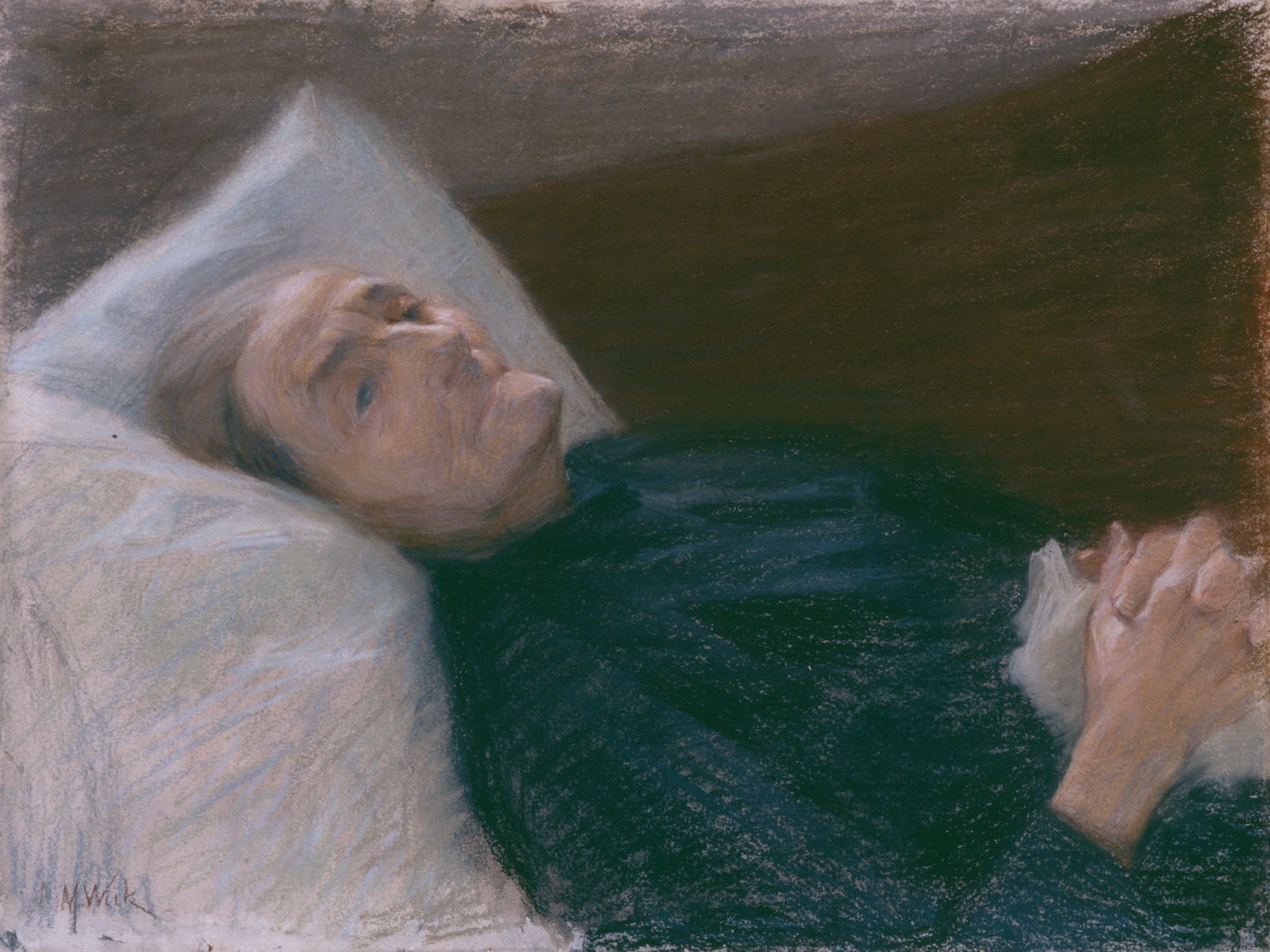
“Old Woman in Her Sickbed” by Maria Wiik (1895-1896), Gosta Serlachius Fine Arts Foundation, Finland, Source/Photographer https://serlachius.fi/suunnittele-vierailusi/koululaisohjelmat/taidekoulu/miten-taideteos-syntyy/ (PD)
Pain and suffering frequently create a space in our lives, a pause. We may no longer be able – at least for the time being – to continue our normal pursuits. Without work or other usual activities to fill our days, we are left with time on our hands.
Redemptive Prayer
“No suffering [that we offer to Christ] is wasted! As clouds carry rain over mountains, So your patience with cancer, Your resignation to withered limbs, Rebounds to some soul in Ceylon And helps a missionary in Seoul.”
–Archbishop Fulton J. Sheen, excerpt from “Complicity”
While we may feel helpless, useless on our sickbeds, this is a time in our lives we can be most productive. We can pray powerfully for loved ones (saved and unsaved), for the poor and disadvantaged, for missions, for the persecuted church, and countless other worthwhile causes – joining our suffering to Christ’s.
“Through prayer we can carry in our heart all human pain and sorrow, all conflicts and agonies, all torture and war, all hunger, loneliness and misery, not because of some great psychological or emotional capacity, but because God’s heart has become one with ours.”
–Henri Nouwen in “The Way of the Heart”
Our pain and suffering are not diminished by such prayers. But they become meaningful, and consequently more bearable.
Of course, if we have sufficient concentration, we can spend time in the Word. Not only is there great comfort to be found in Scripture. It strengthens our faith. The people who know their God can stand strong despite Satan’s opposition, whatever form it takes (Dan. 11: 32). Read more…

“The Eternal Father” by Paolo Veronese (c. 1558), Gallerie dell’Accademia, Venice, Source/Photographer https://www.artisangallery.es/cuadro-el-padre-eterno-164.html (PD)
“Our glory is hidden in our pain, if we allow God to bring the gift of Himself in our experience of it.”
–Henri Nouwen from “Turn My Mourning into Dancing”
Few of us welcome pain or suffering. They can drive us away from God…or toward Him. So it is worth considering them in some depth.
Scripture teaches us that our pain can be redemptive (Col. 1: 24); that it deepens our hearts (2 Cor. 1: 3-4); that it unites us with Christ (Rom. 8: 17; 2 Cor. 1: 5); that it is, in fact, a calling (1 Peter 2: 21); and that it ultimately transforms us (Jer. 9: 7; Zech. 13: 9; Mal. 3:3; James 1: 2-4).
God’s Sovereignty
Before we can examine any of these outcomes, we must first acknowledge that our pain and suffering are part of God’s plan. That fact can be difficult to swallow.
In his novel Sirens of Titan, Kurt Vonnegut, Jr. set as one of the tenets of the Church of God the Utterly Indifferent:
“Luck is not the hand of God. It is the way the wind swirls and the dust settles eons after God has passed by.”
That thought may actually be a consolation to those who feel God is cruel to allow our suffering. But Christians know that God is love personified.
“What God permits, He permits for a reason. And that reason is His design. If God foresees molecular developments becoming cancer, He can stop it or not. If He does not, He has a purpose…So, when he [Satan] strikes Job with boils (Job 2: 7), Job attributes it ultimately to God (Job 2: 10) — and the inspired writer agrees: ‘They…comforted him for all the evil that the Lord had brought upon him’ (Job 42: 11).”
–John Piper from “Don’t Waste Your Cancer” https://www.desiringgod.org/articles/dont-waste-your-cancer

 A Lawyer's Prayers