
Kids, Adults and Computers at Hack4Kids hack4kids.lu, Author Alexandre Dulaunoy of Less Bulles, Belgium, Source Flickr.com (CC BY-SA 2.0 Generic)
- Your phone service will not allow you to access voicemail, despite a PIN.
- Automatic updates to your computer routinely change the font and format of familiar programs – often removing or altering features you find helpful.
- Your printer randomly repeats print jobs already completed, and will not allow you to stop a job in progress (wasting ink, paper, and time).
- Your bank texts an access code to a cell phone you do not own, then disables your ATM card.
- Your social security number is for sale on the dark web.
Welcome to the modern world. Little wonder that we sometimes snap at unoffending bank tellers or the tech support personnel trying to be of assistance.
Technology, for all it has to offer, can sometimes be a challenge for those of us of a certain age. Change – especially at the rate it is occurring these days – can feel threatening, and be difficult to absorb.
What does not change is human nature. We fear the unknown. We fear aging. We fear loss of control. Read more…
READERS CAN FIND MY VIEWS ON ABUSE AND ABUSE-RELATED ISSUES AT ANNA WALDHERR A Voice Reclaimed, Surviving Child Abuse
https://avoicereclaimed.com
Kristina David has an excellent article in the San Diego Union-Tribune which identifies both the factors that lead many to join hate groups, and the factors that can help them turn away from hate [1].
Not surprisingly, trauma, rejection, and isolation are among the factors favoring radicalization. Hate groups like the Ku Klux Klan can provide participants with a real, if distorted, sense of identity and community, as well as a target for their negative emotions.
Moral arguments may be less effective in countering this appeal than dissatisfaction with the direction a particular group is taking, or infighting among its members. Parenthood may actually cause members to reassess their participation.
Disengagement from the group is an essential step. Christian Picciolini, a former skinhead and the founder of Life After Hate, emphasizes forgiveness, as well.
“And we know that all things work together for good to those who love God, to those who are the called according to His purpose” (Rom. 8: 28).
Christians know that God can use suffering, trials, tragedy, and heartache for His glory and their good. In a world filled with hate, Christ offers hope and redemption.
—
[1] San Diego Union-Tribune, “Cure for hate: Former skinheads recall what turned them around” by Kristina David, 5/12/19, https://www.sandiegouniontribune.com/news/public-safety/story/2019-05-11/cure-for-hate-former-skinheads.
READERS CAN FIND MY VIEWS ON ABUSE AND ABUSE-RELATED ISSUES AT ANNA WALDHERR A Voice Reclaimed, Surviving Child Abuse
https://avoicereclaimed.com

Young girl with sign at Women’s March on Washington/Sister March in Cincinnati, OH, Author DRieselman (CC BY-SA 4.0 International)
“Now I would remind you, brothers, of the gospel I preached to you…For I delivered to you as of first importance what I also received that Christ died for our sins in accordance with the Scriptures, that he was buried, that he was raised on the third day in accordance with the Scriptures…” (1 Cor. 15: 1, 3-4).
This post is drawn from an essay titled “Putting First Things First” by Thaddeus Williams, Assoc. Prof. of Theology for Talbot School of Theology at Biola University. Williams is, also, on the affiliate faculty at Trinity Law School. He discusses the importance of social justice and its distortion in today’s society.
Biblical Command
Williams acknowledges the importance of social justice. However, he makes clear from the outset that the gospel is of first or primary importance.
“God does not suggest, He commands that we ‘Do justice and righteousness, and deliver from the hand of the oppressor him who has been robbed’ (Jer. 22: 3). Jesus launched his public ministry with the stated mission to ‘proclaim good news to the poor…liberty to the captives and recovering of sight to the blind, to set at liberty those who are oppressed’ (Luke 4: 18, quoting Isa. 61: 1, 2). ‘Seek justice’ (Isa. 1: 17) is a clarion call of Scripture…”
True Meaning of Social Justice
Williams next illustrates the true meaning of social justice, i.e. its meaning from a biblical perspective.
“The term [social justice] could be used to describe what our ancient brothers and sisters did to rescue and adopt those precious little image-bearers who had been discarded like trash at the literal human dumps outside many Roman cities. The same two words could describe [the efforts of] William Wilberforce…to topple slavery in the UK, along with Frederick Douglass, Harriet Tubman, and others in the US. ‘Social justice’ could describe Bonhoeffer and the Confessing Church’s efforts to subvert the Third Reich…”
“Nowadays, the same…two words could even describe Christian efforts to abolish human trafficking, work with the inner city poor, invest in micro-loans to help the destitute in the developing world, build hospitals and orphanages, upend racism, and so much more…”
Distortion of Social Justice
Williams explains that social justice has been greatly distorted by our society.
“Over the last couple decades…[however] ‘social justice’ has taken on an extremely charged ideological and political meaning. ‘Social justice’ became a…banner over movements like Antifa, which sees physical violence against those who think differently as ‘both ethically justifiable and strategically effective’… ‘Social justice’ is the banner waved by a disproportionate ratio of professors in humanities and social science departments around the nation where the neo-Marxist oppressor vs. oppressed narrative…[has] been injected into the very definition of the term.”

Chandelier Ballroom at Lechuguilla Cave, New Mexico, Author Dave Bunnell (CC BY-SA 2.5 Generic)
Extending over 120 miles, Lechuguilla in Carlsbad, NM is considered one the most beautiful caves on earth [1].
Unlike most caves, Lechuguilla was formed from the bottom up, rather than the top down. Sulfuric acid dissolved much of the limestone comprising the walls of the cave, leaving behind intricate and unique mineral formations which resemble flowers, crystals, lace, and pearls [2].
The so called “Chandelier Ballroom” at Lechuguilla contains the largest known gypsum stalactites anywhere. Some of these astonishing structures are as long as 18′ or three times the height of a man. Extremophile bacteria shimmer within the rock. Read more…

“Job” by Leon Bonnat (1880), Source https://scribouillart.wordpress.com (PD-Art, PD-Old)
The list below is drawn from the book When God Weeps — Why Our Sufferings Matter to the Almighty by Joni Eareckson Tada and Steven Estes. Joni speaks with authority about suffering, having been rendered paraplegic by a diving accident at the age of 18.
Suffering is used to increase our awareness of the sustaining power of God to whom we owe our sustenance. “Blessed be the Lord, Who daily loads us with benefits” (Ps. 68: 19). “…that I may know Him and the power of His resurrection, and the fellowship of His sufferings, being conformed to His death…” (Phil. 3: 10).
God uses suffering to refine, perfect, strengthen, and keep us from falling. “Who keeps our soul among the living, And does not allow our feet to be moved” (Ps. 66: 9). “For it was fitting for Him, for whom are all things and by whom are all things, in bringing many sons to glory, to make the captain of their salvation perfect through sufferings” (Heb. 2: 10).
Suffering allows the life of Christ to be manifested in our mortal flesh. “We are hard-pressed on every side, yet not crushed; we are perplexed, but not in despair; persecuted, but not forsaken; struck down, but not destroyed — always carrying about in the body the dying of the Lord Jesus, that the life of Jesus also may be manifested in our body” ( 2 Cor. 4: 8-10).
Suffering bankrupts us, making us dependent upon God. “And He said to me, ‘My grace is sufficient for you, for My strength is made perfect in weakness‘ ”(1 Cor. 12: 9).
Suffering teaches us humility. “And lest I should be exalted above measure…a thorn in the flesh was given to me…” (2 Cor. 12: 7).
Suffering imparts the mind of Christ. “Let this mind be in you which was also in Christ Jesus, who, being in the form of God…made Himself of no reputation, taking the form of a bondservant, and coming in the likeness of men. And being found in appearance as a man, He humbled Himself and became obedient to the point of death, even the death of the cross” (Phil. 2: 5-8).
Suffering teaches us that God is more concerned about character than comfort. “…we also glory in tribulations, knowing that tribulation produces perseverance; and perseverance, character; and character, hope” (Rom. 5: 3-4).
Suffering teaches us that the greatest good of the Christian life is not absence of pain, but…[resemblance to Christ]. “And we know that all things work together for good to those who love God, to those who are the called according to His purpose. For whom He foreknew, He also predestined to be conformed to the image of His Son…” (Rom. 8: 28-29).
Suffering can be a chastisement from God for sin and rebellion. “Fools, because of their transgression, And because of their iniquities, were afflicted” (Ps. 107: 17).
Obedience and self-control are from suffering. “…though He was a Son, yet He learned obedience by the things which He suffered” (Heb. 5: 8). “Before I was afflicted I went astray, But now I keep Your word” (Ps. 119: 67). “My brethren, count it all joy when you fall into various trials, knowing that the testing of your faith produces patience” (James 1: 2-3). Read more…

Broderick Crawford as Willie Stark in “All the King’s Men”, Author Columbia Pictures, Source “All the King’s Men (1949) – Trailer” on https://www.youtube.com/, (PD as published w/o a copyright notice)
In the 1949 drama “All the King’s Men” Broderick Crawford portrays a country lawyer who initially attempts to fight corruption, then thrives on it.
Having abandoned the ideals he publicly espouses, Willie Stark adopts the guise of a populist, and champion of the underdog. Invoking God in his speeches, Stark does build roads, schools, hospitals, and dams – all in name of the people, but for his own political and financial benefit.
The Kingfish
The film was based on the novel by Robert Penn Warren, and inspired by the career of the notorious demagogue, Huey P. Long a/k/a “The Kingfish”. Governor of Louisiana from 1928-1932, Long served in the US Senate from 1932 until his assassination in 1935.
Genuine improvements were made in infrastructure, education, and health care during Long’s tenure. But he blurred the lines between federal and state authority, establishing an authoritarian regime dependent on patronage, election fraud, voter intimidation, and graft.
Nonetheless, at the time of his death Long had 25 million radio listeners, and was receiving as many as 60,000 letters a week from his supporters.
Recognizing a Demagogue
In the film, most of Willie Stark’s followers overlook (or do not recognize) his flaws. Those closest to Willie, however, see him for what he is. The situation with Huey P. Long was much the same.
The term “demagogue” is defined by Oxford Dictionaries as “a political leader who seeks support by appealing to the desires and prejudices of ordinary people rather than by using rational argument.” Pres. Donald Trump all too clearly fits this definition [1][2].
The question arises whether American voters have the capacity to recognize a demagogue, and whether the rest of our elected representatives have the courage to oppose one. Read more…
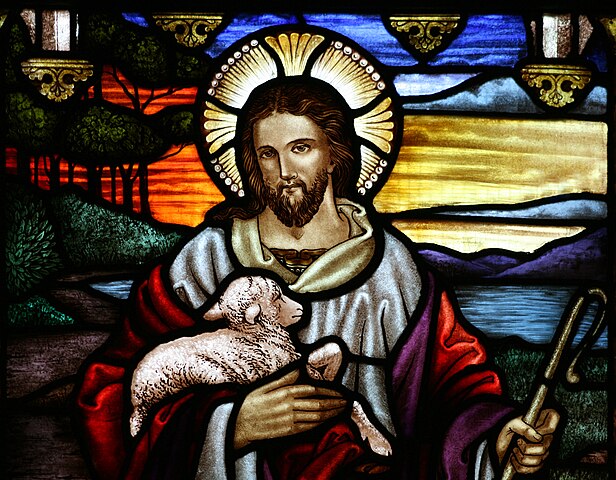
Stained glass depiction by Alfred Handel of Jesus as the Good Shepherd, St. John the Baptist Anglican Church, New South Wales, Author Toby Hudson (CC BY-SA 3.0 Unported)
Our culture values leadership. Leaders, we believe, are brave and independent. We prefer to imagine ourselves that way.
Social media encourages this fantasy. Our readers are deliberately characterized as “followers”. We pursue such followers by all possible means, endlessly tracking the latest totals. But we do not enjoy being viewed as followers, ourselves.
The reality, of course, is that most human beings are followers. This is not a mark of shame. Presumably, we were engineered to follow for a purpose. What matters is the leader we choose.
“ ‘And he who does not take his cross and follow after Me is not worthy of Me’ ” (Matt. 10: 38).
Christians are invited to follow in the footsteps of Christ. That is a call to suffering, not worldly glory. But it is the highest calling of all.
“I, therefore, the prisoner of the Lord, beseech you to walk worthy of the calling with which you were called, with all lowliness and gentleness, with longsuffering, bearing with one another in love, endeavoring to keep the unity of the Spirit in the bond of peace” (Eph. 4: 1-3).
The qualities involved are humility, gentleness, patience, and compassion. For the most part, not qualities our society admires or rewards. Read more…
“But whoever has this world’s goods, and sees his brother in need, and shuts up his heart from him, how does the love of God abide in him? My little children, let us not love in word or in tongue, but in deed and in truth” (1 John 3: 17-18).
Estimates are that as many as 1.3 to 1.7 million young people experience one night of homelessness a year, while 550,000 are homeless for a week or more [1].
—
[1] National Network for Youth (NN4Y), “How Many Homeless Youth Are In America?”, https://www.nn4youth.org/learn/how-many-homeless/.
READERS CAN FIND MY VIEWS ON ABUSE AND ABUSE-RELATED ISSUES AT ANNA WALDHERR A Voice Reclaimed, Surviving Child Abuse
https://avoicereclaimed.com

Suleymaniye Mosque, Turkey, Source http://www.flickr.com, Author Jorge Lascar (CCC BY-SA 2.0 Generic)
Christians in America take for granted the freedom they have to practice their religion. Elsewhere, however, those who leave Islam for Christianity often do so at the risk of their lives [1].
“Growing up in…Bangladesh, Fedu’s life was permeated by Islam. His father was an imam…Fedu studied in an Islamic school, and…[himself] became a Muslim scholar and imam…[Then a Christian friend] gave Fedu a Bible…to read…Fedu at first dismissed the gift…but eventually he started reading…[and] comparing its teachings with those of the Quran. The more he studied the two books, the more he began to doubt Islam…After becoming a follower of Christ, Fedu continued teaching at his mosque…When it came to God’s prophets, he taught that Jesus was above all and that He alone is holy. Members of the mosque became increasingly aware of his Christian views, and one day…someone found Christian literature at his home…‘When they noticed I love Jesus and not Muhammad, they said my job is done,’ Fedu recalled…A group of angry Muslims destroyed Fedu’s pharmacy…Two of his brothers beat him for leaving Islam…[But] ‘I am going out and sharing my faith,’ he said.”
-“Friendship and a New Book”, Voice of the Martyrs Magazine, January 2019

 A Lawyer's Prayers