
Suicide prevention sign at Golden Gate Bridge, Author Tony Webster (CC BY-SA 4.0 International)
- 22.5 million American adults have been diagnosed with cancer; 1.7 million will be added to that number this year alone [1].
- Over 16 million Americans suffer from depression. PTSD affects another 7.7 million [2].
- More than 5 million Americans live with Alzheimer’s Disease [3].
- 500,000 American adults and children have cerebral palsy [4].
- Approximately 60,000 Americans are diagnosed with Parkinson’s Disease, annually [5].
- Over 20,000 Americans live with Lou Gehrig’s Disease (ALS). Some 15 new cases are diagnosed daily [6].
Millions of Americans either suffer from, or serve as caregivers for loved ones with, a chronic illness.
There are those who argue that this is pointless and unnecessary suffering – physical and mental – which suicide could easily eliminate. The suicide rate in the United States is, in fact, on the rise [7]. Designer, Kate Spade, and celebrity chef, Anthony Bourdain, were two recent examples.
Yet many sufferers choose not to take that path. Why?
The Right to Take Our Lives
“There is but one truly serious philosophical problem, and that is suicide.”
-Albert Camus
The German philosopher, Arthur Schopenhauer, argued that man has an unassailable right to his own person. Christians, however, take a different view. We believe that title to our hearts, minds, and bodies belongs to God.
We may despair in the lonely hours of the night. Christians are not immune from that human tendency.
The thought of suicide may – as Friedrich Nietzsche observed – be a consolation at such moments. Suicide is, however, a poor solution to the dilemma of existence in a flawed world.
A So Called “Noble” Choice
“To be, or not to be? That is the question – Whether ’tis nobler in the mind to suffer The slings and arrows of outrageous fortune, Or to take arms against a sea of troubles, And, by opposing, end them?”
-William Shakespeare, Hamlet
Shakespeare posed the now famous question of whether it is “nobler” to endure suffering or end it.
Our society sees no value in suffering; tends to view suffering, itself, as immoral. We may come to despise this flesh, and the ailments to which it is prone. But to equate death with virtue is to mask reality.
Life is a priceless gift. Human beings have value, whether they are physically and mentally “perfect” or not.
Anger at God
“Suicide is man’s way of telling God, ‘You can’t fire me – I quit.’ ”
-Bill Maher, comedian
The novelist, Honore de Balzac, called suicide a “suitable key to the mystery of life for a skeptical society.” Certainly, those who pursue it – believers and non-believers alike – will rapidly find themselves face to face with an Almighty God, all questions about His existence resolved.
Admittedly, anger may figure in the decision to commit suicide. We may feel we have reached the limits of our endurance, and blame God for the trials which have besieged us.
Certainly, illness can deprive us of dignity. It need not, however, deprive us of hope. Read more…

Children threshing corn during school hours (1915), Library of Congress National Child Labor Committee Collection (Digital ID nclc.00246), Author Hine, Lewis Wickes (PD, life plus 70)
“Agriculture is one of the most dangerous industries in the nation. Each year, more than 2 million youth under the age of 20 are exposed to farm-related safety hazards. As a result, a significant number of young people are killed, injured or permanently disabled on farms in the United States.”
-OSHA [1]
About 13.4 million children live in rural America [2].
As a group, rural children have somewhat lower rates of poverty than their urban cousins [3]. The median income of rural households is only slightly less than that of urban households ($52,386 as compared with $54,296). By comparison, a higher percentage of rural homes are mortgage-free (44% as compared with 32.3%).
However, the Fair Labor Standards Act allows farms to employ children as young as 12 y.o. with the written permission of a parent (or if a parent is employed on the same farm) [4A].
Child Labor on the Farm
The Child Labor Coalition of the National Consumers League estimates there are 300,000 to 400,000 child workers in U.S. agriculture. The highly lucrative tobacco industry, in particular, benefits from this.
Children of any age can work on the farm of a parent or guardian [4B]. Those 12 y.o. and younger need not be paid minimum wage, but are not permitted to work during the school day. Those 16 y.o. may work for an unlimited number of hours, even at tasks considered hazardous, like operating a hay baler.
Unfortunately, enforcement of these standards is largely absent. Violations are not closely monitored and rarely penalized. Children as young as 8 y.o. and 10 y.o. can be found working beside men in their 30s and 40s. Read more…

Face of Jesus in art (PD-Art, Old-100)
In architecture, He planned all things before time began (Isaiah 46: 10; 2 Timothy 1: 9), and is the architect of the city of God (Hebrews 11: 10).
In astronomy, He is the Dayspring (Luke 1: 78), the Bright and Morning Star (Revelation 22: 16).
In banking, He is the Redeemer (Job 19: 25), who forgave our sin debt (Matthew 6: 12).
In biology, He is the Son of Mary (Mark 6: 3), and the only begotten Son of God (John 3: 16), born without the normal conception (Luke 1: 34-35).
In brewing, He turned water into wine (John 2: 1-11).
In cartography, He is the way (John 14: 6).
In chemistry, He is living water (John 4: 10).
In economics, He disproved the law of diminishing returns by feeding 5000 with five loaves and two fishes (Matthew 14: 19-21).
In education, He is called Rabbi (Mark 11: 21), Rabboni (John 20: 16), and Teacher (John 3: 2).
In electronics, He is the light of the world (John 8: 12).
In engineering, He is the Maker (Psalm 121: 2; Psalm 146: 6; John 1: 3), who stretched out the heavens (Isaiah 48: 13) and laid the foundations of the earth (Job 38: 4).
In equestrianism, He is the rider on the white horse (Revelation 19: 11).
In fire rescue, He is the Savior (John 4: 42), who rescued us from hell.
In floristry, He is the rose of Sharon (Song of Solomon 2; 1); and the lily of the valleys (Song of Solomon 2: 1).
In funeral science, He is the Resurrection and the Life (John 11: 25).
In gemology, He is the pearl of great price (Matthew 13: 45-46).
In geology, He is the Rock (1 Corinthians 10: 4).
In government, He is called King of kings and Lord of lords (1 Timothy 6: 15), the Prince of Peace (Isaiah 9: 6).
In herding, He is the Good Shepherd (John 10: 11), and the Lamb of God, who takes away the sins of the world (John 1: 29).
In history, He is the Alpha and Omega, the beginning and end (Revelation 22: 13).
In horticulture, He is the Root (Isaiah 11: 10), the Branch (Isaiah 11: 1), and the true vine (John 15: 1).
In law, He is our judge (Acts 10: 42), our mediator (1 Timothy 2: 5), the Faithful and True Witness (Revelation 3: 14), and our greatest Advocate (1 John 2: 1).
In literature, He is the Word (John 1: 1), the author and finisher of our faith (Hebrews 12: 2).
In masonry, He is the chief cornerstone (Ephesians 2: 20).
In medicine, He is the Healer (Exodus 15: 26), who cured the sick and blind without drugs or surgery.
In nutrition, He is the bread of life, and none who come to Him will ever hunger again (John 6: 35).
In philosophy, He is the truth (John 14: 6).
In physics, He is the Creator (Isaiah 40: 28; Colossians 1: 16), who brought the world into existence, then disproved the law of gravity by ascending into heaven (Acts 1: 9).
In prophecy, He is Immanuel (Matthew 1: 23), the Messiah (Daniel 9: 25).
In psychology, He is the Wonderful Counselor (Isaiah 9: 6).
In religion, He is the Beloved (Ephesians 1: 6), the bridegroom (Matthew 9: 15), the head of the church (Ephesians 5: 23), and the High Priest (Hebrews 6: 20).
In seafaring, He is the anchor of our souls (Hebrews 6: 19).
In theology, He is the Holy One (Mark 1: 24), the Son of the Living God (Matthew 16: 16); no one comes to the Father except through Him (John 14: 6).
In woodworking, He is the carpenter (Mark 6: 3), and the door (John 10:9).
In zoology, He is the Lion of the tribe of Judah (Revelation 5: 5).
The greatest man who ever lived, He made Himself the Servant to all (Matthew 12: 18, Mark 9: 35).
He had no army, yet was feared by kings.
He won no military battles, yet conquered the world (John 16: 33).
He committed no crime (Luke 23: 4), yet was crucified.
He was buried in a tomb, yet lives today (Job 19: 25)!
He is Jesus Christ!
– Author Unknown
Originally posted 1/26/14
READERS CAN FIND MY VIEWS ON ABUSE AND ABUSE-RELATED ISSUES AT ANNA WALDHERR A Voice Reclaimed, Surviving Child Abuse
https://avoicereclaimed.com

Photo: Poverty in India (CC0 Public Domain)
“Mudlarks” was a 19th Century term for street children who survived by scavenging amid the mud along the River Thames. A British film titled The Mudlark (1950) told the fictional tale of how one such child – a boy named Wheeler – supposedly found his way into Queen Victoria’s presence [1].
The speech below is attributed to Prime Minister Benjamin Disraeli in the film. In view of prevailing conditions today, the words retain their poignancy and power.
Some 15 million children still live in poverty in the United States, a billion worldwide [2][3]. Two million children die annually from preventable diseases like diarrhea and pneumonia because of a lack of basic medical care. Over 44 million have been aborted legally in the United States alone [4][5].
“The House of Commons may be a strange place to discuss the conduct of a mudlark. But it is perhaps the best of all places to examine certain aspects of this particular mudlark’s conduct. For here they are placed not only before the honorable members but also before the entire nation.
Now I confess I am as puzzled as anyone by some of the mystery of young Wheeler. How did he manage to reach the age of 10 in the face of all that we did to prevent it?
I ask you to think how hard society tried to kill him. It laid an ambush for him at his birth, surrounding his cradle with rats and vermin. It sent gases…to pollute the air he breathed, tried to poison his mother’s milk through her drinking water, but only succeeded in poisoning his mother. She died of typhus before he could walk, according to the police investigation.
As there is no record of a father, his government was spared the necessity of a second murder in the same family.
So now that he was an orphan – alone, defenseless and entirely at the mercy of his country – it went further. It attacked his spirit and his soul. It taught him nothing. It withheld the word of God from him. In the end, it sent him into the Thames to be a mudlark – barefoot and clothed in the merest rags, subject daily to cold and damp and fever – and in the warrens and lanes of the waterfront exposed him to the worst influences of immorality and evil, and most final of all it denied him hope.
Now as a result of this indifference and cruelty there seems to have developed in this small boy an unnatural attitude toward England. Unnatural because in spite of all that it has done to him, he seems to love it.
Sylvester found himself in a situation often faced by the clients of Christian Legal Clinics of Philadelphia. Though he had done nothing wrong, Sylvester was being sued and did not know what to do. Without legal help, he could have lost his family’s home. The video above tells the full story.
Though I am not affiliated with Christian Legal Clinics of Philadelphia (and derive no benefit from donations), I was one of the group of Christian attorneys who founded the predecessor organization.
Thousands of hours of legal assistance have been provided to clients free of charge, in the years that have passed. Attorneys volunteer their time in destitute areas of Philadelphia for the love of God and love of neighbor.
But Christian Legal Clinics of Philadelphia does more than just provide legal assistance. Host organizations like the Salvation Army address the food, clothing, and shelter needs of clients. All staff share the Gospel.
By giving to Christian Legal Clinics of Philadelphia you can make a real difference in the lives of the poor. Please, consider donating at https://www.clcphila.org/get-involved/donation/.
Whether or not you are able to give, keep the men and women of this ministry in your prayers. It remains dear to my heart.
May God bless you.
READERS CAN FIND MY VIEWS ON ABUSE AND ABUSE-RELATED ISSUES AT ANNA WALDHERR A Voice Reclaimed, Surviving Child Abuse
https://avoicereclaimed.com
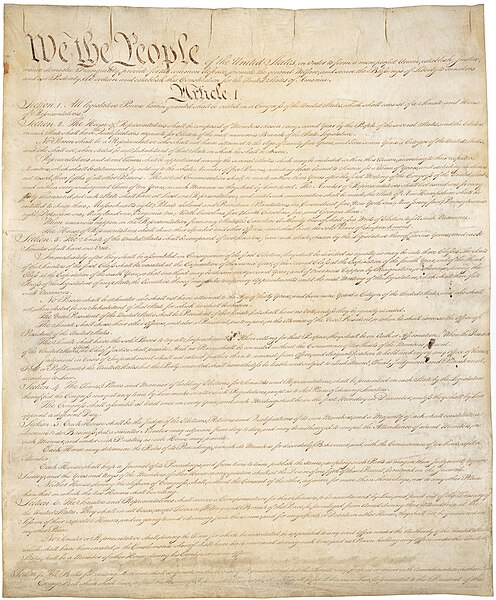
US Constitution, National Archives and Records Administration (NAID 1667751) (PD as work product of federal govt.)
Edward Gibbon authored a monumental work titled The History of the Decline and Fall of the Roman Empire. Coincidentally, Gibbon’s work was published around the time the United States was founded.
Like the United States, Rome was initially a republic – a state in which ultimate power is held by the people through their elected representatives, with a president rather than a monarch at its head.
Though we often use the terms interchangeably, a republic is distinguished from a democracy by the limits placed on government by law. In a republic, a constitution “protects certain inalienable rights that cannot be taken away by the government, even if it has been elected by a majority of voters. In a ‘pure democracy’, the majority is not restrained in this way and can impose its will on the minority [1].”
The Rule of Law
“If men were angels, no government would be necessary. In framing a government which is to be administered by men over men, the great difficulty lies in this: you must first enable the government to control the governed; and in the next place oblige it to control itself.”
-James Madison, Federalist Paper No. 51 (1788)
From the beginning, the United States was conceived as a nation of laws. The rule of law is firmly established in our Constitution and Bill of Rights [2]. The arbitrary exercise of power by an executive is, in other words, subordinate to well-defined laws. All people and institutions are subject to and held accountable by laws that are (or should be) fairly applied and enforced [3].
Democracy in Jeopardy
Democracy, itself, is jeopardized when the rule of law is undermined.
This can happen in many ways, most especially when checks on executive power are weakened or eliminated; when an executive attempts to politicize or otherwise undermine institutions like law enforcement, designed to function independently; when disinformation is disseminated to diminish public confidence in such institutions; and when elections are corrupted [4][5].
The United States has reached this critical juncture [6]. Read more…

Hungry child (1900), Author Bain News Service, Source Library of Congress (Catalog https://lccn.loc.gov/2014713460) (PD-old-70-1923)
“Now Cain talked with Abel his brother: and it came to pass, when they were in the field, that Cain rose up against Abel his brother and killed him. Then the LORD said to Cain, ‘Where is Abel your brother?’ He said, ‘I do not know. Am I my brother’s keeper?’ And He said, ‘What have you done? The voice of your brother’s blood cries out to Me from the ground’ ” (Gen. 4: 8-10).
Many Christians have come to view political conservatism as synonymous with morality. By contrast, they view political liberalism as synonymous with unnecessary largesse, leading to (or rewarding) immoral behavior [1]. This is, at best, an over-simplification; at worst, a serious error.
Self-Righteousness
The single mother sins by having sex outside marriage. Never mind that many Christians do the same. No regard is taken of what may be her tender age, her destitute circumstances, her lack of education and employable skills, or the many factors influencing her – for instance, the desperate desire for love.
She then has the effrontery to raise the resulting child herself. Never mind that her partner may be long gone by that point. Never mind that Christians oppose abortion. The child should bear the stigma of this sin for life. His mother has chosen to bring him into a hopeless situation. It is up to her to deal with the consequences, however dire they may be for him.
Is that really what we think? Do these conclusions not smack of self-righteousness?
Or does our imagination run to even darker imagery? Is this mother, in our minds, a strumpet, who thinks of nothing but momentary carnal pleasure? Do we imagine that she is content to remain in her grim circumstances, relying on god-fearing taxpayers to pay for her mistakes?
Self-Sufficiency v. Child Hunger
Politicians calling themselves “conservative” frequently complain about the cost of safety net programs, arguing that assistance in any form weakens character. But the safety net comprised of Social Security, Medicare, Medicaid, Food Stamps (SNAP), and public housing is not an unfair and unnecessary burden on taxpayers. For the vast majority of recipients, it is a lifeline [2].
It may be true that we are raising an entitlement generation. We should teach our children self-sufficiency and the value of work. First, however, we must make sure they have enough to eat. Read more…
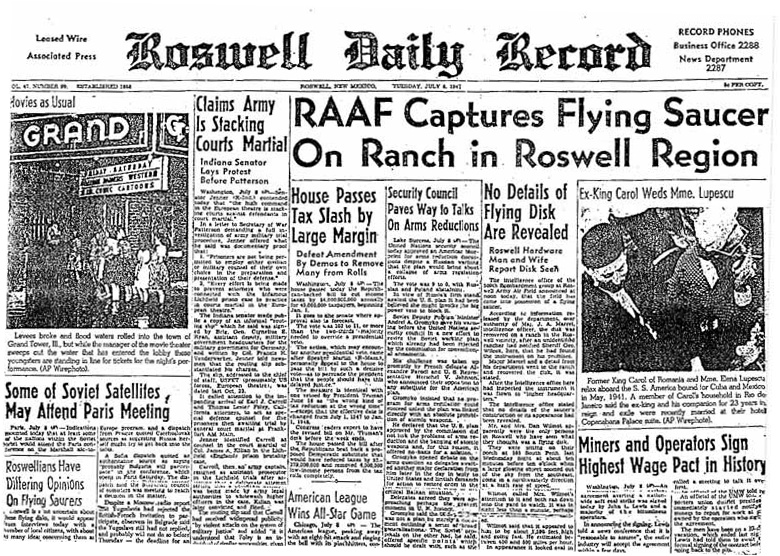
Roswell Daily Record 7/9/47, one basis for Area 51 Conspiracy Theories (PD)
The internet is buzzing with conspiracy theories that dispute the validity of mass shootings and attribute dark motives to hidden cabals [1]. The so called “deep state” is said to have hired “crisis actors”” to convince gullible citizens to give up their weapons, in a misguided effort to prevent more deaths from gun violence. So the theories go.
There is a certain comfort in these explanations of events that – to many of us – feel incomprehensible, as well as threatening. The heated and divisive political atmosphere prevailing gives such explanations added power.
We should consider carefully, however, before we place our trust in conspiracy theories.
For one thing, the brain is wired in such a way as to make conspiracy theories attractive – whether they are accurate or not. For another, Christians are warned not to trust in things with a spiritual dimension merely because they are “urged with vehemence, zeal, or plausibility” [2A]. We are instead to apply “the appropriate tests from reason and the word of God…” [2B].
Wiring Errors
Conspiracy theories have appeal because of the way the human brain is engineered.
Pattern – The brain is designed to seek out and detect patterns. This can deceive us into seeing patterns where none exist. Most of us, for example, can see the face of the “man in the moon” if we stare hard enough. That is not, however, proof of his existence.
Intentionality – The brain seeks rational explanations. This can deceive us into believing hidden motivations underlie random events. We prefer any explanation to none at all.
Proportionality – When events are particularly shocking, we are inclined to believe the explanation for them must be proportional. It is, in other words, difficult for us to believe Pres. John F. Kennedy was assassinated by a single gunman.
Errors in Judgment
Biblical discernment is the ability to decide between truth and falsehood, right and wrong [3]. It is the responsibility of Christians to be discerning about the things of God:
“Test all [spiritual] things; hold fast what is good. Abstain from every form of evil” (1 Thess. 5: 21-22).
We are instructed that two or three prophets should speak, and others weigh carefully what is said (1 Cor. 14: 29). In fact, the ability to distinguish between good and evil spirits is a gift of the Holy Spirit not all possess to equal degree (1 Cor. 12: 10).
“[However] Christianity does not require people to disregard their reason, or to be credulous. It does not expect them to believe anything because others say it is so. It does not make it a duty to receive as undoubted truth all that synods and councils have decreed; or all that is advanced by the ministers of religion.”
-Barnes’ Notes on the Bible [2C]
The Word of God provides us guidance in every area of life. God grants us “all things that pertain to life and godliness, through the knowledge of Him” (2 Peter 1: 3). Unfortunately, Christians often engage in unbiblical thinking. Unfamiliar with the Word of God, they are swayed by worldly influences.

Dressing change, Author kcxd, Source https://www.flickr.com/photos/26786061@N00/6434955639/, (CC BY-SA 2.0 Generic)
Schools today regularly hold drills on when to lock doors, and hide in classrooms. However, in the time required to secure a classroom against a shooter, a child can bleed to death.
An initiative known as “Stop the Bleed” offers teachers in all 50 states training on how to stop bleeding, in the event of another school shooting [1]. Some 125,000 teachers, counselors, and administrators have taken this medical training nationwide.
It is a remarkable commentary on our times that classrooms are now stocking tourniquets, gauze, and bandages, while school staples like chalk are in short supply.
At some level, violence has become acceptable. Since we can conceive of no other remedy to stem it, teachers are actually being urged to arm [2]. Read more…

Old books, Hendrik Conscience Heritage Library, Antwerp, Author missmarettaphotography (CC BY-SA 4.0 International)
“We don’t need no education.
We don’t need no thought control…
Teachers leave them kids alone.
Hey! Teachers! Leave them kids alone!
All in all it’s just another brick in the wall…”-“Another Brick in the Wall” by Pink Floyd
There is a disturbing trend in America to applaud ignorance, as if the pursuit of higher education were somehow unmanly…even unAmerican [1].
Generations relied on the sweat of their brow to advance the American dream. There is no shame in that fact. It was always, however, the goal that their children should have more opportunities than they did.
With the complicity of our politicians, that concept is being lost.
Tax cuts are never unpopular with the electorate. In fact, the Tea Party demanded them, as a protest against uncontrolled government spending and perceived waste. On a state level, however, tax cuts have had a dramatic and detrimental impact on the quality of education in this country [2].
A reduction in state revenue has resulted in increased class size, deteriorating infrastructure, and decreased resources (with teachers often providing badly needed classroom supplies at personal expense) [3][4]. Reduced tax revenue is the root cause behind teacher salaries stagnant at 1990s levels in many states [5]. Read more…

 A Lawyer's Prayers