 A Desk in an Office (“Schreibtisch”), Photo by User:Mattes
Most of our days are ordinary ones. We go into the office, meet with clients, deal with vendors and personnel issues. We return phone calls; respond to faxes and emails.
We fight traffic and the never ending battle with paperwork; reply to motions; attempt to schedule depositions.
We become experts on obscure statutes; review police reports and medical records – some dry, some so horrific we could never have imagined ourselves dealing with them. All in the course of our ordinary days.
A few of us try cases, and have the scars to show for it. Rarely though can any of us know the full impact of our lives.
So, too, with Ruth. A pagan, Ruth chose to follow her widowed mother-in-law back to Judah. Once there, Ruth’s days were occupied working in the fields. No one could have predicted, when she married Boaz, that Ruth would become the great-grandmother of King David.
She had already entered the lineage of the Messiah.
“Then she left, and went and gleaned in the field after the reapers. And she happened to come to the part of the field belonging to Boaz… ” (Ruth 2:3).
Lord Jesus, we labor in Your fields, unaware of what fruit our efforts may yield. Pour your grace out on our ordinary days, that there may be a great harvest.
Amen
Originally posted 7/17/12
READERS CAN FIND MY VIEWS ON ABUSE AND ABUSE-RELATED ISSUES AT ANNA WALDHERR A Voice Reclaimed, Surviving Child Abuse https://avoicereclaimed.com

Thanksgiving at US Army Combat Post in Afghanistan (2009), Source Flickr (PD – work product of US federal govt.)
A foundation stone for democracy on this continent, the Mayflower Compact was the first document under which the Plymouth Colony was governed. The agreement, which established an elected authority all would obey, was signed in 1620 as the Mayflower rode at anchor in Cape Cod Harbor.
For the Sake of Freedom and Equality
The Pilgrims were actually comprised of two groups: Separatists and non-Separatists.
The Separatists sought religious liberty, specifically the right to separate from the Church of England. They had initially emigrated to the tolerant Netherlands, but found the Dutch culture at odds with their own.
The non-Separatists — like many to follow them — sought economic and social opportunity, and the chance for a better life in America.
In the broadest terms, all risked their lives for the sake of freedom and equality. Read more…
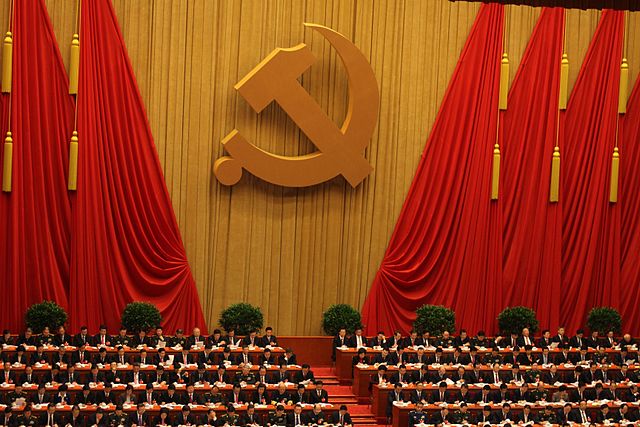
18th National Congress of Chinese Communist Party, Author Dong Fang (PD as created by Voice of America)
A growing cult of personality is developing around China’s President Xi Jinping, so much so that Christians there are actively being urged by the Communist Party to place their trust in Xi, and replace any pictures of Christ with his [1A].
Party members engaged in addressing poverty issues make a specific point of taking credit for the relief their actions may provide “melting the hard ice in the hearts of religious believers” [1B].
False Gods
Xi is not the first leader lauded as a savior. Mass murderer, Mao Tse-tung, was, also, glorified in China. North Korea’s Kim Jung-un is similarly exalted today.
But history is littered with the graves of others like them, men enamored of power and self-deluded enough to presume themselves gods.
Christians are aware that this is a fallacy – that these men are merely false gods – which is why we are viewed by totalitarian governments as posing an existential risk. Truth is always at odds with lies.
“Jesus answered [Pilate], ‘My Kingdom is not an earthly kingdom. If it were, my followers would fight to keep me from being handed over to the Jewish leaders. But my Kingdom is not of this world’ ” (John 18: 36 NLT).
Christ, of course, made clear that His kingdom is not of this world. But Christianity offers a competing world view to that of such governments – a world view in which each life matters, and material things are not the measure of a man’s existence. Read more…

Luxury shoes at Kurt Geiger Store, Canary Wharf, London, Author UggBoy heart UggGirl//PHOTO//WORLD//TRAVEL, Source Flickr (CC BY-SA 2.0 Generic)
We “love” a long list of things from Chinese food, the latest high tech devices, diamond studs, and chocolate cheesecake to classic rock, designer handbags, and soy latte.
There is nothing wrong with these things or our enjoyment of them. They are, however, things. Too often, we purchase them in the futile effort to fill an empty place inside – a place that has nothing to do with actual need.
Real Love
We “love” readily, yet have little concept of real love. Our portrayals of love are a clear indication.
The vast majority of images we see of love on film or in print are of attractive, upscale couples in their twenties or early thirties. Attractive and well-dressed children are added to the picture when we are being sold life insurance, family vacations, or disposable diapers.
With baby boomers retiring, a few older couples have lately appeared on the screen, to market dating services and erectile dysfunction cures to us.
Happily Ever After
We are experts at romance, but not at happily ever after. Happily ever after is the hard part, something for which the fairy tales do not prepare us.
Actually loving someone for richer or poorer, in sickness and in health. Through bankruptcy and bad decisions, beer gut and crow’s feet, mastectomy and stroke. Remaining true to a single individual, despite a barrage of messages to “trade up”.
The Care of Strangers
And what of those who have no husband or wife, no daughter or son? Who will love the homeless? The orphaned? Who will love the aged, relegated to the care of strangers? Who will love the victims of war or catastrophe? The veterans who have given their all to protect the rest of us?
We should be able to muster for them at least the degree of love we have for, say, latte or golf. In the process, we may find that empty place inside has been filled.
“ ‘A new commandment I give to you, that you love one another; as I have loved you, that you also love one another’ ” (John 13: 34).
Originally posted 1/2/13
READERS CAN FIND MY VIEWS ON ABUSE AND ABUSE-RELATED ISSUES AT ANNA WALDHERR A Voice Reclaimed, Surviving Child Abuse
https://avoicereclaimed.com

Two pan balance, Author Nikodem Nijaki (CC BY-SA 3.0 Unported)
“And I heard a voice…saying, ‘A quart of wheat for a denarius, and three quarts of barley for a denarius; and do not harm the oil and the wine’ “ (Rev. 6: 6).
When the populace can no longer afford the goods being offered for sale or services required for daily life, there is hardship and unrest. Real people suffer. Governments have toppled under such circumstances, and totalitarian regimes come to power.
Emerging Economies
- Average annual wage in India $616 per capita, $3168 per household [1A]
- Average annual income in South Africa $1217 per capita, $5217 per household [1B]
- Average annual income in Romania $4495 [2]
- Average annual income in Thailand $4509 [3]
- Average annual income in China $4397 rural, $7947 urban [4]
- Average annual income in Mexico $6143 [5]
- Average annual income in Poland $8280 [6]
- Average annual income in Brazil $9801 [7]
- Average annual income in Russia $11,378 [8]
Many pre-industrialized nations have yet to regulate working hours or conditions to ensure employee or product safety.
These are costs built into the pay-scale of industrialized nations (as are the costs associated with an improved standard of living, e.g. a universally accessible electric grid and nationwide highway system).
In fact, outright slavery is not uncommon in the developing world [9]. India, China, and Qatar are among the nations known to utilize it. Underpaying workers encourages slavery. That American companies are benefiting from this is a travesty [10].
The cost of doing business in emerging countries will remain low until there are no longer people desperate enough to live in pitiable conditions and risk their lives to make a living [11].
If the Lord tarries, that is likely to be a very long time.
—
[1A and 1B] https://qph.ec.quoracdn.net/main-qimg-413a0744b016486a022a54ddc3859b03-c.
[2] World Salaries, Romania, http://www.worldsalaries.org/romania.shtml.
[3] World Salaries, Thailand, http://www.worldsalaries.org/thailand.shtml.
[4] World Salaries, China, http://www.worldsalaries.org/china.shtml.
[5] World Salaries, Mexico, http://www.worldsalaries.org/mexico.shtml.
[6] World Salaries, Poland, http://www.worldsalaries.org/poland.shtml.
[7] World Salaries, Brazil, http://www.worldsalaries.org/brazil.shtml.
[8] World Salaries, Russia, http://www.worldsalaries.org/russia.shtml.
[9] Time, “The Developed World Is Missing the Point about Modern Slavery” by Chandrn Nair, 6/19/16, http://time.com/4374377/slavery-developed-developing-world-index-slave-labor/.
[10] The industries most heavily impacted by slavery include agriculture, automobiles and steel, technology, mining/minerals, and transportation. See, Ethical Corporation, “Modern slavery and the role of business” by Polly Foley, 10/8/14, http://www.ethicalcorp.com/supply-chains/modern-slavery-and-role-business.
[11] Scientific American, “Does Globalization Help or Hurt the Poor? Overview/Globalization and Poverty” by Pranab Bardhan, 3/26/06, https://www.scientificamerican.com/article/does-globalization-help-o-2006-04/.
This series focused last week on industrialized nations.
READERS CAN FIND MY VIEWS ON ABUSE AND ABUSE-RELATED ISSUES AT ANNA WALDHERR A Voice Reclaimed, Surviving Child Abuse
https://avoicereclaimed.com
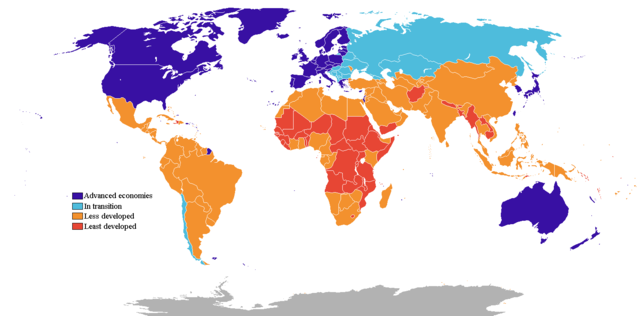
World map showing advanced (dark blue), transitioning (light blue), less (orange) and least (red) developed countries, Author Sbw01f, Source CIA World Factbook (CC Attribution 3.0 Unported)
“Children, it is the last hour; and just as you have heard that the antichrist is coming, so now many antichrists have appeared. This is how we know it is the last hour” (1 John 2: 18).
There has never been globalization on today’s scale.
Many Christian eschatologists interpret Scripture as predicting a despotic New World Order under the authority of Satan, the Anti-Christ, and the False Prophet in the last days. Globalization for that reason takes on special dread for Christians.
Even setting aside end time prophecy, however, globalization has not delivered the rosy outcomes its proponents promised.
Military Empires
Military empires of the past came closest to this model, merging cultures and facilitating the movement of goods. The Roman Empire, the Mongol Empire, and the more recent USSR are examples. Since these empires were by definition held together with force, the merging of cultures and movement of goods were never entirely “free” or painless.
Commercial Interests
The current globalization movement has not been prompted by a desire for peace or brotherhood either. It is commercially motivated – implemented by nation states, to profit their powerful corporate citizens.
Mutual commercial interests have been a reason for treaties since time immemorial. The brunt of modern globalization has, however, been borne by individual employees – the flesh and blood citizens of industrialized nations (now required to compete with those in pre-industrialized nations paid a great deal less). Read more…
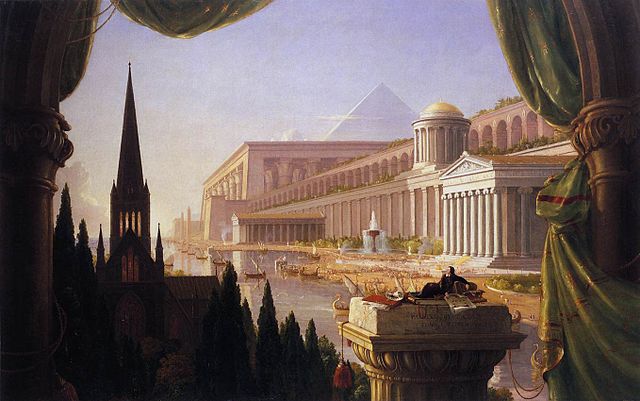
“The Architect’s Dream” by Thomas Cole (1840), Toledo Museum of Art (Accession No. 1949.162), Source Web Gallery of Art (PD- Art l Old-100)
In the night hours, I search enormous empty law firms for case files I am unable to locate; scour the stacks frantically for legal precedents I am unable to discover. I return in dreams to settings that were once familiar, and wander the corridors unable to find the office I once occupied.
I grieve over the work I am no longer able to do, and wake with tears in my eyes. There is no glory. There is no longer even satisfaction in completing a necessary task. There is only a sense of failure.
I never thought I would become famous. I did, however, think I could be of service. That a variety of ailments have interfered with this torments me.
Pain, depression, anxiety, and PTSD constrain my actions; have set borders around my life. They, also, filter my reality. I throw myself against the bars of this prison uselessly.
Within these limits, I attempt to function.
That is not, however, the end of the story. The story is not, in fact, about me. It is about God. It is to Him the glory goes. Read more…
RISE UP
Performed by the Cardinal Shehan School, Baltimore, MD
“You’re broken down and tired
Of living life on a merry go round
And you can’t find the fighter
But I see it in you so we gonna walk it out
And move mountains
We gonna walk it out
And move mountainsAnd I’ll rise up
I’ll rise like the day
I’ll rise up
I’ll rise unafraid
I’ll rise up
And I’ll do it a thousand times again
And I’ll rise up
High like the waves
I’ll rise up
In spite of the ache
I’ll rise up
And I’ll do it a thousand times again
For you
For you
For you
For youWhen the silence isn’t quiet
And it feels like it’s getting hard to breathe
And I know you feel like dying
But I promise we’ll take the world to its feet
And move mountains
We’ll take it to its feet
And move mountainsAnd I’ll rise up
I’ll rise like the day
I’ll rise up
I’ll rise unafraid
I’ll rise up
And I’ll do it a thousand times again
For you
For you
For you
For youAll we need, all we need is hope
And for that we have each other
And for that we have each other
We will rise
We will rise
We’ll rise, oh oh
We’ll riseI’ll rise up
Rise like the day
I’ll rise up
In spite of the ache
I will rise a thousand times again
And we’ll rise up
Rise like the waves
We’ll rise up
In spite of the ache
We’ll rise up
And we’ll do it a thousand times again
For you oh oh oh oh oh
For you oh oh oh oh oh
For you oh oh oh oh oh
For you”Written by Cassandra Monique Batie, Jennifer DecilveoCopyright © BMG Rights Management US, LLC
READERS CAN FIND MY VIEWS ON ABUSE AND ABUSE-RELATED ISSUES AT ANNA WALDHERR A Voice Reclaimed, Surviving Child Abuse
https://avoicereclaimed.com

“The Beheading of St. John the Baptist” by Pierre Puvis de Chavannes (c. 1869), National Gallery (Accession No. NG3266), Source Web Gallery of Art (PD-Art l Old-100)
Christians in this day and age have cause for grief as well as joy, for fear as well as celebration. This Bible Study examines Scripture in light of the tumultuous times in which we live.
Still, we are the voice in the desert crying [1]
“The voice of one crying in the wilderness:
‘Prepare the way of the Lord;
Make straight in the desert
A highway for our God’ ” (Isa. 40:3).
Often, it feels as if we are the voice in the desert, the last remnant praising God. We long for Jesus’ return in a dry and weary land (Ps. 63: 1). When He comes again, the last shall be first, and the first last (Matt. 19: 30). The rough places will be made smooth, and His glory will shine for all to see (Isa. 40: 4-5).
No one but the Father knows the day or the hour, when that will be (Matt. 24: 36). Meanwhile, we cannot despair (2 Cor. 4: 8). We are to “defend the poor and fatherless, do justice to the afflicted and needy” (Ps. 8: 3) as long as God gives us strength.
“Prepare ye the way of the Lord!”
“In those days John the Baptist came preaching in the wilderness of Judea, and saying, ‘Repent, for the kingdom of heaven is at hand!’ ” (Matt. 3: 1-2).
John the Baptist was assigned the task of preparing the way for the Messiah. John was the final prophet to precede the Lord, baptizing Him in the Jordan. Not long afterwards, John was martyred for his adherence to the truth (Mark 6: 18-19, 27-28).
Jesus said of John the Baptist that from among those born of women there was none greater (Matt. 11: 11). The Lord added, however, that the least in the kingdom would be greater than John. Astonishingly, that was a reference to us. The Lord knew that faith would be a challenge in our day.
Some speculate that John the Baptist may be one of the two witnesses in Jerusalem at the end of days, and Elijah the other. Whatever their identity, we are told the two witnesses – like Elijah earlier (1 Kings 17: 1) – will be given power “to shut heaven so that no rain falls” (Rev. 11: 6).
Behold He comes riding on the clouds
“ ‘…[H]ereafter you will see the Son of Man sitting at the right hand of the Power, and coming on the clouds of heaven’ ” (Matt. 26: 64).
Jesus made this reply, when asked by the high priest whether or not He was the Christ, the Son of the living God. For these words He was condemned. Yet we will see them fulfilled when He returns in glory. Read more…
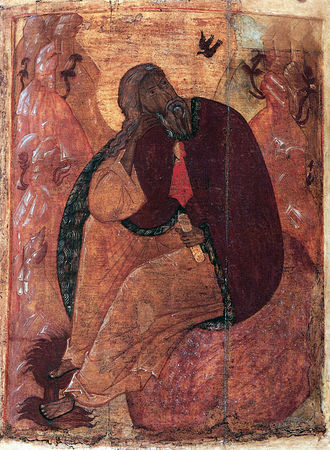
“The Prophet Elijah in the Desert”, Eastern Orthodox icon (end of 14th Century) (PD-Art l Old-70)
This Bible Study will focus on Scriptural passages with bearing on the present day. Some are prophetic. Others are not, but speak to our circumstances, as if penned yesterday. All offer us assurance and encouragement, in God’s own words.
These are the days of Elijah [1]
“ ‘But I tell you truly, many widows were in Israel in the days of Elijah, when the heaven was shut up three years and six months, and there was a great famine throughout all the land…’ ” (Luke 4: 25).
Jesus, Himself, spoke of the “days of Elijah,” a time of drought lasting over three years with severe famine the result. We are not living in the days of the prophet, Elijah, literally speaking. For many, however, ours is a time of hardship and testing.
Christianity is often ridiculed, and persecution not far off.
While there is widespread drought in our nation as of this writing, the drought for us is as much spiritual as physical. We are bombarded by information, while the concept of truth has been virtually lost. Though few realize it, we are famished for the Word of God.
Ultimately, Elijah brought rain and revival. Christians long for the quickening of the Holy Spirit, a downpour turning this beloved nation of ours once again toward God.
Declaring the word of the Lord
“…[T]he word of the Lord came to Abram in a vision, saying, ‘Do not be afraid, Abram. I am your shield, your exceedingly great reward’ ” (Gen. 15: 1).
The “word of the Lord” is a phrase used consistently throughout Scripture to designate communication from God. Patriarchs and prophets received their instruction in this way, then conveyed God’s message to His people.
As Christians in this modern day and age, we, too, have a responsibility to declare the word of the Lord, the Gospel message. This is the Great Commission (Mark 16: 15). Our audience is the world which is in desperate need of Salvation.
And these are the days of Your servant, Moses
“Then Moses said to the Lord, ‘O my Lord, I am not eloquent, neither before nor since You have spoken to Your servant; but I am slow of speech and slow of tongue’ ” (Ex. 4: 10).
Despite our inadequacies, we stand on the verge of great things. This is not greatness as the world esteems it. Rather, this is the greatness of the Lord. His power is beyond measure, His love beyond imagining. And we have the enormous privilege of being His servants, His adopted children, and making Him known to the world. Read more…

 A Lawyer's Prayers