
A homeless man outside the UN in New York City, Author/Source CGP Grey (CC Attribution 2.0 Generic)
We have learned to ignore them: the homeless. Fixtures on every street corner. Present but, for all practical purposes, invisible.
Population Size
On any given night there are over a half million Americans sleeping on the streets [1]. Slightly under half those are homeless families. Approximately 50,000 are veterans (down from a high of 76,000 in 2010).
About 15% of the total are chronically homeless.
Contributing Factors
“…for I was hungry and you gave Me food; I was thirsty and you gave Me drink; I was a stranger and you took Me in…” (Matt. 25: 35).
The problem of homelessness is complex.
A significant percentage of the homeless will, when questioned, reveal that they were abused.
A large number are children, made homeless along with their parents. This creates issues involving child safety and child custody, with fear of losing their children hanging like a sword of Damocles over the heads of homeless parents.
Veterans (both male and female) are at higher risk of homelessness than the general population [3].
A. Affordable Housing
“And Jesus said to him, ‘Foxes have holes and birds of the air have nests, but the Son of Man has nowhere to lay His head’ “ (Matt. 8:20).
One factor contributing to homelessness is the lack of affordable housing.
Some 12 million renters and homeowners spend over 50% of their income on housing alone [2]. “…a family with one full-time worker earning the minimum wage cannot afford the local fair-market rent for a two-bedroom apartment anywhere in the United States [3].”
The US Dept. of Housing and Urban Development (HUD) considers 30% of monthly income the upper limit a household can devote toward housing without compromising on other essentials (food, clothing, transportation, and medical attention). The households spending more are at risk for homelessness. Over 450,000 veteran households fall into this category, teetering on the edge [6].
For those already homeless, shelters are often seen as a last resort. Shelters have limited availability, and may be perceived as too dangerous. In rural areas, services are even more scarce. There the poor, if they can, cope by moving perpetually from one friend or relation to another.
B. Mental Illness
“And always, night and day, he was in the mountains and in the tombs, crying out and cutting himself with stones” (Mark 5: 5).
In the USA homelessness is further complicated by mental illness.
As long ago as the 1970s, the policy of de-institutionalisation began discharging mentally ill men and women to the streets, without adequate medical support. There were and are too few half-way houses. Community opposition (“not in my backyard”), and limited funding have played a role in this.
Emergency rooms (unable to house the homeless and ill equipped to treat their long-term health conditions) and police “drunk tanks” have absorbed the brunt. Read more…
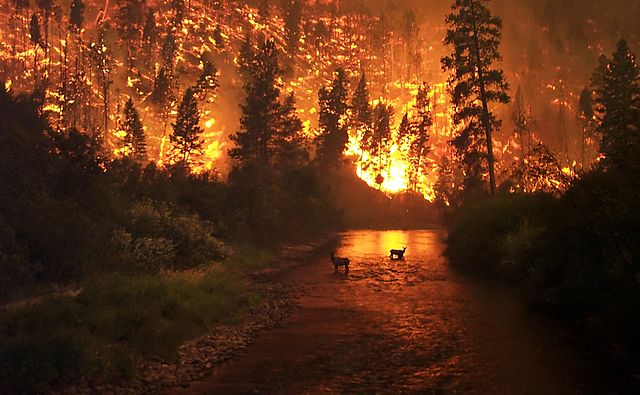
A wildfire in Bitterroot National Forest, Montana (PD – federal govt.)
God’s creation is stunning in its beauty and complexity. Fire, for instance, serves a purpose in nature we are only now beginning to understand.
The beauty of God’s creation extends to the best aspects of man’s character. The devotion and self-sacrifice of firefighters is amazing. “Smoke jumpers” actually enjoy their work!
However, human efforts by themselves are inadequate – whether to control fire in the natural world, or bridge the spiritual chasm between God and man. Every approach human beings have, thus far, taken toward wildfire management has failed over the long haul and/or given rise to new problems. Far more so with spiritual issues: we are nothing without God and no substitute for Him.
The small, inglorious tasks are often those which shape and define us. Despite technologic advancements, wildfires are still fought one man and one woman at a time. Underbrush, dried grass, and other potential fuels must be cleared laboriously and at great risk, by hand.
Heroism lies in continuing what – to us, at least – may seem a hopeless fight. Some wildfires are so vast and fast moving, they cannot be put out. Firefighters must fall back repeatedly, yet they fight on. Some of the spiritual battles we face are this daunting. But, as Christians, we fight in the knowledge that our war has been won.
“ ‘When you walk through the fire, you shall not be burned, nor shall the flame scorch you. For I am the Lord your God…’ ” (Is. 43: 2-3).
Lord God, Your lessons are all around us. You seek in every possible way to teach us who You are, and draw us closer to You.
Again and again, we mistake Your glory for our own. Again and again, we see our own reflection where Your face should be. Forgive us, Father. Walk with us through the fire, despite that. You know our helplessness without You, even if we do not.
We ask this in His name who walked in the furnace with Shadrach, Meschach, and Abednego.
Amen
Originally posted 7/7/13
READERS CAN FIND MY VIEWS ON ABUSE AND ABUSE-RELATED ISSUES AT ANNA WALDHERR A Voice Reclaimed, Surviving Child Abuse
https://avoicereclaimed.com
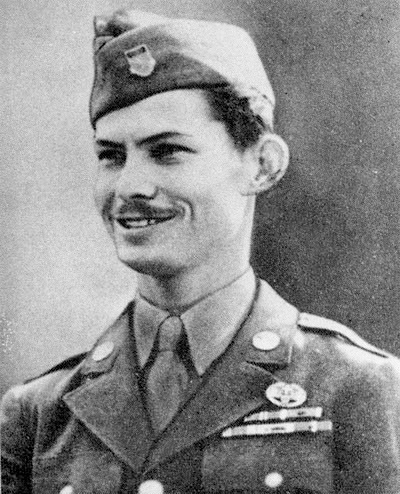
Pfc. Desmond Doss, Source http://history.amedd.army.mil/MOH/dossd.html (PD-federal govt.)
The new Mel Gibson film “Hacksaw Ridge” is the true story of Desmond Doss, a WWII conscientious objector. Doss – a Seventh Day Adventist – served as a medic to the 1st Battalion, 307th Infantry, 77th Infantry Division, ultimately saving the lives of over 75 men for which he won the Medal of Honor.
The documentary “The Conscientious Objector: Pvt. Desmond Doss – The Fearless Warrior Without a Rifle” includes moving interviews with Doss and those who served with him. You can find it at https://www.youtube.com/watch?v=K5JVQt-C8YE.
What first strikes the viewer is that Doss was a small man. For him to lift and carry even a single soldier must have been a challenge. Yet he repeatedly risked his life to transport 75 wounded companions off an exposed Okinawa ridge under heavy fire by the Japanese.
What is equally remarkable is Doss’ humility. He accepted little, if any, credit for his valor.
Here is how Doss’ citation describes the events and their immediate aftermath:
“Private First Class Doss was a company aid man when the 1st Battalion assaulted a jagged escarpment 400 feet high. As our troops gained the summit, a heavy concentration of artillery, mortar and machine gun fire crashed into them, inflicting approximately 75 casualties and driving the others back. Pfc. Doss refused to seek cover and remained in the fire-swept area with the many stricken, carrying all 75 casualties one-by-one to the edge of the escarpment and there lowering them on a rope-supported litter down the face of a cliff to friendly hands.
On May 2, he exposed himself to heavy rifle and mortar fire in rescuing a wounded man 200 yards forward of the lines on the same escarpment; and 2 days later he treated 4 men who had been cut down while assaulting a strongly defended cave, advancing through a shower of grenades to within eight yards of enemy forces in a cave’s mouth, where he dressed his comrades’ wounds before making 4 separate trips under fire to evacuate them to safety…”
There is more – no Hollywood embellishment necessary. When Doss’ legs were shattered by an explosion, he instructed litter bearers to evacuate a more critically injured man first. Shot in the arm, as well, Doss used a rifle stock as a splint and crawled 300 yards to the aid station.
These were not acts of bravado. They involved no posturing, no chest pounding. They were instead acts of faith. For Doss entrusted his life wholly to God, whatever the outcome.
Few of us can say as much.
“Greater love has no one than this, than to lay down one’s life for his friends” (John 15: 13).
READERS CAN FIND MY VIEWS ON ABUSE AND ABUSE-RELATED ISSUES AT ANNA WALDHERR A Voice Reclaimed, Surviving Child Abuse
https://avoicereclaimed.com
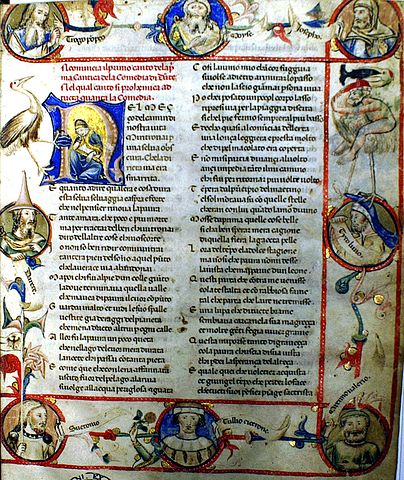
Page from Dante’s “Inferno” (PD-Art l Art-old)
“Oh that my words were written! Oh that they were inscribed in a book!” (Job 19: 23).
Those of us who write and/or minister naturally long for an audience, a congregation. Bubbling over with words, we ache to share our thoughts and feelings, even more so to share our faith.
Sometimes, we write simply to express ourselves, for instance, in a personal journal. This is “art for art’s sake” or private prayer. Other times, we want to make a splash! Sometimes, we speak in a representative capacity, in public prayer, articulating what many may experience but most find difficult to express.
We write on topics ranging from the secular to the sacred, the silly to the sublime, as God moves us. But, whatever the topic, we want a receptive audience, an engaged congregation – usually the bigger, the better.
Audience (and Congregation) Size
“After these things I looked, and behold, a great multitude which no one could count…” (Rev. 7: 9).
Online, the size of our audience is touted as its foremost characteristic. The goal, in that context, is material, specifically commercial, as in the sale of goods and services.
Politically, size again matters. We hear how many were present at a rally; how many tuned in to watch a televised debate. The goal, in that case, is the “sale” of a candidate and his/her ideas.
All too often, the Gospel (or what purports to be the Gospel) is peddled this way, too – as if it were another commodity. Step right up. Make your bargain with God. Get your blessings here, postage and handling not included.
These days audiences and congregations are, also, dissected by their component parts. Is a certain blog or ministry sufficiently appealing to millennials? What percentage of readers are over age 55? Does an article adequately target liberals? How about gun owners? Evangelicals?
Never mind the truth. Read more…

“St. Martin and the Beggar” by El Greco (c. 1598), National Gallery of Art (Accession No. 1942.9.25), Source Web Gallery of Art (PD)
“Socioeconomic status is the most powerful predictor of disease, disorder, injury and mortality we have.”
– Tom Boyce, MD, Chief of Division of Developmental Medicine, Dept. of Pediatrics, UCSF
Epidemiologists term poverty the “cause of causes” because it underlies so many illnesses.
The life expectancy of an adult living at or below the federal poverty level ($11,770 per one-person household) in the Rust Belt or rural South is 7-8 years less than that of an individual making the average American income of $55,775 [1].
Race, Poverty, and Chronic Illness
Race further widens the gap. Chronic illnesses (responsible for 70% of the deaths in this country) show earlier onset and greater frequency in minority populations living in poverty [2].
According to the Gallup-Healthways Well-Being Index, Americans living in poverty suffer from depression at twice the rate of those not in poverty. Asthma, diabetes, hypertension, and heart attack rates are, also, higher among the poor [3].
And the United States is second to last among 29 developed countries ranked by child poverty rates – scoring worse than Poland, Latvia, Hungary, and Lithuania [4][5].
A Complex Relationship
The available data barely scratches the surface of the relationship between poverty and illness.
The relationship between poverty and depression is, we know, complex. Depression can both cause and be caused by poverty [6].
Other health problems may be influenced by the limited healthcare available to the poor, and the environmental conditions under which they live. Lead pipes, for example, are common in America’s inner cities [7]. Read more…
This is an update from Christian Legal Clinics of Philadelphia (CLCP) http://www.clcphila.org/, a volunteer organization that has long been close to my heart.
Philadelphia has the highest rate of “deep poverty” of the nation’s ten largest cities [1]. The child poverty rate in the city is consistently around 40% [2].
“Speak up for those who cannot speak for themselves, for the rights of all who are destitute. Speak up and judge fairly; defend the rights of the poor and needy” (Prov. 31: 8).

Philadelphia City Hall, Author Max Binder (CC BY-SA 3.0 Unported)
“For four years, Senora Carmen had been waiting for her veteran benefits from her husband’s years of service [3]. After being denied once, she received another packet from the U.S. Department of Veteran Affairs. Twenty pages of fine print seemed to indicate more paperwork was needed. Extensive paperwork. Then her request–and financial need–would be considered, or denied again.
Senora Carmen had lived in the U.S. over twenty years, but her limited English was still a barrier for her. Anxious and troubled, she brought the packet to CLCP.
Attorney John Visher, a retired Navy JAG Officer and CLCP volunteer, used his…legal skills to decipher the document.
‘Todo va estar bien?’ Carmen asked. Will everything be okay?
As an attorney, Visher…cannot always guarantee resolution for every client he works with through CLCP, but…[much]of his work is providing comfort…Visher …watches over his clients, and at times, an attorney acting as the legal watchman for an impoverished client is the needed weight to resolve an issue.
With Visher’s involvement, the legal process picked up speed, and Carmen received her benefits check and the promise of continual monthly support.
As a Christian attorney, Visher counts it a privilege to demonstrate his care to needy clients as a watchman of justice, and Carmen, a devout Christian herself, not only had her financial need resolved, but in the process, she also received godly comfort through CLCP.”
—
[1] Philly.com, “Among the 10 largest cities, Philly has the highest deep-poverty rate” by Alfred Lubrano, 10/1/15, http://articles.philly.com/2015-10-01/news/67015543_1_poverty-rate-deep-poverty-philadelphians.
[2] NPR, “Unrelenting Poverty Leads to ‘Desperation’ in Philly Schools” by Eric Westervelt, 11/21/13, http://www.npr.org/2013/11/21/246413432/weighing-the-role-of-poverty-in-philadelphia-s-schools.
[3] The client’s name has been altered in the interest of privacy.
Anyone interested in Christian legal aid can find more information on that topic above
READERS CAN FIND MY VIEWS ON ABUSE AND ABUSE-RELATED ISSUES AT ANNA WALDHERR A Voice Reclaimed, Surviving Child Abuse
https://avoicereclaimed.com

Mir Diamond Mine, Yakutia, Russia, Author Staselnik (CC BY-SA 3.0 Unported)
“I will give you the treasures of darkness And hidden riches of secret places, That you may know that I, the Lord, Who call you by your name, Am the God of Israel” (Isa. 45: 3).
Diamonds are one of the hardest natural substances known. Billions of years old, diamonds form deep in the earth, under tremendous pressures and temperatures [1]. They are considered among the most valuable gemstones in the world, and are mined only with great difficulty.
But the treasures of darkness which God promises us are infinitely more precious.
Literal and Figurative Darkness
The word “darkness” can be interpreted both literally and figuratively.
Strong’s Concordance informs us that darkness is not only to be found in mines (Job 28: 3). Darkness was over the surface of the deep at Creation (Gen. 1: 2). Darkness was one of the plagues God caused to fall on Egypt, giving it a supernatural dimension (Ex. 10: 21).
The word can, also, be used to signify ignorance;confusion/perplexity; doubt, depression, and mourning; secrecy; evil and sin; death, destruction, and judgment.
What treasures can these possibly yield? Let us examine them one at a time.
Ignorance
“…[T]he fool walks in darkness” (Eccl. 2: 14). But “…wisdom excels folly As light excels darkness” (Eccl. 2: 13).
The fear of the Lord is the beginning of wisdom (Prov. 9: 10). Wisdom is, therefore, the first treasure of darkness.
Confusion/Perplexity
“[The wicked] grope in darkness with no light, And He makes them stagger like a drunken man” (Job 12: 25).
The wicked grope in darkness, relying on their own devices. But the Lord is a lamp to the feet of the righteous. He enlightens the Christian’s darkness (2 Sam. 22: 29), so much so, that we are instructed not to lean on our own understanding (Prov. 3: 5).
Direction/guidance is, therefore, the second treasure of darkness.
Doubt, Depression, and Mourning
“For the enemy has persecuted my soul; He has crushed my life to the ground; He has made me dwell in darkness, Like those who have long been dead” (Ps. 143: 3).
Many Christians suffer from depression and/or doubts. Others wrestle with the question of faith as a result of losing a loved one. These factors do not diminish faith. In fact, they can ultimately strengthen it.
“The people who sat in darkness have seen a great light, And upon those who sat in the region and shadow of death Light has dawned” (Matt. 4: 16).
This identifies faith as the third great treasure of darkness.
Secrecy
“Indeed, the darkness shall not hide from You, But the night shines as the day; The darkness and the light are both alike to You” (Ps. 139: 12).
Nothing can be hidden from the Lord. No secret plot, no hidden motive by others can harm us, if God does not allow it.
Whatever may befall us, God will use for good (Rom. 8: 28). He has numbered the very hairs on our head (Luke 12: 7). We are safely in His care.
Security is, therefore, the fourth treasure of darkness.
Evil and Sin
“Woe to those who call evil good, and good evil; Who substitute darkness for light and light for darkness…” (Isa. 5: 20).
We may at times be discouraged. It may appear that the world is growing ever more dark, ever more evil. But Christ has overcome the power of darkness. And we are promised justice – if not in this world, then the next.
Justice is, therefore, the fifth great treasure of darkness.
Death, Destruction, and Judgment
“Near is the great day of the Lord… A day of wrath is that day, A day of trouble and distress, A day of destruction and desolation, A day of darkness and gloom, A day of clouds and thick darkness, A day of trumpet and battle cry Against the fortified cities…” (Zeph. 1: 14-16).
We have been saved through the death and resurrection of Christ, rescued from banishment to outer darkness for our sins.
Salvation is, therefore, the sixth and greatest treasure of darkness.
—
[1] This statement, admittedly, takes an “old earth” view of Creation.
READERS CAN FIND MY VIEWS ON ABUSE AND ABUSE-RELATED ISSUES AT ANNA WALDHERR A Voice Reclaimed, Surviving Child Abuse
https://avoicereclaimed.com

Bangladeschi child labor, Author Niriho khoka (CC BY-SA 4.0 International)
“Every day, millions of Americans use products or eat foods that are produced by slave labor. Rare metals from Africa are embedded in our cell phones. Harvested fish or fruit or fabric are thawing in our fridge or hanging in our closets [1].”
Human trafficking is among the fastest growing and most lucrative criminal enterprises [2]. Currently, there may be as many as 46 million slaves worldwide – more than at any time in history.
The problem of trafficking is closely tied to that of poverty. Ironically, trafficking is estimated to generate over $150 billion in profit annually [3].
Today’s slaves fall into three categories:
- Those including children forced into the sex trade;
- Those including children forced to engage in heavy labor, e.g. brickmaking, rock quarrying, and cocoa production;
- Those including children utilized as soldiers, involuntary organ donors, drug mules, etc.
Two thirds of the world’s slaves can be found in India, Pakistan, and China (18.3 million in India alone). However, the United States is, also, an importer. Some 300,000 children are thought to be trafficked in the United States (100,000 in the sex trade alone). Other large slave markets include Japan, Korea, Thailand, and Cambodia.
Deceit, Abduction, and Coercion
Trafficking is accomplished by means of deceit, abduction, and coercion. A recruiter will visit an impoverished village promising good jobs, good wages, and good living conditions. These promises are all false.
Children, since they are defenseless; those anxious to improve their lives; and refugees fleeing conflict, since they lack social support, are targeted.
Some children are actually trafficked by their own families. Two out of three children trafficked are girls, the most marginal members of what may be a desperately poor family.

Prostitutes outside a bar in Thailand, Author Kay Chernosh for the US State Dept., Source Images of Human Trafficking https://gtipphotos.state.gov/photos.htm (PD)
Slaves are instructed to hand over their passports and other identification to the trafficker [4][5]. Violence and intimidation are used to coerce compliance and prevent escape. Slaves may be denied food, kept in darkness, fed alcohol and drugs, and/or beaten. Threats may, also, be made against the families they left behind.
Close to Home
Human trafficking is often hidden in plain sight. It need not involve foreign nationals. Perhaps 8 out of 10 prostitutes on American streets are being coerced, whether or not they recognize and acknowledge it to authorities.
A pimp may initially have offered a homeless girl (or boy) a dry place to sleep. That “kindness” is quickly exposed as deceit, with a view toward enslavement. Keep in mind that the average starting age for prostitutes in the United States is 13 y.o. [6A and 6B]. Read more…

“So the last will be first, and the first last” (Matt. 20: 16).
There is a short story by the great American author and famed humorist, Mark Twain, which contains no humor at all. “A True Story Repeated Word for Word as I Heard It” is the life story of Mary Ann Cord, the family cook, as she told it one afternoon [1].
Born into slavery in Virginia, Mary Ann married and had seven children. Tragically, her family – like many other slave families – was torn asunder. Mary Ann’s husband and children were sold off in 1852, and lost to her. All connection with them was severed.
A dozen years later, in North Carolina during the chaos of the Civil War, Mary Ann was startled by a familiar face, while preparing a meal for black troops occupying her owner’s plantation. It was her youngest son Henry, now grown and fighting for the Union.
This is how Twain says Mary Ann described the scene:
“I was a-stoopin’ down by de stove, an’ I’d jist got de pan o’ hot biscuits in my han’ an’ was ‘bout to raise up, when I see a black face come aroun’ under mine, an’ de eyes a-lookin’ up into mine, an’ I jist stopped right dah, an’ never budged! Jist gazed, an’ gazed, an’ de pan begin to tremble, an’ all of a sudden I knowed! De pan drop’ on de flo’ an’ I grab his lef’ han’ an’ shove back his sleeve, an’ den I goes for his forehead an’ push de hair back so, an’ ‘Boy!’ I says, ‘if you ain’t my Henry, what is you doin’ wid dis welt on yo’ wris’ an’ dat sk-yar on yo’ forehead? De Lord God ob heaven be praise’, I got my own ag’in!”
After 150 years, we can still feel the grief – and incalculable joy – of this mother [2]. The patois Twain recorded is no obstacle at all [3]. If anything, it makes the moment more intimate. We are almost reluctant to intrude.
Federal Writers Project
From 1936 to 1938, the Federal Writers Project of the Works Progress Administration (WPA) interviewed over 2300 former slaves, recording the details of their lives under slavery.

These first-person accounts are preserved in the Library of Congress. They speak of destitute conditions, staggering workloads, whippings and beatings, a prohibition against literacy, and rigid restrictions on travel.
Above all, they reflect the humanity of enslaved people – their strength, their pride, their spirit of resistance, and their faith.
Here are excerpts from a few:
Alice Alexander, age 88, Oklahoma –
“We lived in a one room log hut, and slept on homemade rail bed steads wid cotton, an’ sum times straw, mos’ly straw summers an’ cotton winners… Yas, we had a overseers an’ my mother said he was the meanest man on earth. He’d jest go out in de fields and beat dem n_s, an’ my mother tole me one day he come out in de field beatin’ her sister an’ she jumped on ‘im an’ nelly beat ‘im half to death an’ ole Marster come up jest in time to see it all an’ fired dat overseer [4]. Said he diden want no man working fer ‘im dat a woman could whip.”
George Fleming, age 83, South Carolina –
“Slaves started to work by de time dey was old enough to tote water and pick up chips to start fires wid. Some of dem started to work in de fields when dey about ten, but most of ‘em was older… Women worked in de field same as de man. Some of dem plowed jes’ like de men and boys. Couldn’t tell ‘em apart in de field, as dey wore pantelets or breeches. Dey tied strings ‘round de bottom of de legs so de loose dirt wouldn’t git in deir shoes… Us didn’t pay much mind to de clock. We worked frum sun to sun.”

Slave ship diagram: Africans transported like cargo, Author Jbolden030170 (CC BY-SA 3.0 Unported)
WARNING: Graphic Images
“ ‘What profit is there if we kill our brother and conceal his blood? Come and let us sell him…and let not our hand be upon him, for he is our brother and our flesh’…[S]o the brothers pulled Joseph…out of the pit, and sold him to the Ishmaelites for twenty shekels of silver. And they took Joseph to Egypt” (Gen. 37: 26-28).
Lonnie Bunch, director of the Smithsonian Museum of African American History and Culture, and anthropologist, Steve Lubkemann, a founder of the Slave Wrecks Project, have joined forces to excavate a long lost Portuguese slave ship, the first of its kind to be located and studied.
The Sao Jose sank in a storm, off the coast of Cape Town, South Africa in 1794. More than 200 slaves – men, women, and children – perished [1]. Over 590 ships engaged in the slave trade are known to have gone down [2].
The Middle Passage
Viewed as cargo, slaves were laid side by side in the hold, like lumber, during the Middle Passage. Often shackled – with limited light and air, no room to move, and little or no provision for sanitation – slaves were forced to endure a trip which could last months. Women might be raped by the crew at will.
The freed slave and author, Olaudah Equiano, had this to say about the Middle Passage in his autobiography:
“This wretched situation was again aggravated by the galling of the chains, now become insupportable; and the filth of the necessary tubs, into which the children often fell, and were almost suffocated. The shrieks of the women, and the groans of the dying, rendered the whole a scene of horror almost inconceivable.”
Estimates vary, but the number of those transported like this may have been as high as 12.5 million. Many died en route, either from sickness, violence, or despair.
Valuable Property
Ships were equipped with netting that stretched from the hull to catch slaves who might attempt to jump overboard [3]. Slaves could though be tossed overboard to lighten a ship’s load, when weather threatened. This was a last resort, since slaves were recognized as valuable property.
According to Lonnie Bunch:
“In the years before the Civil War, the amount of money invested in slaves was more than the amount of money invested in railroads, banks, and businesses combined. This was the economic engine of Europe and the United States.”

 A Lawyer's Prayers