
Gnostic texts of Gospel of Thomas and The Secret Book of John a/k/a Apocryphon of John, Codex II The Nag Hammadi manuscripts, Source https://manuscritoseneltiempo.blogspot.com/, (PD)
Gnosticism is a distorted form of Christianity again gaining popularity [1A][2A][3][4A][12A]. This post is not equipped to explore all the nuances of Gnosticism (which is not a single, standardized belief system), but rather highlights the principal areas where Gnosticism deviates from Christianity.
Gnosticism (which asserts that the natural realm was created by an evil lesser god or demiurge, and emphasizes an elite spiritual knowledge over faith as necessary for Salvation) has been considered a heresy by mainstream Christianity from the outset, as historic creeds reflect [5A][6A].
The Catholic, Presbyterian, Lutheran, and Baptist churches still see Gnosticism as heretical [6B][13]. The Methodist and Episcopal churches for centuries did recognize Gnosticism as a heresy but are currently equivocating, in response to cultural pressures [7A][8].
Scripture, itself, warns against Gnostic influence at 1 Tim. 6: 20, 1 Cor. 8: 1-3, 1 John 4: 1-3 and elsewhere.
Background
A blend of Christian and pagan beliefs, Gnosticism arose in the 2nd Century, incorporating elements of Judaism and Greek philosophy with religions from Syria, Asia Minor, Persia, and India. The name Gnostic comes from the Greek gnosis, meaning “knowledge”.
Like most heresies, Gnosticism was founded on a twisted version of the truth, a partial truth taken as the whole [4B].
“The Gnostics believed there was a…secret knowledge reserved for those with true understanding, leading to the salvation of the soul. Spiritual salvation was of preeminence to the Gnostics because they thought the human spirit was naturally good and was entrapped or imprisoned in the body, which was naturally evil or merely an illusion. Their goal, therefore, was to free the spirit from its embodied prison…” [1B].
Gnostics, for example, considered sex and marriage evil, since procreation merely produces more “evil” bodies [5B]. As a result, by warped logic, some sects considered contraception, adultery, fornication, and homosexuality good [5C].
Because of this spirit-matter dualism, Gnostics generally rejected the Old Testament, viewing it as false [4C]. Cain and the inhabitants of Sodom and Gomorrah were the real heroes, from the Gnostic perspective. This was all the more ironic, since Gnostics have always prided themselves on seeking knowledge, and the Bible – Old and New Testaments – is the revealed word of God, Himself.
Early church fathers like Ignatius of Antioch (c. 35 – 108 AD), Justin Martyr (c. 100 AD – 166 AD), Irenaeus (c. 130 AD – c. 200 AD), and Tertullian (c. 160 AD – 225 AD) condemned Gnostic beliefs as inconsistent with Christian doctrine [9A][12B].
Doctrine, in the sense used here, is not meant to suggest a rigid set of rules, but rather the best and most accurate reading of Scripture, as guided by the Holy Spirit (John 14: 26, 15: 25, 16: 8, and 16: 13). Many Gnostic texts, for instance, do not deal with sin and repentance. Rather, they focus on illusion and enlightenment, offering the allure of secret knowledge.
The Manichees, a Gnostic sect founded by the Persian teacher Mani, continued into the 13th Century [6C]. The Albigenses and Cathars (12th and 13th Centuries), also, followed Gnostic thought [6D].
A renewed interest in Gnosticism developed after the discovery in 1945 of Egypt’s Nag Hammadi library, a collection of 50 rare Gnostic texts, including the so called Gospel of Thomas, Gospel of Philip, Secret Book of John a/k/a Apocryphon of John, Apocryphal Epistle of James, Apocalypse of Paul, Letter of Peter to Philip, Gospel of Truth, Gospel of the Egyptians, On the Resurrection, Dialogue of the Redeemer, and Apocalypse of Adam [10][11].
The so called Gospel of Judas was found separately. This portrays Judas Iscariot, who betrayed Christ, instead as the most enlightened disciple, who received secret instructions from Christ [9B].
Most scholars today agree that the Gnostic texts are later than the canonical sources. Read more…

“The Crossing of the Red Sea” by Nicolas Poussin (1634), National Gallery of Victoria, Melbourne, Australia (Accession No. 1843-4), Source/Photographer http://www.1st-art-gallery.com/Nicolas-Poussin/The-Crossing-Of-The-Red-Sea,-C.1634.html (PD)
This week we conclude our examination of the archaeological evidence for Moses.
Yam Suf
“Then Moses stretched out his hand over the sea; and the Lord caused the sea to go back by a strong east wind all that night, and made the sea into dry land, and the waters were divided. So the children of Israel went into the midst of the sea on the dry ground, and the waters were a wall to them on their right hand and on their left” (Ex. 14: 21-22).
Yam Suf (also spelled Yam Suph) refers to the body of water the Israelites crossed during the Exodus [1].
But Yam Suf (generally translated as the “Sea of Reeds”) is used in the Bible to refer to two different locations: the Gulf of Aqaba a/k/a the Red Sea and the Gulf of Suez [2]. Some scholars, also, suggest it may refer to the El-Ballah lake region between the Gulf of Suez and the Mediterranean forming a defensive barrier on the eastern frontier of Egypt [3].
Controversy, therefore, remains as to where the Exodus crossing actually took place.
The existence of a sandbar perpendicular to shore or a raised plateau on the sea floor which the wind could have temporarily revealed has been put forward as one explanation for how the miracle may have taken place [4]. Wind setdown is a natural phenomenon in which strong, persistent winds blowing offshore cause a temporary drop in water levels, exposing submerged areas [5].
Again, however, the timing would have had to be precise to allow the Israelites to pass, yet drown the Egyptian troops following them.
Mount Sinai
The Bible does not give the exact location of Mount Sinai which most biblical scholars agree was another name for Mount Horeb. There are several candidates.
Of these, Jabal Musa (translated from the Arabic as the “Mountain of Moses”) on the Sinai Peninsula is a leading contender based on oral tradition [6]. Located at its base is the Greek Orthodox Monastery of St. Catherine founded in 527 AD [7].
There is evidence of encampment in what is thought to be the area of Rephidim in Saudi Arabia where the Israelites camped on their way to Mount Sinai, as the Bible says [8][9][10]. Rephidim is where Moses first struck the rock and water gushed forth. Read more…

“Lamenting the Death of the Firstborn of Egypt” (1877) by Charles Sprague Pearce, Source https://artvee.com/dl/lamentations-over-the-death-of-the-first-born-of-egypt-2#00, (PD)
We continue our examination of the archaeological evidence for Moses.
Brickmaking
We know from the Bible that the Hebrew slaves were pressed into was making bricks (Ex 5: 6-18). Egyptian tomb paintings depict slaves making bricks. The Egyptian papyri Anastasi IV and V highlight the importance of straw as a binder in brickmaking [1A]. This is consistent with the dismay the Bible indicates the Israelites felt when the pharaoh stopped supplying it, yet required the same number of bricks (Ex 5: 18-21).
Note that the Bible does not describe the Hebrew slaves as constructing the pyramids, but rather as building the cities of Pithom and Rameses (Ex. 1: 11). (Skilled Egyptian craftsmen are known to have built the pyramids, cinematic depictions notwithstanding.)
Avaris
According to the biblical text, the Israelites settled “in the land of Rameses” (Gen. 47: 11) sometime in the 19th Century BC. Use of the word “Rameses” is an update of the biblical text by later editors to replace an archaic place-name with one that was more recognizable [1B].
Because of extensive excavation, we now know that Tell el-Dab‘a in the eastern Nile Delta was the site of the city Rameses, built over the previous city Avaris [1C]. The site is most famous as the Hyksos capital (the Hyksos being Semitic traders who ruled lower Egypt c. 1660 BC to 1550 BC) [2]. Pottery and weapons found indicate the site was originally settled by a group of non-Egyptians from Canaan in the 19th Century BC, the time of Joseph [1D].
There is, also, evidence of a four-roomed house in the village (the same layout as houses typical in Israelite settlements during the later Iron Age) [1E]. A palace complex dates to the time of Moses.
Interestingly, the site was suddenly abandoned after the reign of Amenhotep II, suggesting that a plague may have been the reason. Read more…
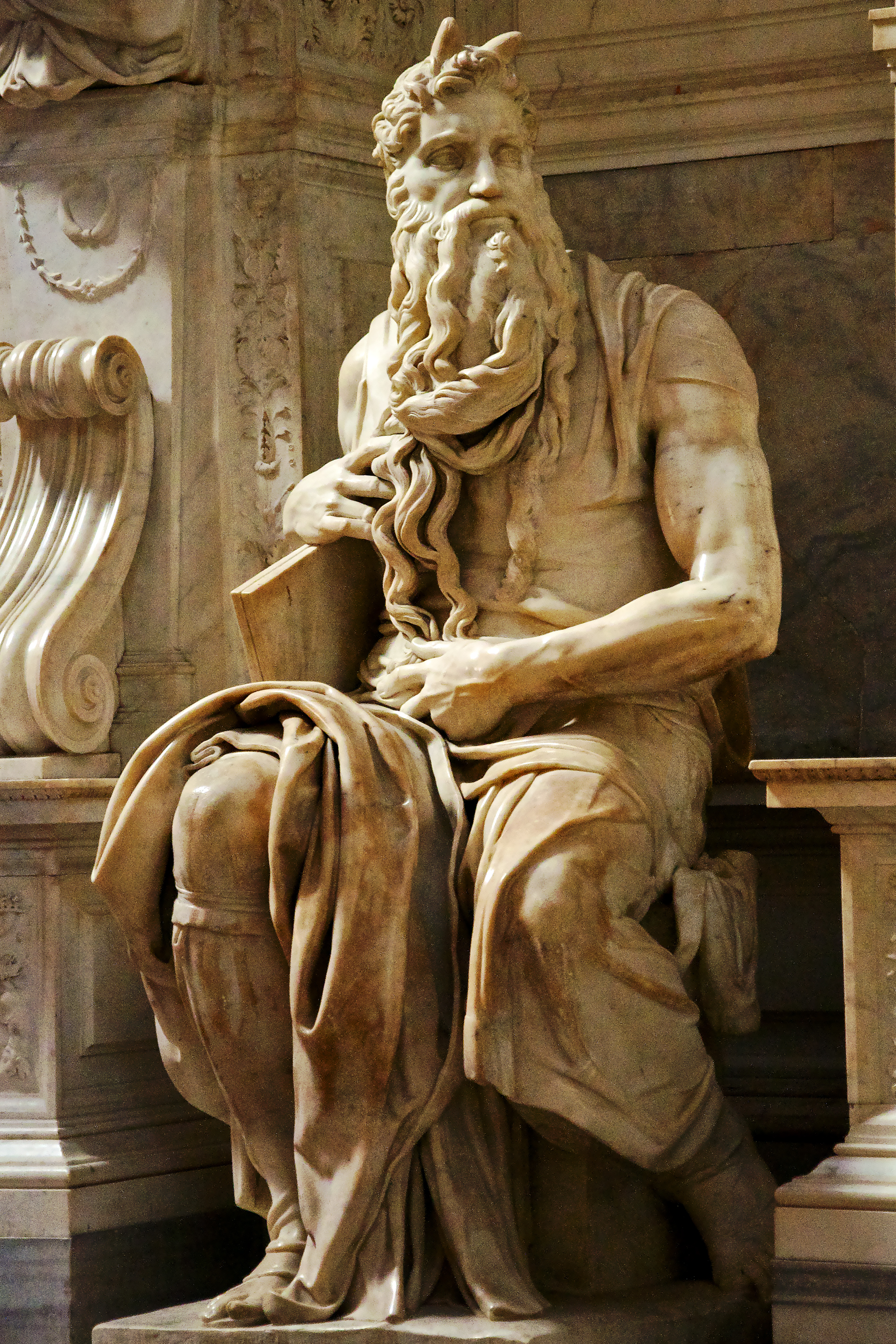
Michelangelo’s Moses, Author Goldmund100 (Luca Volpi), (CC BY-SA 3.0 Unported)
Moses is a monumental figure in the Bible – a Hebrew prophet, leader, and lawgiver [1].
This is the man who heard God from the burning bush, who demanded that the pharaoh let God’s people go, who witnessed the plagues of Egypt, who parted the Red Sea, who received the Ten Commandments from the hand of God, who led the Israelites for 40 years in the desert, and who wrote the Torah (the first five books of the Bible a/k/a the Pentateuch). He is honored by Judaism, Christianity, and Islam.
While the Bible and 3500 years of Passover observance testify to the truth of Moses’ existence, secular scholars continue to search for archaeological evidence.
Timing
A central issue relating the search for such evidence concerns the dating of Moses’ life. Traditionally, scholars have claimed he lived in the 13th Century BC, and that the pharaoh he confronted was Rameses II a/k/a Rameses the Great. However, the Bible suggests otherwise [2A].
First Kings 6: 1 indicates that Solomon built the first temple “in the four hundred and eightieth year after the children of Israel had come out of the land of Egypt.” This would place the Exodus in 1446 BC. That time frame is consistent with other biblical passages: Judges 11: 26, the number of generations listed at 1 Chronicles 6: 33-38, and Acts 13: 19-20.
Authorship
A. Proto-Sinaitic Script (Alphabet)
Some contend that Moses did not write the Torah, but that it was instead written a thousand years later by priests living in exile in Babylon who were attempting to invent a glorious past for Israel [3].
As a member of the Egyptian court, Moses would have been literate. Hieroglyphics would, however, have been a lengthy and cumbersome way of transcribing the biblical text.
What we know now is that an alphabetic script, also, existed [2B]. Sir Flinders Petrie discovered examples of this alphabet, known as Proto-Sinaitic, inscribed on stones at Serabit el-Khadim, an Egyptian turquoise mine in the Sinai. Dating from the 19th Century BC to 15th Century BC, Proto-Sinaitic script was invented by Semites working at the mine and gave rise to the alphabet we use today.
B. Name “Moses”
Douglas Petrovich more recently presented evidence that these inscriptions were written by Israelites, and that Hebrew was the language behind the script [4]. His translation of one inscription (Sinai 361) appears to contain the name Moses, though this is contested.
Some scholars, like Abraham Yehuda, suggest that the name “Moses” could be a shortened form of an Egyptian name like “Ah-meses,” “Tutmose,” or “Rameses” – all of which incorporate the element “meses” meaning “born of”, then the name of a god. Moses, having rejected the gods of Egypt, could have intentionally shortened his name [5A].
The Hebrew version of the name “Mosheh” (meaning “drawn out”) places emphasis on the act of drawing the infant from the Nile (Ex. 2: 10) [5B].
C. Egyptian Words
It should not be overlooked that there are numerous Egyptian words in the biblical text [2C]. For instance, the word “river” in the account of the infant Moses is not the usual Hebrew word “nahar”, but a transliteration of the Egyptian word for the Nile. Read more…

Timeline of generations in the Western world, Author Cmglee, (CC BY-SA 4.0 International, GNU Free Documentation License)
Indications are that Gen Z is finding religion [1]. There seem to be multiple reasons for this [2].
- Loneliness has become an epidemic in America – among young people, in particular. The social aspect of church is appealing. Cancel culture has negative consequences. By contrast, the assumption is that “no one can reject you” in church.
- Millennials (born between 1981 and 1996) have as a whole moved away from religion. Some 30% of Americans now view themselves as atheists or agnostics (the so called “nones” on surveys about religion). The move toward religion by Gen Zers (those born between 1997 and 2012) may reflect the younger generation’s rebellion.
- Covid raised the issue of mortality. The young tend to believe they will live forever. Covid cast some doubt on that.
There is a gender gap in this trend. More men than women are returning to church. Nearly 2 of every 3 Gen Z women believe religious institutions do not treat men and women equally [3]. Almost 1 in 3 Gen Z women now identify as LGBTQIA+ [4]. Read more…

We continue our examination of Psalm 23, and the tools of a shepherd.
The Staff
“The staff [or crook] is essentially a symbol of the concern, the compassion that a shepherd has for his charges…
Just as the rod of God is emblematic of the Word of God, so the staff of God is symbolic of the Spirit of God…
The first…[use of the staff] lies in drawing sheep together into an intimate relationship. The shepherd will use his staff to gently lift a newborn lamb and bring it to its mother if they become separated. He does this because he does not wish to have the ewe reject her offspring if it bears the odor of his hands upon it…
But in precisely the same way, the staff is used by the shepherd to reach out and catch individual sheep, young or old, and draw them close to himself for intimate examination…
Similarly in the Christian life we find the gracious Holy Spirit, the Comforter, drawing folks together into a warm, personal fellowship with one another. It is also He who draws us to Christ…” Read more…
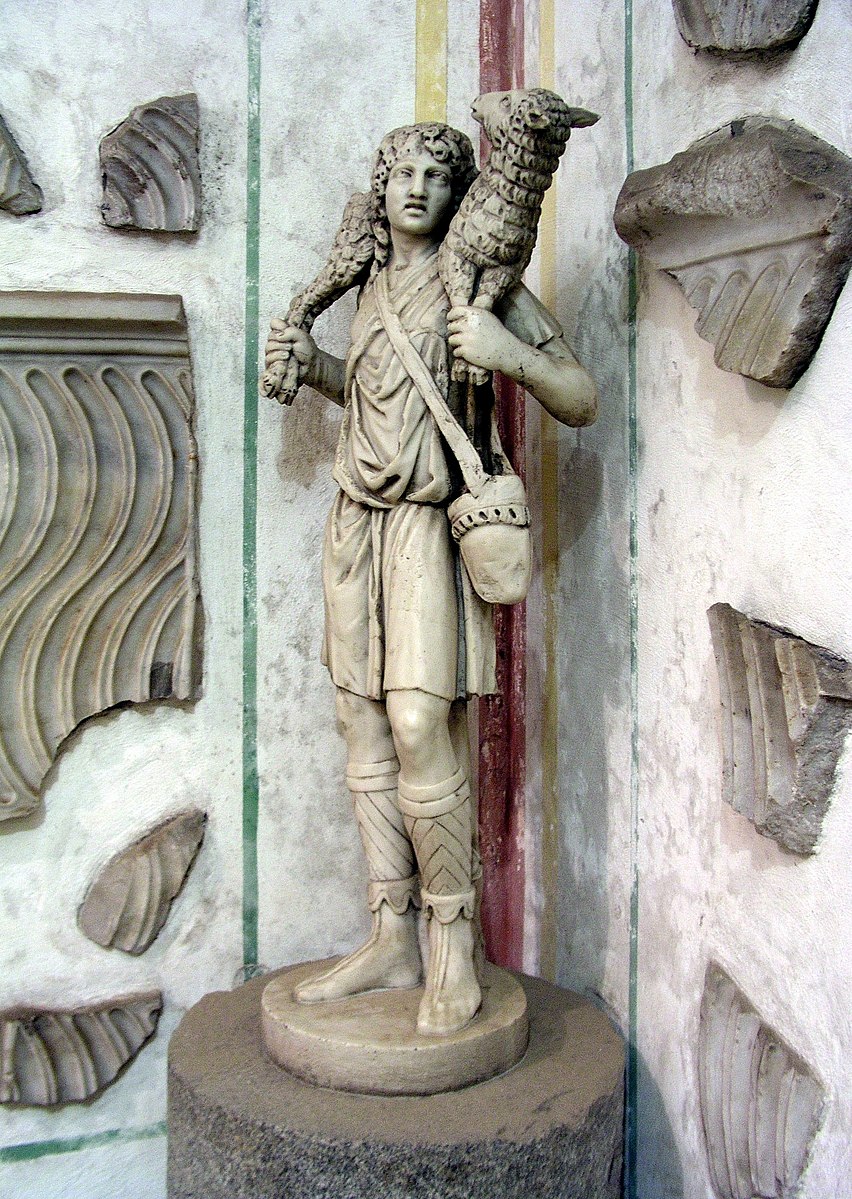
“Your rod and Your staff, they comfort me” (Ps. 23: 4).
The beloved Psalm 23 speaks of the relationship between our Good Shepherd and His sheep. We can understand this better, if we understand the tools of the shepherd.
In the Middle East the shepherd carried only a rod and staff.
The Rod
“The rod [a crude club] was, in fact, an extension of the owner’s right arm. It stood as a symbol of his strength, his power, his authority in any serious situation. The rod was what he relied on to safeguard both himself and his flock in danger. And it was, furthermore, the instrument he used to discipline and correct any wayward sheep that insisted on wandering away…
It will be recalled how when God called Moses, the desert shepherd, and sent him to deliver Israel out of Egypt from under Pharaoh’s bondage, it was his rod that was to demonstrate the power vested in him. It was always through Moses’ rod that miracles were made manifest not only to convince Pharaoh of Moses’ divine commission, but also to reassure the people of Israel…
Just as for the sheep of David’s day there was comfort and consolation in seeing the rod in the shepherd’s skillful hands, so in our day there is great assurance in our own hearts as we contemplate the power, veracity, and potent authority vested in God’s Word. For, in fact, the Scriptures are his rod…” Read more…
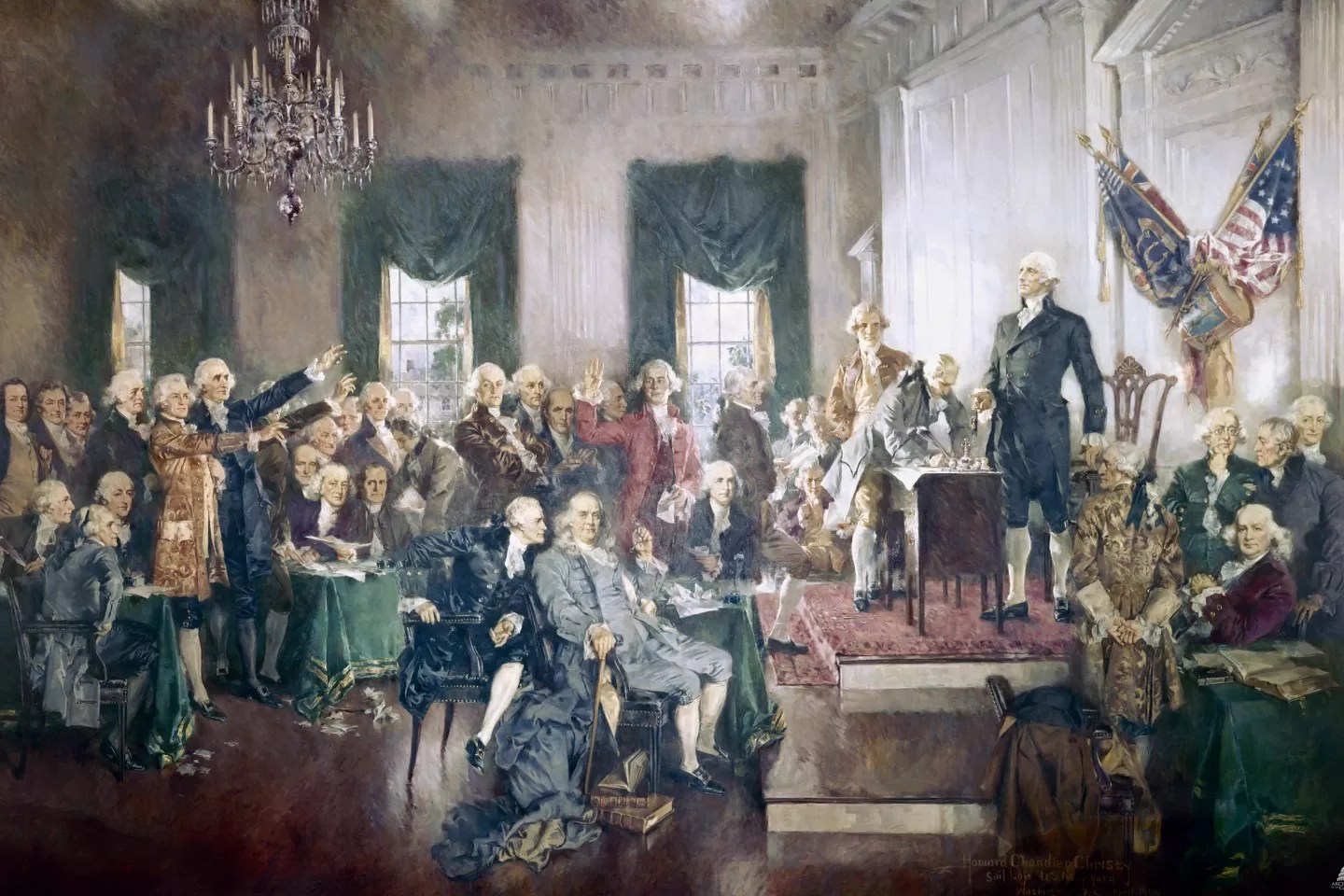
“Signing of the US Constitution” (1940) by Howard Chandler Christy, US Capitol Building (PD as work product of federal govt.)
“Remember, democracy never lasts long. It soon wastes, exhausts, and murders itself. There never was a democracy yet that did not commit suicide.”
–John Adams
Beginning in the 1920s, the Brownshirts, a Nazi paramilitary group, used violence and intimidation to suppress opposition and sway German public opinion [1]. Ultimately, Adolf Hitler was able legally to dismantle the German democratic republic in 53 days [2].
Propaganda based on misleading information played a key role in Hitler’s ascension to and retention of power [3][4]. The free press was muzzled or run out of business, and replaced with Nazi-owned machinery [5]. The judicial system was perverted, with the ethics of judges corrupted [6].
Both Russia and China have constitutions filled with high sounding phrases [7][8][9]. Yet both are totalitarian regimes which closely monitor their populations for any sign of dissent.
The United States, too, has a constitution – a document few people other than lawyers ever read [10][11]. It enshrines the liberties on which this nation was founded. Those include freedom of religion, freedom of speech, and freedom of the press.
What makes the US Constitution different is that it has, for well over 200 years, been a living document. We have fought and died over it, in the courts and on the battlefield. We reinterpret the unchanging principles on which it is based in the context of changing times.
But we are perilously close to losing our democracy now. Read more…
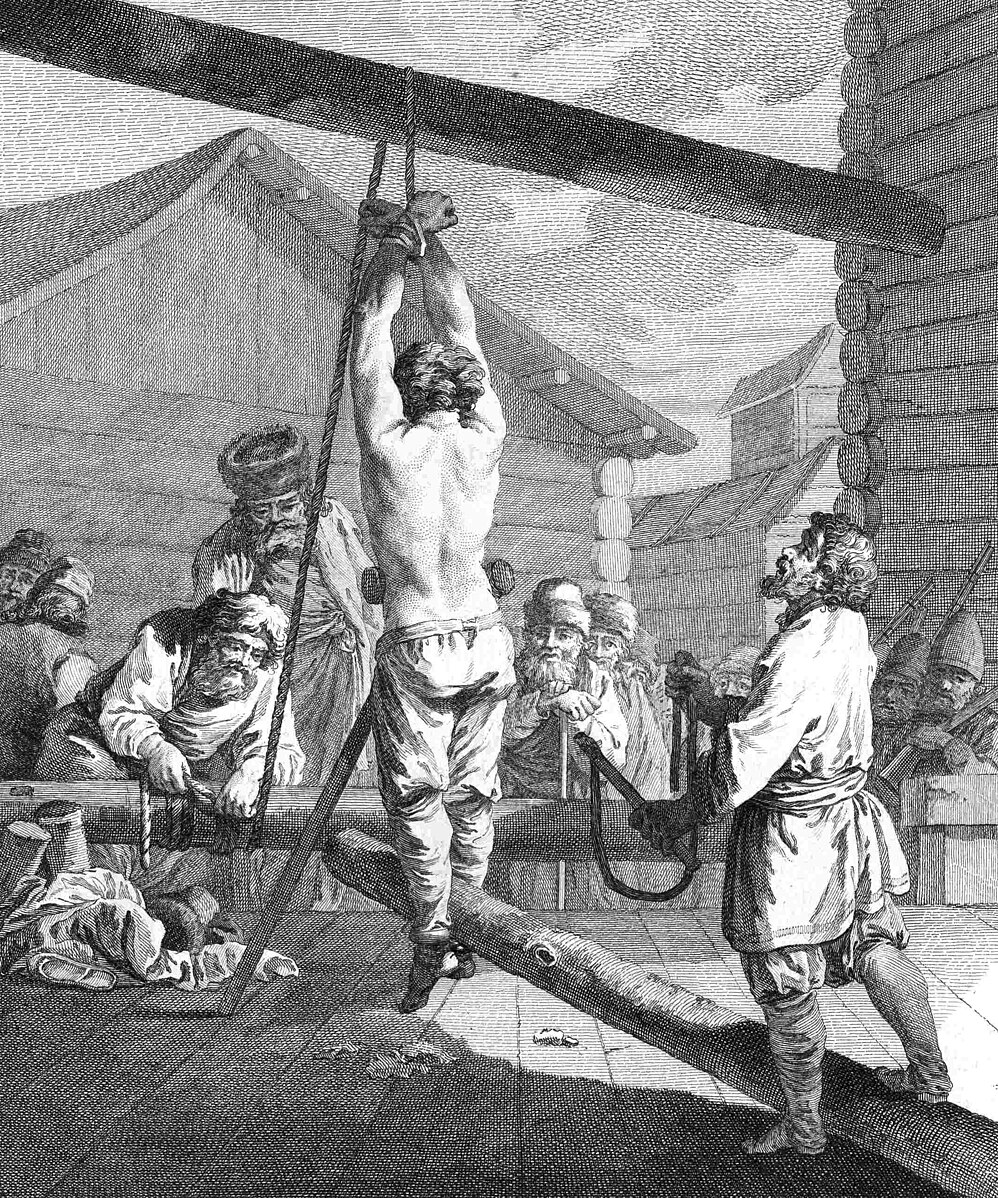
“Torture by the Grand Knout” [a whip used to inflict punishment in Siberia, often causing death], Library of Congress, (PD)
“A Russian Army captain came to a minister in Hungary and asked to see him alone. The young captain was very brash, and very conscious of his role as a conqueror. When he had been led to a small conference room and the door was closed, he nodded toward the cross that hung on the wall.
‘You know that thing is a lie,’ he said to the minister. ‘It’s just a piece of trickery you ministers use to delude the poor people to make it easier for the rich to keep them ignorant. Come now, we are alone. Admit to me that you never really believed that Jesus Christ was the Son of God!’
The minister smiled. ‘But, my poor young man, of course I believe it. It is true.’
‘I won’t have you play these tricks on me!’ cried the captain. ‘This is serious. Don’t laugh at me!’
He drew out his revolver and held it close to the body of the minister.
‘Unless you admit to me that it is a lie, I’ll fire!’
‘I cannot admit that, for it is not true. Our Lord is really and truly the Son of God,’ said the minister.
The captain flung his revolver on the floor and embraced the man of God. Tears sprang from his eyes.
‘It is true!’ he cried. ‘It is true. I believe so, too, but I could not be sure men would die for this belief until I found it out for myself. Oh, thank you! You have strengthened my faith. Now I too can die for Christ. You have shown me how.'”
The above is a true account, recorded by Richard Wurmbrand in Tortured for Christ. Wurbrand, himself, was imprisoned by the Communists for 14 years. During that time, he was repeatedly tortured and brainwashed. He spent nearly three years in solitary confinement. Read more…
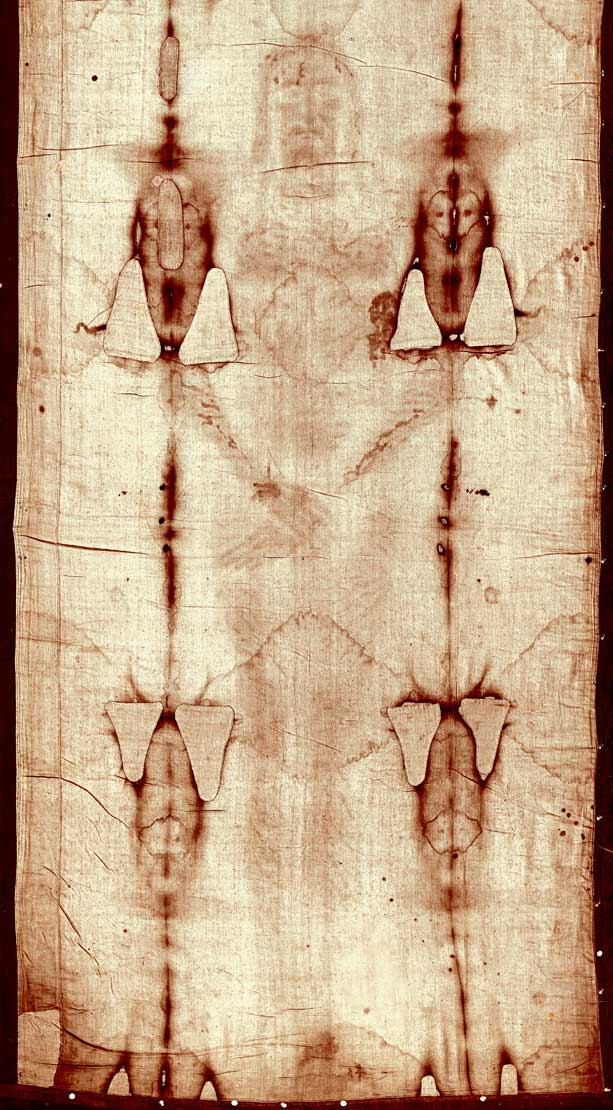
Shroud of Turin (PD)
Venerated by many as the burial shroud of Christ, the Shroud of Turin is a length of linen cloth bearing the faint image of a man who was scourged and crucified [1A][2][3][4].
What appear to be blood stains are present on the front and back of the cloth. However, the image is not merely the result of having been draped over a bloody body or it would appear distorted.
History
The Shroud is thought to have been brought initially from Jerusalem to Constantinople, then to Western Europe during the Crusades. It was first exhibited in 1354 AD in Lirey, France.
The Shroud was acquired by the House of Savoy in 1453 AD. It was damaged in a fire at the Chapel of Chambery in 1532 AD. The Shroud has been kept in the Chapel of the Holy Shroud in Turin, Italy since 1683 AD. Ownership of the Shroud did not pass to the Catholic Church until 1983.
Photography
The image on the Shroud of Turin is, for all intents and purposes, a photonegative on a linen cloth which is not photosensitive, centuries before photography was developed. This was discovered when the Shroud was first photographed in 1898 by Secondo Pia.
Scientific Testing
Controversies surround the Shroud of Turin.
A. Anatomy
Most agree that the image on the Shroud is anatomically correct. It depicts a man between 5’7” and 6’2” in height. The body is naked, which is consistent with Roman crucifixion practices intended to humiliate the victim.
The body has the following characteristics:
- A broken nose;
- A swollen face, and bruised right eye;
- Part of the beard plucked out;
- Wounds on the head from a crown of thorns;
- Some 120 tearing wounds on the back and legs produced by scourging;
- Bruises on the shoulder due to carrying a cross;
- Knee injuries from repeated falls;
- Nail wounds on the hands and feet from crucifixion;
- An oval wound between the fifth and sixth ribs on the right side (serosanguineous fluid on the cloth demonstrating that this injury occurred after death).
Blood flow is at an angle consistent with the arms held at a 70 degree angle on the cross.
The wrists are crossed. The thumbs are turned under which is consistent with median nerve contraction as the result of nails through the wrists (today considered more likely than nails through the palms).
B. Place of Origin
Pollen grains have been found on the Shroud consistent with an origin in the Holy Land. There are, also, pollen grains which reflect its travel across Europe. Read more…

 A Lawyer's Prayers