
“The Temptation of Christ” (1854) by Ary Scheffer, Walker Art Gallery (Accession No. WAG 6584), Liverpool, England, (PD)
The Bible records in detail Christ’s temptation in the desert before He began His ministry. Since Christ was fully human, as well as fully divine, we can be sure this was not the only time He was tempted (Heb. 4: 15).
We can learn much from the temptation of Christ, not only about Him but ourselves.
Satan, we know, sought to tempt Christ in an effort to undermine the plan of Salvation, formulated before the foundations of the world were laid (Eph. 1: 4; 1 Peter 1: 19-20). Redemption required a sinless Savior.
But the temptations in the desert can, also, be applied to the ages of man. Archbishop Fulton J. Sheen explored that in his book A Brief Life of Christ [1].
First Temptation
“Then Jesus was led up by the Spirit into the wilderness to be tempted by the devil. And when He had fasted forty days and forty nights, afterward He was hungry. Now when the tempter came to Him, he said, ‘If You are the Son of God, command that these stones become bread.’ But He answered and said, ‘It is written, “Man shall not live by bread alone, but by every word that proceeds from the mouth of God”‘” (Matt. 4: 1-4).
Satan first urged Christ to become an economic savior, to offer the public wealth, prosperity, and the overthrow of the elite. This would have assured His popularity, as it later did for such pseudo-saviors as Joseph Stalin and Mao Tse-tung who made false economic promises.
Knowing His destiny, however, Christ declined this suggestion.
This first temptation, also, parallels the first stage of man’s life, i.e. his youth. Since cognitive reasoning skills take time to develop, temptations involving the flesh or physical gratification are difficult to resist at this stage. Think of an infant crying for a bottle or a small child longing for a toy.
“It is in our youth that we must learn that our passions are not necessarily wrong, but ‘eating bread’ without God will harm us, meaning that we should reject passions outside of God’s will, even if we must go ‘hungry’.”
–Archbishop Fulton J. Sheen [2A]

“Stu-mick-o-sucks (Buffalo Bull’s Back Fat, Head Chief, Blood Tribe) (1832) by George Catlin, Smithsonian American Art Museum, (PD)
Confronted with the human history of war, crime, corruption, and environmental destruction, some part of our hearts longs for a lost Eden.
The Noble Savage
The Greek poet Homer, as long ago as the 8th or 9th Century BC, idealized primitive societies like the Arcadians [1A]. The historian Tacitus in 98 AD attributed honesty and bravery to the German tribes Romans viewed as barbarians [1B].
The 18th Century philosopher Jean-Jacques Rousseau in his work Discourse on Inequality argued that human beings in their “natural” uncivilized state are inherently good, peaceful, and egalitarian [1C]. This popularized the idea of the “noble savage”, though Rousseau did not use the term.
The stereotype of the “noble savage” (essentially a fantasy) was applied to indigenous groups like Native Americans, though ultimately with negative consequences for them [1D][2]. While romanticizing such groups, Europeans could distance themselves, and legitimize colonization. Indigenous people were natural, but Europeans were considered culturally superior.
The Nobel Savage Today
The concept of the “noble savage” never reflected the real nature of indigenous people, or the complexity of relations with them. Nor did it describe the true nature of mankind.
Nonetheless, that concept has again been adopted by our own culture in the context of environmentalism and land stewardship. Indigenous groups from Australia to the Amazon are said to possess a concern for nature unmatched by the industrial West [3A]. Read more…

The Patriarch Abraham, detail of “Abraham Casting Out Hagar and Ishmael” (1657) by Guercino, Brera Art Gallery, Italy, Author Octave 444 (CC BY-SA 4.0 International)
“I will make you a great nation…And in you all the families of the earth shall be blessed” (Gen. 12: 2-3).
God promised the Hebrew patriarch, Abraham, that his descendants, the Jews, would be a blessing to all the earth [1]. That promise has been fulfilled many times over.
Medicine
Historically, Jews emphasized education and literacy, so that their children could study and understand the Torah.
As a result, about 14% of physicians in the United States are Jewish, although Jews make up only about 2.5% of the general population. In other words, Jews are greatly overrepresented in the medical field [2].
- The vaccine developed by Jewish physician, Dr. Jonas Salk, conquered polio – once a public health threat which paralyzed and killed thousands. Salk chose not to patent the vaccine, prioritizing public health over profit [3A]. Within ten years, polio cases in the United States dropped from 35,000 to 161. There was only 1 reported case in 2024 [3B].
- Research by Dr. Paul Zoll, a Jewish surgeon during World War II, led to the development of external defibrillators and pacemakers, now widely used in heart disease [3C].
Science
According to a Pew Research Center study, approximately 8% of scientists identify as Jewish [4]. This, too, is significantly higher than the percentage of Jews in the general population.
Between 1901 and 2023, around 22% of Nobel Prize winners – among them Albert Einstein – had at least one Jewish parent. This is 110 times the percentage of Jews in the world’s population [5]. Similarly, 37% of the recipients of the US National Medal of Science, and 27% of the recipients of the Kyoto Prize have been Jewish [6A].
- Stainless steel, a critical material in modern medicine, construction, and transportation, is credited to Hans Goldschmidt, a German chemist of Jewish descent [3D].
- Jewish American scientist, Paul Berg, discovered recombinant DNA molecules in 1972, revolutionizing both medicine and agriculture [7].
Communication
We take for granted the internet and software now an integral part of modern life. However, the co-founder of Google, Sergey Brin, is Jewish. So were the cofounders of PayPal, Oracle, Lotus, EBay, and Facebook [6B]. Jewish Americans, also, pioneered the technology that led to WiFi, GPS, and Bluetooth [8]. Read more…

Altered image of God from Michelangelo’s “Creation of the Sun and Moon” for use by Template:User atheist2, Presumed Author CenozoicEra~commonswiki (CC BY-SA 3.0 Unported)
DEFINITION
Delusion – a persistent strong belief in the face of solid evidence to the contrary.
Christians are often accused of being under a delusion. God, we are told by Sigmund Freud and other atheists, is merely the imaginary product of our wishful thinking. We cannot cope with reality. We long for comfort and protection against harm, so create a fantasy figure. We devise a pie-in-the-sky life after death to offset current inequities.
Nothing, of course, could be further from the truth. But the accusation is worth examining, since it reveals a great deal about our accusers.
The One True God v. Pagan Gods
Atheists (some scientists among them) often conflate the Judeo-Christian God with pagan gods like Apollo and Zeus. This is an attempt to diminish God in importance.
While it is true that Apollo and Zeus have long since been shown powerless and relegated to the shelf, the triune God does not fall into the same category. God is not simply the label we apply to phenomena we cannot explain. Unlike pagan gods, He had no beginning and will have no end.
Science v. Religion
“Religion is a fairy story for people afraid of the dark.”
–Stephen Hawking, physicist, cosmologist, and professed atheist, when interviewed by “The Guardian”
“Atheism is a fairy story for people afraid of the light.”
–Dr. John Lennox, mathematician, philosopher of science, and Christian apologist, when interviewed by Grand Canyon University News Bureau
There is a widespread belief that one must choose between science and God. This reveals two things: a vast ignorance about the history of science, and the many Christian scientists who advanced it because of their belief in God; and a limited worldview grounded in materialism.
“Everyone who is seriously involved in the pursuit of science becomes convinced that a spirit is manifest in the laws of the Universe – a spirit vastly superior to that of man, and one in the face of which we with our modest powers must feel humble.”
–Albert Einstein, physicist who developed the Theory of Relativity, in “The World as I See It”
Modern science was an outgrowth of the Christian view that God is a rational deity who made the world comprehensible. Isaac Newton, not a traditional Christian, was inspired by the fact we can understand natural laws; Albert Einstein, a deist though not a Christian, was astonished by that fact.
CS Lewis put it this way:
“Men became scientific because they expected Law in Nature, and they expected Law in Nature because they believed in a Legislator.”
–CS Lewis in “Miracles”
There is no “scientific” reason the world should be comprehensible. That it is points us toward God, and is likely one of the reasons He made it so. Read more…
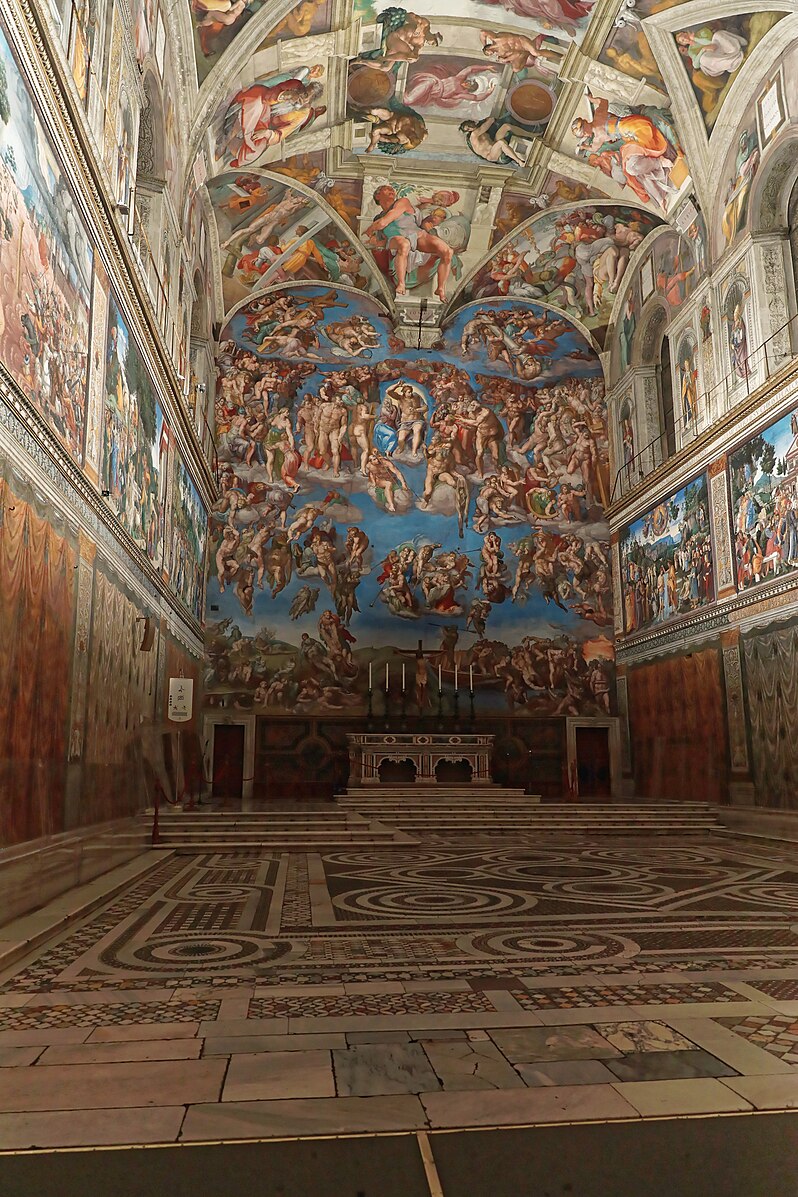
Sistine Chapel (1508 – 1512) by Michelangelo, Author Burkhard Mucke, (CC BY-SA 4.0 International)
“God…has in these last days spoken to us by His Son…who being the brightness of His glory and the express image of His person…when He had by Himself purged our sins, sat down at the right hand of the Majesty on high” (Heb. 1: 1-3).
Sacred art raises the mind and heart to God; draws people to prayer and adoration; and attempts to express the mystery of God through artistic media [1]. Christians who approve such art consider it justified by the Incarnation, through which Christ took on human nature (along with His divine) and was seen in the flesh.
Famous examples of sacred art from the Renaissance and Baroque Periods include the Sistine Chapel by Michelangelo Buonarroti; “The “Annunciation” by Fra Angelico; the “Transfiguration” by Raffaello (“Raphael”) Sanzio da Urbino; “The Taking of Christ” by Michelangelo Merisi da Caravaggio; and “Christ Crucified” by Diego Velazquez.
But artistic styles have varied greatly across the centuries.
During the early Middle Ages, perspective was largely unknown. However, painting played a vital role in educating the faithful [2]. Medieval art was rich in symbolism. Doves symbolized the Holy Spirit; lambs symbolized innocence and purity. Christ was represented by a lion, or by a lamb with an exposed heart, holding a cross. In Byzantine art, in particular, a gold background signified the glory of God and the heavenly realm [3].
Ornate altar screens a/k/a rood screens separated the domain of the clergy (chancel) from the area at church where lay people gathered to worship (nave), and were decorated with pictures of Christ, the Virgin Mary, and the saints [4].
Sacra Conversazione (“sacred conversation”) paintings featuring the Virgin Mary and Child surrounded by saints became popular in 16th century Italy. These were private devotional images, scenes which had no express basis in scripture or doctrine [5][6].
Fearing that such depictions could lead to idolatry, Protestants destroyed much sacred art during the Reformation [7]. Read more…

“The Good Samaritan tending the wounds of the traveler (Luke 10: 25-37)” (1665) by Nicolaes Roosendael, Frans Hal Museum (Accession No. os I-297), Source/Photographer Geheugen van Nederland, (PD)
“‘And you shall love the Lord your God with all your heart, with all your soul, with all your mind, and with all your strength.’ This is the first commandment. And the second, like it, is this: ‘You shall love your neighbor as yourself.’ There is no other commandment greater than these” (Mark 12: 30-31).
When questioned about the Trump Administration’s aggressive deportation of illegal immigrants and sudden cancellation of almost all foreign aid programs, VP JD Vance referred in a recent interview to the biblical principles known to Catholics as ordo amoris (rightly ordered love) [1].
This raised a firestorm. It seemed to some that the Vice President was using religion to justify the “America First” policy long put forward by Pres. Donald Trump [2][3]. While not necessarily endorsing Trump Administration policies, others explained the concept of ordo amoris as a series of concentric circles of love [4]. Even Pope Francis weighed in, expressing concern in a letter to Catholic bishops [5].
Since we are daily bombarded by conflicting obligations, the Bible does provide us guidance in formulating our priorities – both on an individual and a societal basis. Setting both personal agendas and public policy involves confronting the limitation on available resources. Therein lies the challenge.
Family Dysfunction
One might suppose that few need to be reminded to care for their families (1 Tim. 5: 4, 8). Yet there are numerous dysfunctional families where such care is lacking. Does society have an obligation to care for the children whose parents do not do so? The Bible confirms that it does. We are to care for the widow and orphan (Isa. 1: 17; Matt. 25: 34-40; James 1: 27). What form that care takes and how far it extends is the issue at the heart of public assistance of all kinds.
Poverty
Does society have an obligation to care for the poor? Again, the Bible supports this with countless passages about God’s love for the poor. What we grapple with as a nation is how to distinguishes between those truly unable to care for themselves and those malingering – how to care for the former, and incentivize the latter to care for themselves (1 Tim. 5: 5-6).
Included in this calculation must be a determination of whether the poverty in our own nation should be addressed before the poverty in other nations, and where the correct balance lies. This is just one issue over which the political Right and Left clash [6].
Immigration
Are we to welcome the stranger and treat him fairly? This is unquestionably a biblical mandate (Lev. 19: 34; Deut. 27: 19; Ex. 23: 9). It does not mean we cannot place limits on immigration, or requirements on citizenship. However, what those limits and requirements should be is not spelled out in the Bible. This, too, is an issue over which the Right and Left clash.
There is no algorithm, no formula that will answer these questions for us. Though practicalities will inevitably play a role, we must be guided by conscience. But biblical principles are not to be taken out of context, and appropriated for political ends [7]. It is all too easy to mistake our own priorities for God’s…and label them accordingly.
The Good Samaritan
In large part, the outcome of all this will depend on who we define as our “neighbor”.
The lesson of the Good Samaritan is not to be forgotten: “If someone says, ‘I love God,’ and hates his brother, he is a liar; for he who does not love his brother whom he has seen, how can he love God whom he has not seen?” (1 John 4: 20).
We are a nation richly blessed by God. Our great resources come with a correspondingly great obligation to use them generously, not for our benefit alone [8]. That, as Christians, we are first to do good to the faithful (Gal. 6: 10) does not translate into “America First”.
Whether the Trump Administration will choose to apply these biblical principles remains to be seen. But there are troubling signs.
—
[1] Catholic News Agency (CAN), “What is the ‘ordo amoris’? JD Vance’s comments on Christian love spark debate” by Jonah McKeown, 2/4/25, https://www.catholicnewsagency.com/news/261989/what-is-the-ordo-amoris-jd-vances-comments-on-christian-love-spark-debate#:~:text=Though%20you%20won%27t%20find%20the%20term%20%E2%80%9Cordo,love%E2%80%9D%20in%20his%20work%20%E2%80%9COn%20Christian%20Doctrine.%E2%80%9D.
[2] Time, “What Is ‘Ordo Amoris’? JD Vance Invokes Catholic Concept When Justifying Immigration Crackdown” by Associated Press, 2/6/15, https://time.com/7213348/what-is-ordo-amoris-vice-president-jd-vance-invokes-catholic-concept-immigration/
[3] Patheos, “What Vance Got Wrong on Ordo Amoris” by Julia Smucker, 2/10/25, https://www.patheos.com/blogs/voxnova/2025/02/09/what-vance-got-wrong-on-ordo-amoris/.
[4] Word on Fire, “First, Love Locally: JD Vance and ‘Ordo Amoris’” by Dr. Richard Clements, https://www.wordonfire.org/articles/first-love-locally-jd-vance-and-ordo-amoris/.
[5] Church Leaders, “Pope Appears to Correct JD Vance on the ‘Ordo Amoris’ in Letter to Bishops on Immigration” by Jessica Lea, 2/14/25, https://churchleaders.com/news/505831-pope-francis-jd-vance-ordo-amoris-bishops-immigration.html.
[6] Ironically enough, it is the Left (often characterized as “godless”) which advocates for more foreign aid to impoverished nations.
[7] David Cassidy, “Augustine, Aquinas, the Veep, and Ordo Amoris” by David Cassidy, 2/10/25, https://www.davidpcassidy.com/blog/thomas-aquinas-and-the-ordo-amoris-a-response-to-jd-vances-interpretation#:~:text=The%20Ordo%20Amoris%E2%80%94the%20%E2%80%9Corder,family%20and%20grow%20in%20grace.
[8] America Magazine, “The problem with JD Vance’s theology of ‘ordo amoris’ – and its impact on policy” by Stephen Pope, 2/13/15, https://www.americamagazine.org/faith/2025/02/13/ordo-amoris-stephen-pope-vance-249926.
READERS CAN FIND MY VIEWS ON ABUSE AND ABUSE-RELATED ISSUES AT ANNA WALDHERR A Voice Reclaimed, Surviving Child Abuse
https://avoicereclaimed.com

Gutenberg Bible, Latin Vulgate (1455), Image originally posted to Flickr, Author NYC Wanderer (Kevin Eng), (CC BY-SA 2.0 Generic)
“The ends justify the means.”
–Niccolo Machiavelli, as frequently misquoted from Chapter XVIII of “The Prince” [1]
“Attempting to legislate faith does not create disciples; it creates resentment.”
–Bruce Cooper, Christian blogger [2]
It may be a relief to Christians that the Trump Administration has shifted the direction of government toward Christian values, and away from the Woke values of the Biden Administration, along with expressing strong support for Israel. But we must not applaud too readily.
Among other things, Pres. Donald Trump has already in the first few weeks of his second term:
- Created a Dept. of Justice Task force to root out anti-Christian bias in the federal government;
- Established a White House Faith Office to defend religious liberty and promote faith based adoption and foster care programs;
- Declared that the US will recognize only two sexes (male and female), excluding transgender individuals from the military;
- Signed an executive order titled “Protecting Children from Chemical and Surgical Mutilation” to restrict sex change operations for minors;
- Eliminated Diversity/Equity/Inclusion (DEI) programs in the federal government;
- Pardoned a number of anti-abortion activists;
- Withdrawn the US from the World Health Organization; and
- Rescinded sanctions the former Administration imposed on West Bank settlers [3][4][5][6].
While these actions may be well intentioned, they are not necessarily all wise.
True, anti-Christian bias is a reality, inside government and out. There are only two sexes in God’s eyes, and life is precious to Him. So called “Diversity/Equity/Inclusion” (DEI) programs, while arguably well-meaning, focus on identity politics with the ultimate goal of creating a strict standard against which organizations can be evaluated (and severely penalized for non-compliance). The World Health Organization is unabashedly globalist, as its first Director General, Brock Chisholm made terrifyingly clear [7][8].
However, the goal of Christianity was NEVER political power. If it had been, Christ would have overthrown the Roman Empire, and established an earthly kingdom when He walked this earth.
Salvation
The goal of Christianity is eternal Salvation. And Salvation cannot be legislated. It is a personal decision between an individual and his/her God which involves repentance, faith, and a conscious decision to follow Christ (Rev. 3: 20) [9].
Indeed, those forced to adopt Christianity outwardly are all the more likely to develop a hidden resentment toward it [10]. Read more…

“Massacre of the Innocents” by Leon Cogniet (1824), Source Museum of Fine Arts of Rennes (Accession No. 88.6.1), (PD-Art, PD-Age)
Mala Cumana were apples from the Greek colony of Cumae in Southern Italy picked only at midnight under a full moon, supposedly to imbue them with magical properties [1A][2]. Considered a rare delicacy during the Roman Empire, the apples were preserved in wine, with honey and spices.
King Herod the Great (infamous for the murders of his wife Mariamne and sons, as well as the Massacre of the Innocents recorded in the Bible) is known to have had Mala Cumana packed and shipped 1500 miles to his palace fortress at Masada [1B][3][4].
Luxury Fruit
PlazaFresh, based in the Netherlands, sells apples picked at midnight under a full moon today [5]. In fact, their popularity has continuously increased, since they again became available. Though apples have been associated with magic in many cultures, this seems to have less to do with magic, than with the growing trend of luxury fruit [6A][7].
Noble Fresh Cart sells a single Crown melon – grown on a vine from which every other fruit was pruned, to increase its sweetness – for around $150 [8]. Del Monte offers a Ruby Glow pineapple, packaged as if it were a work of art, for $400 [9A]. Oishii offers a solitary strawberry, grown indoors under special lights, without the use of chemicals, for $2 [9B].
There are legitimate reasons for these prices: selective breeding, intensive farming practices (individual vine tending, and the like), and strict quality controls (implying a high discard rate of less than perfect product) [6B]. Certainly, this amount of care can improve taste. But the attraction of such produce is less about quality, and more about prestige.
Poverty and Malnutrition
According to the US Census Bureau, 37.9 million people were living in poverty in the United States in 2024, over 9 million of these children [10][11]. Malnutrition is closely intertwined with poverty [12]. Children living in poverty rarely have access to fresh fruit and vegetables…let alone luxury fruit. Read more…

Nigerian women carrying water, Author Shamus08 (CC0 1.0 Universal Public Domain Dedication)
“Religion that is pure and undefiled before God the Father is this: to visit orphans and widows in their affliction…” (James 1: 27 ESV).
- The Fulani Militia are from a nomadic Muslim tribe, based in central Nigeria. As of 2014 the militia were named the fourth deadliest terrorist group in the world by the Global Terrorism Index (the others being Boko Haram, the Taliban, and ISIS-West Africa) [1A]. Fulani Militia target non-Muslim communities, particularly Christians. They attack isolated communities and individuals at their most vulnerable, including men and women working in the fields [1B].
- Boko Haram is a self-proclaimed jihadist terrorist organization based in Nigeria but, also, active in Chad, Niger, Cameroon, and Mali [2][3]. Boko Haram and ISIS-West Africa carry out hundreds of kidnappings and ambushes in Nigeria annually using small arms, captured military equipment, and improvised explosive devices [4].
Islamist attacks have widowed over 10,000 Christian women in Nigeria in the past 20 years [5A]. Many women have young children now left fatherless. Widows may be forced into prostitution, in an effort to feed their children.
Meanwhile, Sudan has the world’s largest hunger crisis and world’s largest displaced population, with nearly nine million people having fled their homes [6]. Neither side in the conflict there – the Sudanese Armed Forces supplied by Iran or the paramilitary Rapid Support Forces – is sympathetic to Christians, giving Islamist extremists greater opportunity to target them [7][8]. Sudanese Christians from a Muslim background are at particular risk. Read more…

Image courtesy of Pixabay, Author TyliJura
“Apart from Christ there is no art, no science, no technology, no agriculture, no microprocessor, and no medical innovation. If God is the center of our life, technology is a great gift. If technology is our savior, we are lost.”
–John Piper, author of “Desiring God“
Technology is neither a threat to God, nor inherently adverse to Him. How we view and apply technology is what matters. Both David and Goliath employed the technology of their day. So, of course, did Hitler.
Surveillance cameras, smart phones, and electronic vehicles all reflect recent rapid advances in technology. The pace of change can at times feel overwhelming.
And technology can alter the way we see ourselves, dehumanizing us if we allow it to do that. Despite artificial intelligence’s potential benefits for productivity, medicine, and national defense, AI can diminish the importance we place on human beings.
Technology can, also, inflate our egos. We may begin to believe that science is superior to religion, even that we have become gods.
Both these extremes feed into today’s Transhumanist Movement. Transhumanism is a philosophic and scientific movement aiming to utilize technology to exceed normal biological limitations and extend human lifespan [1]. Julian Huxley originated the concept in 1957. Read more…

 A Lawyer's Prayers