“He will bring forth justice for truth. He will not fail or be discouraged, ’til He has established justice in the earth; and the coastlands shall wait for His law” (Is. 42: 3-4).
In every heart there is initially a longing for justice, the recognition of God’s law. This forms the basis for conscience. Standards of morality may differ from one society to the next. Sensitivity of the conscience will differ from one individual to another. But from the start, we bear the handprint of our Maker.
This does not imply that we will never sin. To the contrary, conscience is intended to warn us against sin. It points even those entirely unacquainted with Jewish or Christian Scripture toward God. Read more…

Detail from “Jesus and the Children”, Stained Glass Window by Franz Borgias Mayer at Cathedral of Our Lady of the Angels, Los Angeles, CA, Photo by Andreas Praefcke (Licensed-PD-Art)
The children were lined up for lunch in the cafeteria of a Catholic elementary school. At the head of the table was a pile of apples. The nuns had made a large sign, and posted it on the apple tray: “Take only ONE. God is watching.” Farther along the lunch line, at the other end of the table, was a pile of chocolate chip cookies. A child had scribbled a note, “Take all you want. God is watching the apples.”
Sweet joke. God is not, of course, stingy. He made – and watches over – apples and chocolate chip cookies alike. Not to mention children.
“ ‘Let the little children come to Me, and do not forbid them; for of such is the kingdom of heaven’ ” (Matt. 19:14).
Lord Jesus, we lift our little ones up to You at this time.
To our shame, there are children in our world – in our own cities even – without adequate food or clothing; without adequate shelter. Daily there are children exposed to guns, drugs, and alcohol. Daily there are children neglected or abused.
Having borne the brunt of our sins, You better than anyone know the impact of those sins on our children. Reach out to our little ones, especially those at risk. Surround them with Your love and protection.
Amen
READERS CAN FIND MY VIEWS ON ABUSE AND ABUSE-RELATED ISSUES AT ANNA WALDHERR A Voice Reclaimed, Surviving Child Abuse
https://avoicereclaimed.com
At the time of this writing there were two major abuse cases on trial in Pennsylvania: Msgr. William Lynn, alleged to have facilitated the systematic cover up by Catholic Church officials of pedophile priests; and former Penn State University coach Jerry Sandusky, alleged to have molested ten boys.
Each year, some six million children in the United States are sexually or physically abused. Since abuse is so common and the scars of abuse can last a lifetime, there is every possibility an attorney will at some point in his or her career encounter an abuse survivor, whether as a client or otherwise.
This article is an attempt to explore the emotional and spiritual ramifications of abuse, and provide Christian attorneys some guidance in dealing sensitively (and biblically) with abuse victims. Not all abuse victims, are, of course, Christian. However, the principles outlined here are intended to be universal.
Predators – Responsible Adults
It must be said at the outset that children are NEVER responsible for the abuse inflicted upon them. The idea of a “bad or “seductive” child is a lie perpetrated by child molesters, a rationale to excuse their heinous actions.
Predators are often manipulative, convincing child victims that they brought on the violation; consented to the violation; will not be believed, if the violation is reported; will be sent away from home, if the violation is reported; will place their parents (or pets) in danger, if the violation is reported, etc.
As a consequence, victims will often experience a misplaced sense of guilt and shame. Read more…
It would be remiss not to acknowledge the many paralegals, law students, and legal secretaries with whom attorneys serve. Though we take the bows, the support of these capable and devoted individuals is essential to our success.
Who else types and catalogues (not to mention copies) thousands of pages a year for us? Who else manages to find not only the documents we misplaced, but the most obscure of cases on point for our cause?
Who rushes to Court to bring us new information in the midst of a trial? Who stays late evenings at our side, types multiple revisions, comes in on snow days, collates motion papers on the floor…and puts up with us, in general? Read more…

“Three Lawyers in Conversation” by Honore Daumier (PD-ArtlPD-old-100)
“Talk no more so very proudly; let no arrogance come from your mouth, for the Lord is the God of knowledge; and by Him actions are weighed” (1 Sam. 2: 3).
In case you have not noticed, we lawyers have a tendency toward arrogance. The trait is not what anyone would call Christian, and does not exactly endear us to others.
Oh, arrogance has its uses. Arrogance can intimidate those who believe the sight of a chest being pounded signifies strength. Sometimes we pound our chests to convince ourselves of that very thing.
Arrogance may be employed defensibly, as armor against the barrage of barbs, disappointments, and failures we must be prepared to endure, in the hope of ultimate success on behalf of our clients. The world, by contrast, views hope as an emotion not worth acknowledging. Hope might imply weakness, because it admits of the possibility of defeat. Defeats bounce off arrogance; they can be blamed on circumstances or the errors of subordinates – though, deep down, we know the truth. Read more…

Golden Gate through which it is said the Messiah will return, Source https://www.flickr.com, Author Chadica (CC Attribution 2.0 Generic)
A legend from the Talmud:
Rabbi Yoshua ben Levi came upon Elijah, and asked the great prophet when the Messiah would at last come. “Go and ask Him yourself,” Elijah replied. Astonished, the rabbi then asked where the Messiah was to be found.
“Sitting at the gates of the city, among the poor and covered with wounds,” Elijah replied.
Sure enough, Rabbi Yoshua found the Messiah sitting among the poor at the gates of the city. After some hesitation, the rabbi inquired respectfully, “When is the Master coming?” “Today,” the Messiah responded.
Disappointed, Rabbi Yoshua returned to Elijah, who asked why he appeared so dejected. “The Messiah deceived me,” responded the rabbi, “for He said, ‘Today I am coming’ and He has not come.” Elijah gently corrected the rabbi, “This is what He told you: today if you would listen to His voice.”
Today He stands at the gate to our hearts. Today He knocks and seeks entry. Today we are invited to join in His supper. Today we are called to follow in His footsteps.
“Today, if you will hear His voice: ‘Do not harden your hearts…’” (Ps. 95: 7-8).
READERS CAN FIND MY VIEWS ON ABUSE AND ABUSE-RELATED ISSUES AT ANNA WALDHERR A Voice Reclaimed, Surviving Child Abuse
https://avoicereclaimed.com
 European Chemical Bureau’s Hazard Symbol for Toxic and Highly Toxic Substances
“Their wine is the poison of serpents, and the cruel venom of cobras” (Deut. 32: 33).
In Takhar province, Afghanistan, 160 school girls were poisoned this week. A puzzling headline, hardly a blip on the screen. But this is not the first instance of such poisoning. Last week, more than 120 school girls were hospitalized in another poisoning incident. In April, over 170 women and girls were poisoned by well water at a school. There have been other incidents in the past several years.
Under the Taliban’s rule from 1996-2001, few Afghan girls were permitted to attend school. Though the Taliban denies responsibility for these latest poisonings, the prohibition against schooling for women is deeply rooted. Schools have gradually reopened since the US invasion in 2001, but conservative Afghan families frequently prohibit their wives and daughters from pursuing an education. Domestic abuse of women is, also, tolerated with victims blamed for provoking the violence inflicted on them.
Across time and across the globe, women have been harassed, threatened, imprisoned, violated, and put to death for seeking equality with their male counterparts. Read more…
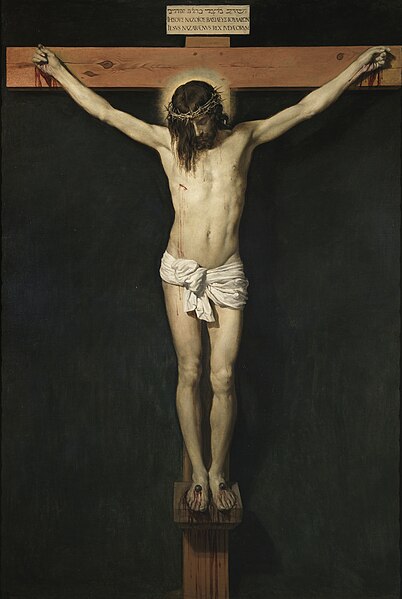
“Christ Crucified” by Diego Velazquez (c. 1632), Prado Museum (Accession No. P01167), Source Web Gallery of Art, (PD-Art, Old-100)
The 18th Century rabbi, Israel ben Eliezer, wrote of suffering:
“Each prayer has its own meaning, and it is, therefore, the specific key to a door in the Divine Palace. But a broken heart is an axe that opens all the gates.”
The sick, the needy, the desperate, the lost; the grieving; the persecuted and imprisoned; the abandoned and alone. These understand suffering.
To the sick and those in pain, Christ is the Great Physician. To those in need, the desperate, and the lost, He is the Way. To the grieving, He is the Man of Sorrows. To the persecuted and imprisoned, He is the Advocate and Counselor. To the abandoned and alone, He is the Beloved.
The source of all comfort, Christ is with us in all trials. None of us is truly abandoned, for He is there. In return, Christ asks that we extend a hand to the lost and less fortunate, that we reach out in love even when we may be rejected.
Christ does not urge us to live cautious lives. Love is not measured with an eyedropper, in safe increments. It is poured out, as balm on the wounds of the world. As His was for us.
READERS CAN FIND MY VIEWS ON ABUSE AND ABUSE-RELATED ISSUES AT ANNA WALDHERR A Voice Reclaimed, Surviving Child Abuse
https://avoicereclaimed.com

Roman Colosseum, Author Alessandroferri (CC BY-SA 4.0 International)
All of us have experienced prayers denied. How is this to be reconciled with Jesus’ promise, “ ‘[A]sk, and it will be given to you; seek, and you will find; knock, and it will be opened for you’ ” (Luke 11: 9)?
Doesn’t belief in God guarantee us our legitimate desires? Well, not exactly.
- The first Jewish temple was destroyed by the Babylonians in 586 BC. The Babylonian Captivity lasted 70 years, and began the Jewish diaspora.
- The second temple was destroyed by the Romans in 70 AD. The Arch of Titus still stands in Rome portraying the enslaved Jews and booty from the sack of the temple. Archaeological evidence supports a conclusion that temple treasure funded the building of the Roman Colosseum.
- Devout Christians throughout history have been persecuted and martyred.
- Injustice persists to the present day. Any attorney, anywhere, has come in contact with it.
On the surface, these events would appear to contradict the promise of answered prayer. Jesus, Himself, in the garden of Gethsemane asked that the cup be taken away.
“He …fell on His face, and prayed, saying, ‘O My Father, if it is possible, let this cup pass from Me; nevertheless, not as I will, but as You will’ ” (Matt. 26: 39).
Those last eight words are key. God’s will is always paramount. That is not merely a reflection of His supreme power, but His supreme righteousness. And God’s purposes may not be our own. Read more…

“Early Morning After a Storm at Sea” by Winslow Homer, Source/Photographer Wmpearl (Licensed-PD-Art)
Fishing is a hard and dangerous way to make a living. Storms can come up quickly. Ice can form on rigging, and winds blow a man overboard.
Strange that the Lord would have called us to be “fishers of men” (Matt. 4: 19). Why subject us to such hardship and toil? For the sake of an invaluable “catch” with the process, all the while, conforming us to His image.
Again and again, we face storms. Sometimes these teach us new lessons; other times, they test our mettle to assure that old lessons are firmly in place. We re-learn over and over to lean on the Lord.
“He divided the sea and caused them to pass through…” (Ps. 78: 13).
Lord God, Your power is beyond imagining. You govern the storms in our lives, but are greater than they by far.
Increase our awareness of Your presence, as we ride out those storms. Strengthen our hearts that we may endure them.
In Your mercy, make a way for us where there was none.
Amen
READERS CAN FIND MY VIEWS ON ABUSE AND ABUSE-RELATED ISSUES AT ANNA WALDHERR A Voice Reclaimed, Surviving Child Abuse
https://avoicereclaimed.com

 A Lawyer's Prayers