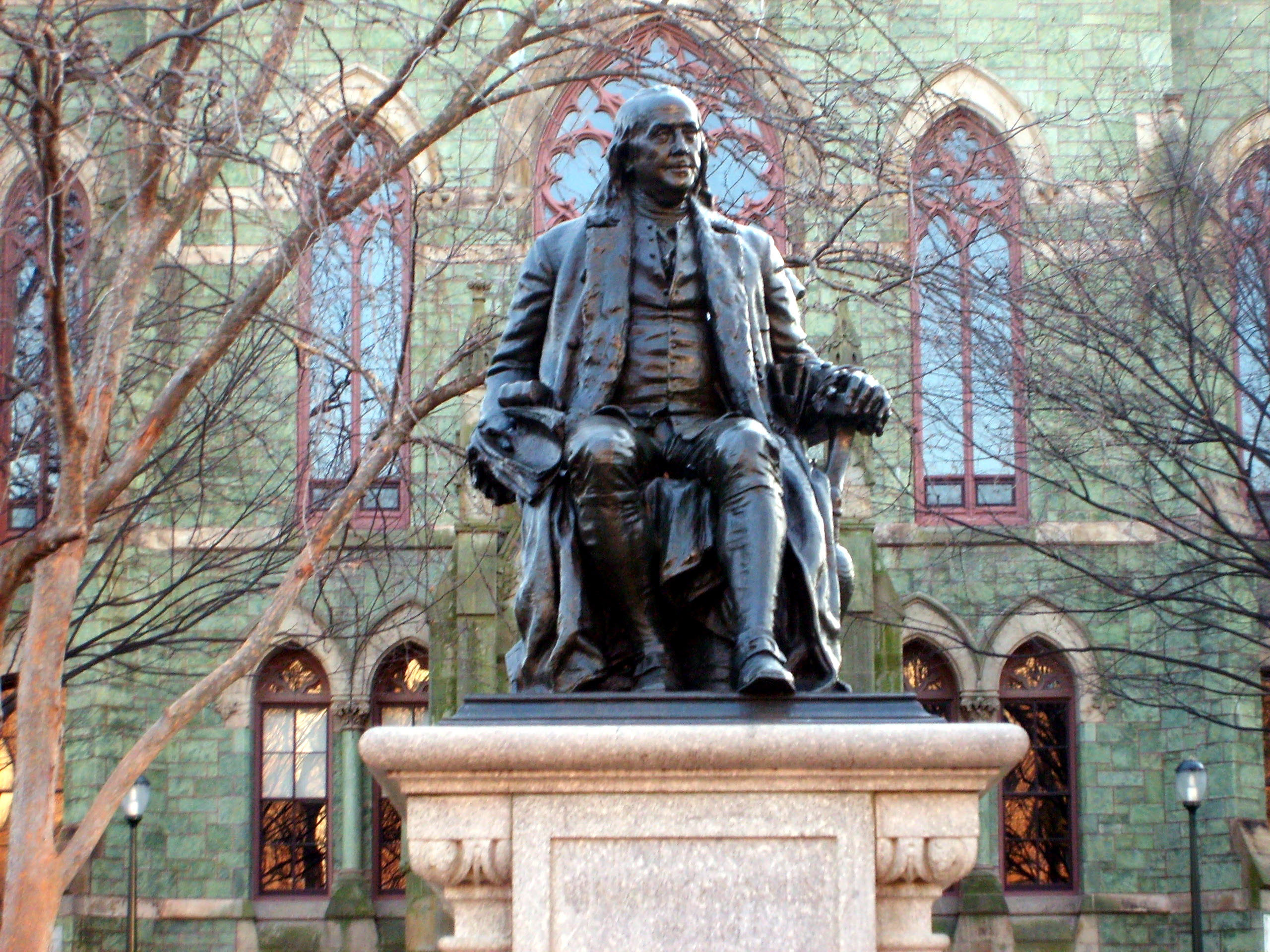
Statue of Benjamin Franklin on campus of University of Pennsylvania, Author MatthewMarcucci, (PD)
“For we walk by faith, not by sight” (2 Cor. 5: 7).
“Which is best?” That was Aretha’s constant inquiry – whether as to books, magazines, housing, clothing, schools, or cities.
I tried to explain that “best” was, for many things, a relative term, dependent on the criteria of the individual making the comparison. Aretha would not be satisfied with so mealy-mouthed a response.
For Aretha, the ivy league University of Pennsylvania was the penultimate, her symbol of excellence.
America’s first university, this venerable Philadelphia institution traces its history to a trust established in 1740. Since first purchased by a group which counted among its members Benjamin Franklin, the school grounds have given rise to a highly reputed business school, medical school, and teaching hospital.
Aretha’s goal, often repeated to me, was to attend Penn. Meanwhile, she struggled with high school math and biology.
Aretha’s school difficulties were not at first apparent to me. Aretha did her best to gloss over these, displaying with great pride the English papers on which she did well, carefully omitting mention of the tests she had failed.
The fault was not Aretha’s. Until removed from her mother’s custody, she had attended (when at all) inner city schools plagued by violence, teen pregnancy, and lack of resources. As Aretha said, “You got an ‘A’ just for bein’ present.” It was a reflection of the generation gap that I should be astonished her inner city school had a nursery.
Now in a suburban school, with a stiffer curriculum, Aretha found her grades plummeting. This produced panic in her. Aretha wanted with all her heart to be someone, to do something that mattered to the world. That possibility was rapidly fading before her eyes.
Gently, I suggested tutoring to her. The house mother suggested tutoring to her. Counselors at her school, I am sure, suggested tutoring to her. Aretha resisted. Alone in her room, she would wrestle with the materials, finally throwing her books against the wall in frustration.
This was a girl teased for reading too much. This was a girl articulate in defending others. This was a girl who preferred business magazines to gossip rags. This was a girl who could imagine becoming a lawyer.
It slowly became clear that Aretha had as much chance of attending Penn as she did of walking on the moon. What preyed on my mind was the thought that there were hundreds of thousands like her, if not more. Read more…

Martin Luther King, Jr. – I Have a Dream Speech, Source https://www.flickr.com/, Author David Erickson (CC Attribution 2.0 Generic)
“…there is neither Greek nor Jew, circumcised nor uncircumcised, barbarian, Scythian, slave nor free, but Christ is all and in all” (Col. 3: 11).
Our first eighteen months together were rocky.
Again and again, Aretha would cancel visits, often at the last moment, while I was actually en route. She was frequently late, sometimes by hours.
I could not be sure if this was outright disinterest or “testing,” her attempt to gauge whether I was sincere. She always apologized profusely, seemed to enjoy our visits when they did take place.
Again and again, I found her asleep when I arrived, whatever the time of day. Sleep was a coping mechanism for her, a way of shutting out the world. This was troubling despite Aretha’s generally upbeat demeanor, since it suggested depression on her part.
I persevered. She was so obviously worth the effort, intelligent, motivated. Any child would have been worth the effort. But with Aretha, I simply could not give up.
This was due, to some extent, to my own upbringing. Because of family issues, my teen years had been tumultuous. The transition to womanhood had been a painful and haphazard process for me. I still bore the scars, and wanted to smooth the way of a child facing the same transition.
Lilian
Then there was the memory of Lilian. My closest friend throughout high school, Lilian, too had been raised in a working class family. Intelligent, sensitive, funny, and shy, Lilian helped me survive those lonely years.
Lilian had a far greater knowledge of music than I did. Otherwise, we shared the same interests and activities, had the same circle of friends, enjoyed the same jokes, endured the same gym classes.
We might have been twins, separated at birth, except that Lilian was African American.
I was made aware of the importance of that difference when I visited her home for the first time.
While Lilian’s mother went to get cookies and milk for us, I had a chance to look around the modest living room. A photo of Martin Luther King, Jr. clipped from a newspaper caught my eye. Framed and hung in a prominent place on the wall, the photo obviously meant a great deal to the family.
That took me by surprise. Here was a public figure to whom my friend and her family felt a personal connection. Why was this? At our house, we had family photos on every flat surface, but none of public figures – strangers – not even the president.
At age thirteen or fourteen, I was vaguely aware of the Civil Rights Movement, but had no connection to it. Lilian did. Read more…
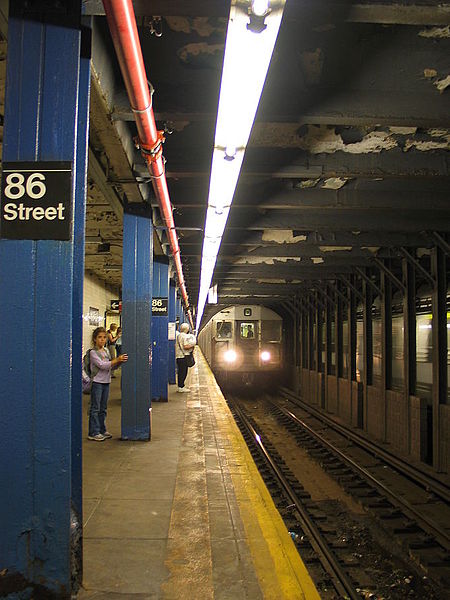
86th Street Subway Station, New York City, Author Daniel Schwen (GFDL)
“But He saves the needy from the sword, From the mouth of the mighty, And from their hand. So the poor have hope, And injustice shuts her mouth” (Job 5: 15-16).
The poverty in America is not, of course, confined to Philadelphia.
Poverty, Drugs, and Homelessness
I had grown up in a working class neighborhood of the Bronx, a short ten minute drive from the nearest public housing project. The high-rise apartments there were monoliths, devoid of any hint of humanity other than graffiti and the occasional Christmas lights draped from a balcony, twenty stories up.
My parents for years owned a small delicatessen in Harlem. My mother dealt daily with the working poor, barefoot children, prostitutes, drug addicts, and the homeless. It was one of the happiest and most difficult times of her life.
As an adult, a personal injury lawyer, I had interviewed the victims of rape and mayhem in projects with lofty names like the Polo Grounds Houses. The irony was not lost on me.
Children amused themselves by skateboarding against the elevator doors, for the clanging sound that made. A special police squad investigated the paralyses and deaths which resulted when the doors gave way, and children disappeared down the shaft.
Behind the desk of one project manager, I noticed a jar of what seemed to be multi-colored marbles. He pulled the jar forward to reveal empty “crack” cocaine vials. “This is what I’m up against,” he said to me, somberly. “This is just a week’s worth from one of the stairwells.”
The Subway
I rode the subway at all hours. Legless veterans would regularly roll through the train cars, flush with the floor, begging for spare change.
One frail young woman pushed a stroller along, calling out, “Milk for the baby! Milk for the baby!” as she pleaded for coins. Whether the money she collected went to the baby or her drug habit, I do not know.
A scrap of conversation stays with me from those subway rides. Three middle-aged, African American women sat across from me, talking over the roar of the train, one gesturing in an animated fashion. I could not help but overhear her distress. “An Uzi!? I sez to him, ‘An Uzi? Why can’ ya jus’ get a reg’la’ gun?’ ”
Flee or Engage
I had gone into the law for idealistic reasons, believing I could make a difference. This constant barrage of pain and sadness wore on me. Yet I could not turn away.
A high school teacher of mine had said perhaps the most profound thing I ever heard in class. “There will come a time when each of you will have to choose. Either run from the cities or save them.” Flee or engage.
Almost against my will, I found myself running toward the flames. Read more…

Philadelphia City Hall, Author Toniklemm, (CC BY-SA 4.0 International)
“For He will deliver the needy when he cries, The poor also, and him who has no helper” (Ps. 72: 12).
I never expected to fall in love with a city, let alone one not my own.
A Proud New Yorker
I was born and raised in New York City, proud to be the daughter of an immigrant family from Eastern Europe, proud of the hustle and bustle of the city.
I grew up in an Irish/Italian neighborhood in the Bronx, but covered the courts in all seven of New York City’s boroughs and bedroom suburbs.
I loved the cultural aspects of the city — theater, ballet, opera — as well as its diversity. I knew its nooks, crannies, and subway routes, could find my way along its pot-holed streets and traffic clogged highways, more importantly, could locate the municipal parking lots near every courthouse.
I loved the Manhattan skyline, the East River Drive, Central Park. I loved the Palisades Parkway, Rockefeller Center, the Empire State Building, the Statue of Liberty, Jones Beach. I loved Fifth Avenue at Christmas, the glitz, the crowds, the pretzel vendors.
Tolerance – New York Style
New Yorkers do not all love one another. For the most part, however, they tolerate one another. Elbow to elbow during a sale at Macy’s or shoulder to shoulder at Ground Zero, they share the crowded island — Hasidic jewelers, Indian cabbies, Greek restaurant owners, Cuban bus boys, and Southampton matrons alike.
A Race Run Everyday
Whatever their race, ethnicity, or point of origin, the vast majority of New Yorkers do not consider the city glamorous. For them, New York is driven, a race run everyday. Taxi horns, ambulance sirens, and gun shots are merely counterpoint in the cacophonous song of a great city.
New York’s Darker Side
The city does have a darker side, make no mistake.
New York has its share of poverty, racial tension, drugs, mob activity, and gang-related violence. Though crime rates have been down in the last few years, rapes and murders are not unusual. New York crowds afford the newcomer anonymity, but anonymity can all too quickly lead to alienation.
By the ‘90s the pace, the congestion, the filth, the crime, most of all the homelessness — the sharp contrast between “haves” and “have nots” — had me longing for a different life. Read more…

Autumn leaves, Author W.carter, (CC BY-SA 4.0 International)
When I let Aretha (not her real name) know that I wanted to do a book on poverty and asked for permission to include aspects of her life in the book, she was enthusiastic. “People are livin’ without heat. Somebody’s gotta do somethin’,” she said.
This is narrative non-fiction. Names have been changed in the interest of privacy. But events like these are playing out daily in cities across America. They reflect tragic statistical realities.
The conclusions reached and solutions proposed constitute my best efforts to understand and respond to heart wrenching situations, many of which I have observed firsthand. Admittedly, those conclusions may be in error; the solutions, inadequate. I implore greater minds to do better.
Despite all this, I have tried to remain faithful to Aretha’s own story. I’ve had no need to exaggerate or embellish that story. Aretha’s valor speaks for itself.
But Aretha’s is just one story of poverty in America. There are, literally, millions. My hope in telling her story is that by personalizing the problem, I may in some small way give voice to those millions.
And that somebody will do something.
“That our daughters may be as pillars, Sculptured in palace style” (Ps. 144: 12).
It was to be a temporary thing, a trial run, really. I had no desire to mentor a teenager – let alone a streetwise girl, from the inner city. Childless, myself, I was not trained or equipped for the challenge.
After all, what could we possibly have in common? And teenagers were notoriously uncommunicative. Family and friends cautioned me not to expect too much from the relationship.
As a lawyer, enamored of books all my life, surely I would bore her to death. Then there was the question of race. My shortcomings – real and imagined – loomed large.
Still, Ruth had convinced me to meet the girl. An experienced social worker, Ruth Hammond headed the volunteer program at a respected children’s relief organization. Grey haired, witness to much suffering and sadness over the years, Ruth said she had a “feeling” the girl and I might click. Read more…

Khirbet Qeiyafa, recognized by the Council for Conservation of Heritage Sites in Israel, Author Abraham Greitzer אברהם גרייצר
(CC BY-SA 4.0 International)
Originating late in the 11th Century BC, the archaeological site known as Khirbet Qeiyafa controls the entrance to Israel’s Elah Valley, and is thought to be the biblical city of Shaarim (“Two Gates”) [1][2].
Shaarim
Shaarim was one of three anchor cities during the early reign of King David, the other two being Jerusalem and Hebron.
The layout of Khirbet Qeiyafa is similar to that of Beersheba, Beth Shemesh, Tell en-Nasbeh, and Tell Beit Mirsim (all in the Kingdom of Judah) [3][4][5][6]. Two defensive walls surround the city, with houses incorporated into these walls.
The age of Khirbet Qeiyafa was established through radiocarbon dating of olive pits found there.
The artifacts uncovered include carved animal bones, pottery, a bronze ax and arrowheads, iron daggers and swords, scarabs, beads, and seals.
Centralized Administration
The scale of construction at Khirbet Qeiyafa suggests conscription of manpower for public works by a central authority.
Numerous storage jars with finger impressions may have been used as a tax collection system, with a certain percentage of agricultural products due the government. While King David is not referenced by name, this, too, suggests a centralized administration. Read more…

Author Man vyi (PD)
There are currently 25 million non-citizens residing in the United States, 11 million of whom are here illegally [1A].
While voting by non-citizens is prohibited in federal elections, only 7 states (AL, AZ, CO, FL, LA, ND, and OH) expressly prohibit non-citizens from voting in state and local elections [1B][2].
DC and certain municipalities in VT, MD, and CA now allow non-citizens to vote in local elections [3]. Only a few distinguish between legal and illegal aliens, for voting purposes.
Political Posturing
By and large, Democrats and Republicans hold opposing views on this topic.
Democrats accuse Republicans of creating a bogeyman to inflame their base. Republicans accuse Democrats of favoring open borders and an expanded electorate in the hope of currying favor with new voters, regardless of consequences.
Arguments in Favor
A. Taxation
“…the United States was founded on the promise of ‘no taxation without representation’ — yet there are some…who are unable to participate in the elections that affect their lives and livelihoods. And yes, most of them pay taxes.”
–Nicholas Goldberg, Assoc. Ed, Los Angeles Times [4A]
Many assume that non-citizens do not pay taxes. However, resident aliens, i.e. those with green cards, are subject to the same tax laws as US citizens [5].
According to the American Immigration Council, even undocumented immigrants pay billions in taxes (including sales, property and income taxes) [6][7].
B. Assimilation
Proponents of non-citizen voting — on the local level, at any rate — argue that it might be viewed as part of the process of becoming assimilated, and ultimately attaining citizen status [4B].
C. Equity
Proponents of non-citizen voting argue that prohibiting non-citizens from voting is discriminatory public policy, since there are substantial barriers to naturalization [8A]. Meanwhile, allowing non-citizens to vote promotes the good of society as a whole [8B]. Read more…

“Saint Basil (The Prayer)” by Sergei Kirillov (1994), Source/Author Sergei Kirillov, (CC BY-SA 3.0 Unported)
There has historically been a strand of asceticism in Christianity [1]. This is perhaps best exemplified by the Desert Fathers who practiced severe self-discipline, the avoidance of any sensual indulgence, and the abandonment of possessions in pursuit of holiness [2A].
Desert Fathers
The Desert Fathers were early Christian hermits living principally in the Scetes desert of Egypt during the 3rd Century. The first of these was Paul of Thebes [3]. But the best known is Anthony the Great, considered the founder of desert monasticism [4].
Anthony viewed the isolation, starkness, and self-sacrifice of the desert environment as an alternative to martyrdom [2B]. Time was spent on “interior silence” and continual prayer — augmented by fasting, psalms, manual labor, and care for the poor — the goal being to exemplify love in the name of Christ in all actions [2C][5].
Eventually, thousands of monks and nuns were drawn to the desert. Their communities became the model for the Christian monastic movement, influencing both the eastern tradition at Mount Athos and the western Rule of St. Benedict [6][7]. Their insights are collected in the Apophthegmata Patrum (Sayings of the Desert Fathers)[8]. Read more…
A conviction may be classified as wrongful if there were substantive or procedural errors which violated the convicted individual’s rights, or if the convicted individual was factually innocent of the charges [1].
There have been 3,489 exonerations since 1989 (over 31,700 years lost) [2][3]. According to the Innocence Project, of the 258 DNA exonerations that staff there have handled, 25% have involved false confessions [4][5]. Eyewitness misidentification is another cause of false convictions [6]. Post-conviction DNA testing is a major factor in exoneration.
Healing Justice is a non-profit which strives to heal the wounds both to exonerees and crime victims, themselves, caused by wrongful convictions. The organization, also, advocates for criminal justice reform [7].
“who comforts us in all our tribulation, that we may be able to comfort those who are in any trouble, with the comfort with which we ourselves are comforted by God” (2 Cor. 1: 4).
—
[1] National Institute of Justice (NIJ), “Wrongful Convictions”, https://nij.ojp.gov/topics/justice-system-reform/wrongful-convictions.
[2] University of Michigan, National Registry of Exonerations, Glossary, “Exoneration”, https://www.law.umich.edu/special/exoneration/Pages/glossary.aspx.
[3] University of Michigan, National Registry of Exonerations, “News”, https://www.law.umich.edu/special/exoneration/Pages/about.aspx.
[4] Eisner Gorin LLP, “What Are False and Coerced Confessions?”, https://www.thefederalcriminalattorneys.com/false-and-coerced-confessions.
[5] False Confessions, “False Confessions Happen”, https://falseconfessions.org/false-confessions-happen/.
[6] Innocence Project, “Eyewitness Misidentification”, https://innocenceproject.org/eyewitness-misidentification/.
[7] Healing Justice, https://healingjusticeproject.org/.
God loves all of us — regardless of sexual orientation or perceived gender. Scripture does not, however, condone homosexual behavior.
Despite this, the United Methodist Church has voted to ordain LGBTQ+ clergy. Hundreds of American Catholic churches will again this year be holding so called “pride masses” to “celebrate queerness”, as Holy Trinity Church in Washington, DC puts it.
Please, pray for all those taking part in these events.
READERS CAN FIND MY VIEWS ON ABUSE AND ABUSE-RELATED ISSUES AT ANNA WALDHERR A Voice Reclaimed, Surviving Child Abuse
https://avoicereclaimed.com
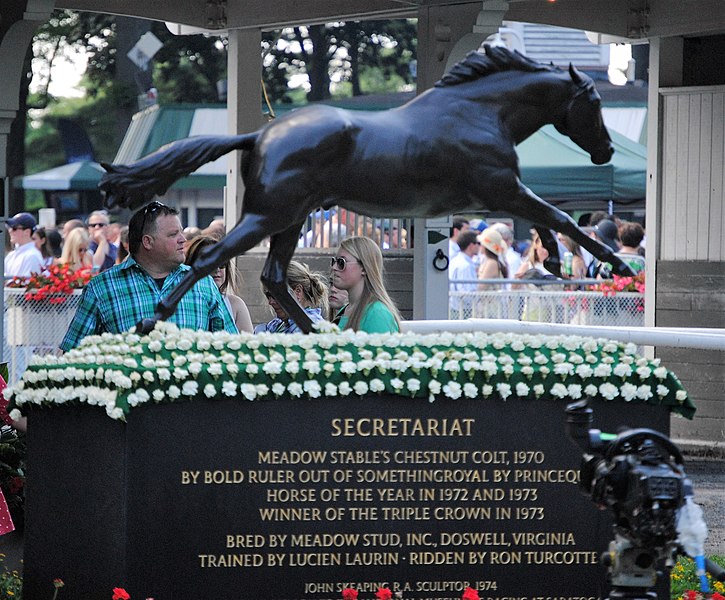
Statue of Secretariat, widely considered the greatest racehorse of all time, Belmont Park, Author Jlvsclrk (CC BY-SA 4.0 International)
Few animals on earth are as extraordinary or beautiful as the horse. Few of mankind’s animal companions have proven as constant or significant.
Horses have been used for transportation, agriculture, hunting, herding, exploration, warfare, entertainment, sport, police work, and most recently therapy [1]. Apart from service, they have provided milk, meat, hide, hair, bone, and pharmaceuticals. Read more…

 A Lawyer's Prayers