Like Rain on Parked Cars, Chapter 2 – City of Brotherly Love
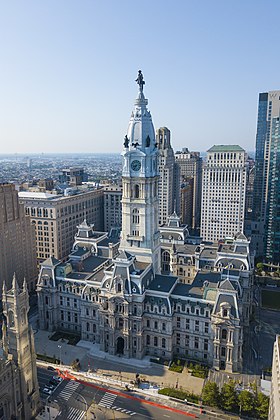
Philadelphia City Hall, Author Toniklemm, (CC BY-SA 4.0 International)
“For He will deliver the needy when he cries, The poor also, and him who has no helper” (Ps. 72: 12).
I never expected to fall in love with a city, let alone one not my own.
A Proud New Yorker
I was born and raised in New York City, proud to be the daughter of an immigrant family from Eastern Europe, proud of the hustle and bustle of the city.
I grew up in an Irish/Italian neighborhood in the Bronx, but covered the courts in all seven of New York City’s boroughs and bedroom suburbs.
I loved the cultural aspects of the city — theater, ballet, opera — as well as its diversity. I knew its nooks, crannies, and subway routes, could find my way along its pot-holed streets and traffic clogged highways, more importantly, could locate the municipal parking lots near every courthouse.
I loved the Manhattan skyline, the East River Drive, Central Park. I loved the Palisades Parkway, Rockefeller Center, the Empire State Building, the Statue of Liberty, Jones Beach. I loved Fifth Avenue at Christmas, the glitz, the crowds, the pretzel vendors.
Tolerance – New York Style
New Yorkers do not all love one another. For the most part, however, they tolerate one another. Elbow to elbow during a sale at Macy’s or shoulder to shoulder at Ground Zero, they share the crowded island — Hasidic jewelers, Indian cabbies, Greek restaurant owners, Cuban bus boys, and Southampton matrons alike.
A Race Run Everyday
Whatever their race, ethnicity, or point of origin, the vast majority of New Yorkers do not consider the city glamorous. For them, New York is driven, a race run everyday. Taxi horns, ambulance sirens, and gun shots are merely counterpoint in the cacophonous song of a great city.
New York’s Darker Side
The city does have a darker side, make no mistake.
New York has its share of poverty, racial tension, drugs, mob activity, and gang-related violence. Though crime rates have been down in the last few years, rapes and murders are not unusual. New York crowds afford the newcomer anonymity, but anonymity can all too quickly lead to alienation.
By the ‘90s the pace, the congestion, the filth, the crime, most of all the homelessness — the sharp contrast between “haves” and “have nots” — had me longing for a different life.
Change
So it was that I came to Philadelphia. Offered a promotion and the chance to oversee litigation nationwide for my employer, I thought the change would do me good.
Philadelphia is a much smaller city than New York, still close enough to allow me regular visits with family. My immigrant mother said, the day I left, “Don’t worry, Anna. At least they speak English.”
I settled in an obscure “ring city’” just outside Philadelphia, but it took me awhile to put down roots. I traveled the country on business over 200 days, my first year here. Philadelphia was little more than a lay-over.
Philadelphia Landmarks
Slowly, I became familiar with the city. Philadelphia’s many landmarks were the first thing to draw me in.
Unlike New York, Philadelphia has cherished its historical roots. Though equivalent in age to Philadelphia, New York worships change. There, a building 20 years old is considered ancient and out of date.
In Philadelphia, I waited on line at the Liberty Bell with hundreds of other tourists, reached out a tentative finger to touch the Bell’s hallowed rim. I stood in Independence Hall, humbled and awestruck that Founding Fathers had stood there before me.
I walked the cobbled streets of Old City, listened as tour guides explained the significance of Carpenter’s Hall, Christ Church, and Elfreth’s Alley; saw Betsy Ross’ home, and Benjamin Franklin’s grave. I roamed the hills at Valley Forge.
A Rich Heritage
Little by little, I discovered Philadelphia’s many neighborhoods and rich heritage. Thankfully, William Penn had laid the city out in a grid pattern I could comprehend.
First came the gleaming towers of Center City, the restaurants in Chinatown, the shops at Rittenhouse Square, and the Delaware riverfront. Next came South Philadelphia (the citadel of cheesesteaks), trendy Manayunk, and political Mt. Airy, each with a distinctive flavor.
Kensington and Southwark had been home to boatbuilders and mastmakers, in the days of sailing ships. Northern Liberties had once hosted tanning yards.
Both the Reading and Pennsylvania Railroads are memorialized on countless game boards.
West Philadelphia
Finally, there was West Philadelphia. I came to know West Philadelphia as a consequence of helping to establish a legal clinic there for the urban poor.
This forlorn part of the city called to me as no other.
A. Ravaged
Officially, West Philadelphia is situated between the Schuykill River and Cobbs Creek, across the river from Center City. That river represents an enormous divide, with Oz the other side.
Center City is a prosperous and shining business district, encompassing City Hall and Society Hill. West Philadelphia (itself composed of smaller neighborhoods like Overbrook, Mantua, and Mill Creek) is an area ravaged by poverty.
One need only drive through the district to see this. Houses in all states of decay sag tiredly against one another, row upon row. Windows are blackened or boarded up, porches collapsed.
Cars by the side of the road are rusted hulks, abandoned lots choked with a combination of weeds, drug paraphernalia, condoms, empty bottles, broken umbrellas, discarded tires, and the skeletons of furniture past salvage.
Children play in the streets in rags.
B. Demographics
According to the Philadelphia City Planning Commission, 72% of the population of West Philadelphia was African American by the time I moved to the city, 24% Caucasian, 3.3% Asian, and 1.4% Hispanic [1]. The statistics have changed somewhat, in the years since [2]. The poverty has not.
The rates of low birth weight and infant mortality here are over twice that in the nation at large. HIV and AIDS are serious problems. Unemployment is rampant, consistently running higher than that in the city overall.
Churches are locked, bars open. Young men with sullen eyes lounge on street corners, hope having been driven out of them. The number of young people confined to wheelchairs is startling — a side-effect of drive-by shootings.
C. Still Alive
Yet this is still a living neighborhood, if gasping for breath.
Fifty-Second Street is the local business district with dollar stores, bodegas, real estate offices, pawn shops, funeral parlors, nail salons, hair braiding emporiums, check cashing establishments, pool halls, and fried chicken palaces all clamoring for attention.
Turn a corner and you stumble across a vibrant street with a geranium on every porch and daisy-filled planters (made from artfully slashed tires) every ten feet. Children fill a schoolyard, and you realize there is life behind these worn, grey walls and broken shutters.
The Philadelphia Zoo, Mann Music Center, and major portions of Fairmount Park are all located in West Philadelphia.
Though transience is common, some families have lived in the same homes for generations. Abolitionist Stephen Smith, Crystal Bird Fauset (a member of Franklin D. Roosevelt’s so-called “Black Cabinet”), and renowned singer/actor Paul Robeson were all once residents. The award winning actor Will Smith was raised here.
Fragmented
As an outsider, what has been most striking to me about Philadelphia over the years is that the city is so fragmented. Each district is a fiefdom unto itself, fearful of and hostile toward its neighbors.
Rarely do these unique locales and diverse groups of people in the City of Brotherly Love view themselves as part of a cohesive whole.
—
[1] Chairman Robert Vance, Esq. and Staff, The Plan for West Philadelphia, Philadelphia, PA, Philadelphia City Planning Commission (June 1994).
[2] Data USA, “Philadelphia City (West and West Park) PUMA, PA”, https://datausa.io/profile/geo/philadelphia-city-west-and-west-park-puma-pa.
Copyright © 2010 – Present Anna Waldherr. All rights reserved.
READERS CAN FIND MY VIEWS ON ABUSE AND ABUSE-RELATED ISSUES AT ANNA WALDHERR A Voice Reclaimed, Surviving Child Abuse
https://avoicereclaimed.com

 A Lawyer's Prayers
I’ve learned a few things about Philly now. Interesting stuff, Anna. Thank you for sharing.
You’re very kind, Petrina. The narrative gets more personal from here on in. I hope you enjoy it. And I hope all is well w/ you. ❤
Thank you for sharing with us and I’m looking forward to more! All is well. I hope you are doing well also.💜🙏🏾
Glad to hear it, Petrina. I always appreciate your blog Impacting Righteously https://impactingrighteously.com/. There is so much helpful information for young women. Things are good here. Of course, God is always good, no matter our circumstances. ❤
I really appreciate your informative blog and your stances as well.
Thank you for your encouragement as always! Yes, thankfully, God is always good no matter what is going on.
Amazing skills of observation, evaluation, realization and presentation, Anna. You make all these (NY, Philadelphia) come alive to your readers. Praise God.
I do not deserve such praise. But I thank you from the bottom of my heart, Erroll. I hope you enjoy the story as it progresses.
Fascinating portrait of the city. Interesting side note re: the founding fathers’ portrait of the signing in Independence Hall:
Did you know John Adams detested the historical inaccuracy of the painting and its story of how it came to be is interesting?
No, I will definitely have to look into that. There are life-size statues of the Founding Fathers at the National Constitution Center. You can see an image here: https://constitutioncenter.org/museum/exhibits-programs/signers-hall. It is eerie to walk among them. Of course, the United States had many more actual Founding Fathers than the 55 delegates who attended the constitutional convention sessions. Almost all were Christian, something revisionist historians would prefer to forget.
John Adams was among the finest examples of a man of Biblical principles. I look forward to meeting him in Heaven one day.🤠
Your attachment both to New York and Philly comes through each detail in this account, Anna, as you prepare us for the next installment in your narrative. As you narrow in on Philly, you open our eyes to the disparities of life and also to your affinity with the locale’s flavor, rich culture/history, its people. I can’t wait to read more!
Thank you so much for the encouragement, Dora. The book is something of a departure from my regular format. I’ve been worried that readers might find the focus on poverty boring. Of course, most of my readers are devout Christians. They are hardly likely to be callous. Please, say a prayer that the book does some good.
🙏✝️
Fascinating! Reading your descriptions of the “big city” causes this “country boy at heart” to admire you even more! There is no way I could ever find my way around such large cities, much less feel comfortable in doing so.
When I traveled on business I usually stayed close to my hotel out of fear of getting lost. I can’t tell you how many times I wanted to venture out to someplace I had wanted to visit, but never did, and felt horrible for not trying.
Just goes to show, we’re all wired a bit differently, which makes life all the more exciting! Looking forward to reading more!
Thank you so much for your support, Ron! It’s funny, but I’ve never had any sense of direction. Going uphill, I always have the sensation that I am heading north (LOL). In the days before GPS and Google Maps, I would carry a folding map in the car, and stop at a gas station for help whenever I got turned around.
I can definitely relate to being turned around! When I turn Right at a certain intersection I feel like I’m going South when it’s always North! My GPS(Debbie) on the other hand has an uncanny sense of direction that I would be lost without
🙂
Dearest Anna, Your writing is colorful, such detail I feel as if I can see the changing landscape as you describe it, as I read this to my husband. Neither of us knew anything about the poverty in West Philadelphia. I can literally see the buildings, with your descriptive phrases I am pulled in to every word.
“One need only drive through the district to see this. Houses in all states of decay sag tiredly against one another, row upon row. Windows are blackened or boarded up, porches collapsed.
Cars by the side of the road are rusted hulks, abandoned lots choked with a combination of weeds, drug paraphernalia, condoms, empty bottles, broken umbrellas, discarded tires, and the skeletons of furniture past salvage.”
Still it sounds like it was time for a change and that you were seeing a place where you amazing skill as an attorney would be blessed to have. Thank you so much for sharing with us, Anna. Love and hugs, Joni
It means such a great deal to me for you to say that, Joni. I wish you continued success w/ your own writing which far outshines my own. I highly recommend your website Rum and Robots https://the-inner-child.com/ to readers.
May God bless you and yours.
Love,
A. ❤