Shroud
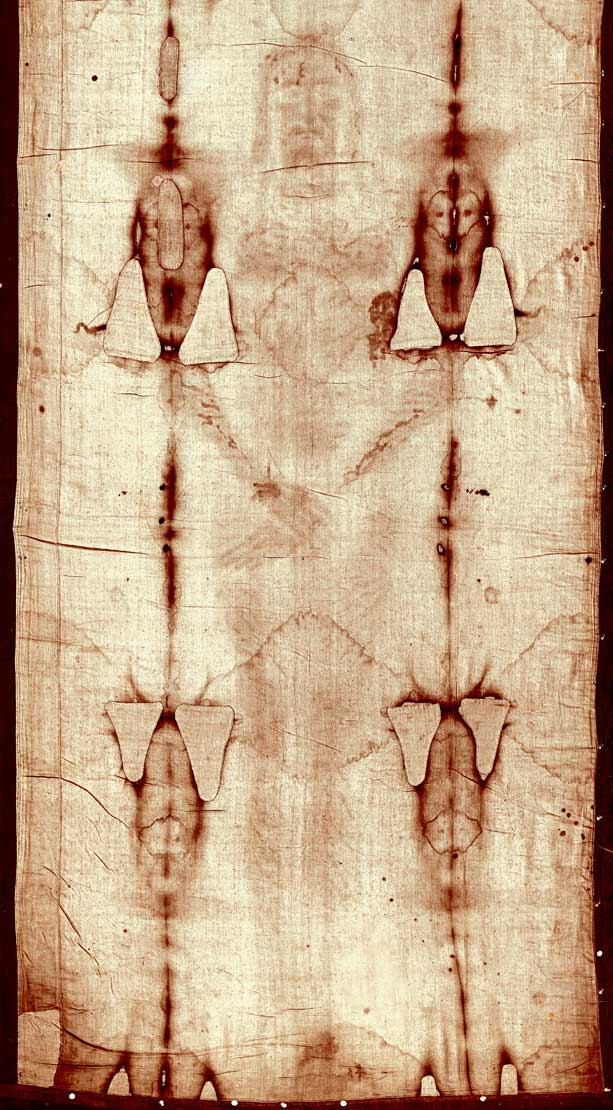
Shroud of Turin (PD)
Venerated by many as the burial shroud of Christ, the Shroud of Turin is a length of linen cloth bearing the faint image of a man who was scourged and crucified [1A][2][3][4].
What appear to be blood stains are present on the front and back of the cloth. However, the image is not merely the result of having been draped over a bloody body or it would appear distorted.
History
The Shroud is thought to have been brought initially from Jerusalem to Constantinople, then to Western Europe during the Crusades. It was first exhibited in 1354 AD in Lirey, France.
The Shroud was acquired by the House of Savoy in 1453 AD. It was damaged in a fire at the Chapel of Chambery in 1532 AD. The Shroud has been kept in the Chapel of the Holy Shroud in Turin, Italy since 1683 AD. Ownership of the Shroud did not pass to the Catholic Church until 1983.
Photography
The image on the Shroud of Turin is, for all intents and purposes, a photonegative on a linen cloth which is not photosensitive, centuries before photography was developed. This was discovered when the Shroud was first photographed in 1898 by Secondo Pia.
Scientific Testing
Controversies surround the Shroud of Turin.
A. Anatomy
Most agree that the image on the Shroud is anatomically correct. It depicts a man between 5’7” and 6’2” in height. The body is naked, which is consistent with Roman crucifixion practices intended to humiliate the victim.
The body has the following characteristics:
- A broken nose;
- A swollen face, and bruised right eye;
- Part of the beard plucked out;
- Wounds on the head from a crown of thorns;
- Some 120 tearing wounds on the back and legs produced by scourging;
- Bruises on the shoulder due to carrying a cross;
- Knee injuries from repeated falls;
- Nail wounds on the hands and feet from crucifixion;
- An oval wound between the fifth and sixth ribs on the right side (serosanguineous fluid on the cloth demonstrating that this injury occurred after death).
Blood flow is at an angle consistent with the arms held at a 70 degree angle on the cross.
The wrists are crossed. The thumbs are turned under which is consistent with median nerve contraction as the result of nails through the wrists (today considered more likely than nails through the palms).
B. Place of Origin
Pollen grains have been found on the Shroud consistent with an origin in the Holy Land. There are, also, pollen grains which reflect its travel across Europe.
C. Image and Blood Stains
Opposed to all relics, John Calvin contested the Shroud’s authenticity in 1543 AD. Protestants do not, therefore, give it much credence.
Remarkably, in 1976 physicist John Jackson and thermodynamicist Eric Jumpera found that the Shroud encodes a third dimension [5]. They viewed a photograph of the Shroud through a VP-8 Image Analyzer, originally developed by NASA to provide topographical information. Ordinary photographs are distorted by this device. However, the grey scale on the Shroud was discovered to contain 3D data. These results have since been replicated.
In 1977, a group of over 30 scientists of various disciplines was given direct access to the Shroud [6]. Having ruled out a priori any supernatural source, scientists of the Shroud of Turin Research Project (STURP) could not agree on how the image or the stains had been created.
Microscopist Walter McCrone took the position that the image was painted on using red ocher in a gelatin medium, and the blood stains painted on using a vermillion pigment in a gelatin medium. McCrone’s conclusions have been contested ever since. Certainly, chemist Alan Adler and biophysicist John Heller disagreed with him [7].
Why the image would have been painted as a negative cannot be adequately explained, even by reference to a camera obscura.
Hematological studies show that severe trauma, like that of scourging and crucifixion, causes hemoglobin to fracture, allowing the red color to remain intact for extended periods [8].
It its official report, STURP concluded in 1981:
“…the Shroud image is that of a real human form of a scourged, crucified man. It is not the product of an artist. The blood stains are composed of hemoglobin and also give a positive test for serum albumin. The image is an ongoing mystery…[1B]”
D. Age
Radiocarbon testing of the Shroud of Turin in 1988 placed its age between 1260 AD and 1390 AD [1C]. As a result, the Shroud was widely declared a medieval forgery. These findings have since been contested on several grounds.
Though multiple samples were recommended, only a single sample was permitted to be taken from the Shroud, then divided and sent to three laboratories. The fire damage may have impacted the Carbon-14 results. Repairs to the Shroud were made in 1534 AD, 1694 AD, and 1868 AD, so the testing may have reflected their age. If the image is the result of intense radiation (as some speculate), that, too, could have impacted the Carbon-14 results.
Most recently, new peer reviewed Wide Angle Xray Scattering (WAXS) studies have demonstrated that the Shroud is, in fact, 2000 years old [9][10][11].
E. Possible Scriptural Reference
Although Christ’s burial cloths are referred to in Scripture, there is no mention of an image appearing on them. Of course, Jews interpreted the Second Commandment as strictly prohibiting images of God and man. Jewish law in the First Century permitted capital punishment for violation of the Second Commandment [12].
This may explain an interesting statement by the Apostle John:
“I have much to write to you, but I do not want to use paper and ink. Instead, I hope to visit you and talk with you face to face, so that our joy may be complete” (2 John 1: 12).
In describing his reaction at the empty tomb, John had earlier said that he believed when he saw the burial cloths and the cloth that had covered Christ’s head (John 20: 1-10). The text makes clear that John’s belief arose from direct observation, but that he still did not fully understand at the tomb that Christ had risen from the dead.
What then did he believe? It may be that John saw the imprint of the Resurrection on the Shroud. Since the image was not created by man, John would have understood it as having been created by God. That would have made Christ’s divinity clear.
Resurrection
There is no question that the image on the Shroud accurately reflects the Gospel story. But Christians do not need such corroboration of the Resurrection.
We know that Christ lives because the Bible – the revealed word of God – attests to that fact, citing the evidence of hundreds of witnesses and other proofs. Moreover, we know Christ personally, as the Son of God.
—
[1A, 1B, and 1C] Wikipedia, “Shroud of Turin”, https://en.wikipedia.org/wiki/Shroud_of_Turin.
[2] Shroud of Turin, https://www.shroud.com/.
[3] YouTube, “Shroud Studies – Dr. John Campbell”, https://www.youtube.com/watch?v=YT1R2kDPHFA.
[4] YouTube, “Unlocking the Secrets of the Shroud”, September 2009, https://www.youtube.com/watch?v=4U6OlUz4qWM.
[5] Shroud 3D, “VP-8 Image Analyzer and Set-Up Research 3D Materials” by Peter Schumacher, https://shroud3d.com/research-on-the-3d-materials/vp-8-image-analyzer-and-setup-research/#:~:text=The%20Vp%2D8%20Image%20analysis%20in%201976%20in,%E2%80%9Cspatially%20encoded%E2%80%9D%20i.e.%2C%20it%20possessed%20depth%20information.
[6] Wikipedia, “Shroud of Turin Research Project”, https://en.wikipedia.org/wiki/Shroud_of_Turin_Research_Project.
[7] New York Times, “Alan D. Adler Chemist Studied Shroud of Turin”, 6/15/00, https://www.latimes.com/archives/la-xpm-2000-jun-15-me-41256-story.html.
[8] National Institutes of Health, National Library of Medicine, National Center for Biotechnology Information, “Trauma Induces Intravascular Hemolysis, Exacerbated by Red Blood Cell Transfusion and Associated with Disrupted Arginine-Nitric Oxide Metabolism” by Terry Schaid et al, 111/16/22, https://pubmed.ncbi.nlm.nih.gov/36378232/.
[9] YouTube, “New Evidence that the Shroud of Turin is 2000 Years Old Coinciding with Christ/EWTN News Nightly”, https://www.youtube.com/watch?v=lJBJPkD8GtU.
[10] YouTube, “New Evidence for the Authenticity of the Shroud of Turin: Digging for the Truth, Episodes 248/249”, https://www.youtube.com/watch?v=6y3zKsxtAEo.
[11] MDPI, “Xray dating of a Turin Shroud’s linen sample” by Liberato De Caro, et al, 3/10/22, https://www.mdpi.com/2571-9408/5/2/47.
[12] Wikipedia, “Capital punishment in Judaism”, https://en.wikipedia.org/wiki/Capital_punishment_in_Judaism.
READERS CAN FIND MY VIEWS ON ABUSE AND ABUSE-RELATED ISSUES AT ANNA WALDHERR A Voice Reclaimed, Surviving Child Abuse
https://avoicereclaimed.com

 A Lawyer's Prayers
Very informative Anna. Whether the Shroud of Turin is the actual shroud of Christ will always be a matter of contention I suppose. Somehow or another, I don’t believe it matters to the Lord however, as He is far more concerned that we have a living relationship with Him and not a piece of fabric.
Very true, Ron. I hope I did not suggest otherwise. What is striking to me is that those determined not to believe in Christ will never believe, no matter the proof set before them.
I thought of the old hymn, “My hope is built on nothing less, than Jesus’ blood and righteousness…” (the whole hymn is apt). Also thought of 1 Cor. 15, et al. Thanks for your research on the shroud, Anna.
My pleasure, Erroll. Always good to hear from you.
I find the Shroud interesting, but become concerned when people treat it as “unquestionably” the shroud in which Jesus was buried. Such veneration almost turns into a relic to be worshipped like people in Chaucer’s day venerated little wooden splinters thought to be from the Cross or pigs’ bones reputed to be bones of John the Baptist or other saints.
Our faith in the historicity of Jesus’ life, death, Resurrection and Ascension should rest on more reliable testimony of Scripture and history and on the personal encounter each of us can have with our Risen Savior.
❤️&🙏, c.a.
My mother is now w/ the Lord. I have a few of her things, including some of the costume jewelry she loved. I do not worship these. But I do cherish them. Even assuming the Shroud of Turin was the burial cloth of Christ (something not proven w/ absolute certainty), it must not be transformed into an idol. But I can understand why the Shroud is handled w/ reverence.
I have seen the Shroud of Turin in 1976 on a train in America called the Freedom Train. To see this was incredible to know the sacrifices my Lord and Savior Jesus Christ did for me and for all of us brings tears to my eyes what unconditional love he has for me and you
So right, Eileen.
Thank you for presenting your careful research, Anna. I remember learning about the Shroud of Turin from a Readers’ Digest article years ago, most likely in the late 1970s after the group of thirty scientists studied it, using the advanced techniques of the time. In my view, the amount of evidence on the cloth, corraborating Christ’s experiences on Good Friday, is quite compelling. (And I’m a Protestant!)
What a fascinating overview of the Shroud and its history, Anna, fascinating and deeply moving as it causes us to reflect on all that Christ suffered for our sake.
Exactly. ❤
I have read a couple of books on the Shroud, such an interesting subject and the details are compelling.