Moses, Part 1 – Timing, Authorship, and Hebrew Presence in Egypt
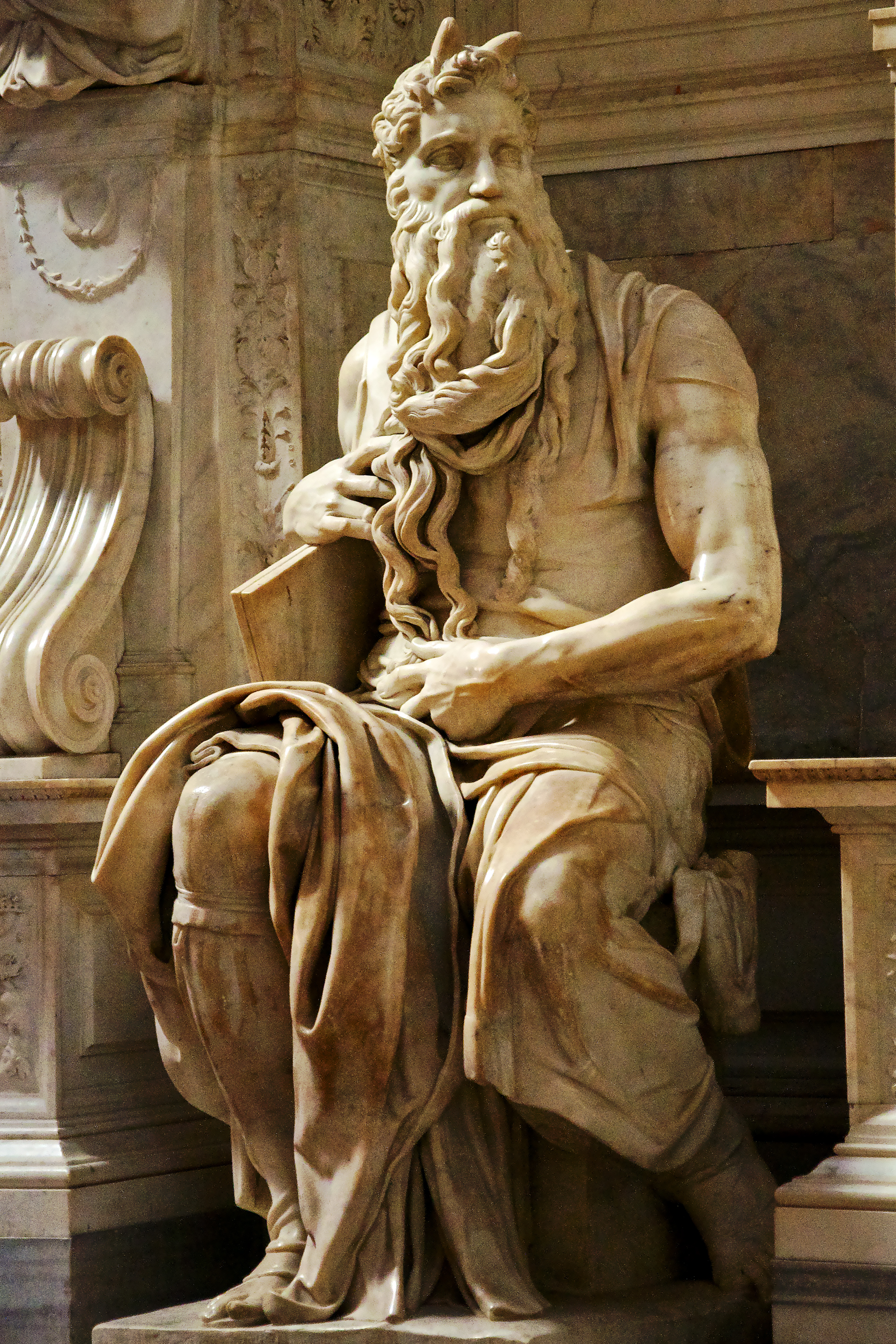
Michelangelo’s Moses, Author Goldmund100 (Luca Volpi), (CC BY-SA 3.0 Unported)
Moses is a monumental figure in the Bible – a Hebrew prophet, leader, and lawgiver [1].
This is the man who heard God from the burning bush, who demanded that the pharaoh let God’s people go, who witnessed the plagues of Egypt, who parted the Red Sea, who received the Ten Commandments from the hand of God, who led the Israelites for 40 years in the desert, and who wrote the Torah (the first five books of the Bible a/k/a the Pentateuch). He is honored by Judaism, Christianity, and Islam.
While the Bible and 3500 years of Passover observance testify to the truth of Moses’ existence, secular scholars continue to search for archaeological evidence.
Timing
A central issue relating the search for such evidence concerns the dating of Moses’ life. Traditionally, scholars have claimed he lived in the 13th Century BC, and that the pharaoh he confronted was Rameses II a/k/a Rameses the Great. However, the Bible suggests otherwise [2A].
First Kings 6: 1 indicates that Solomon built the first temple “in the four hundred and eightieth year after the children of Israel had come out of the land of Egypt.” This would place the Exodus in 1446 BC. That time frame is consistent with other biblical passages: Judges 11: 26, the number of generations listed at 1 Chronicles 6: 33-38, and Acts 13: 19-20.
Authorship
A. Proto-Sinaitic Script (Alphabet)
Some contend that Moses did not write the Torah, but that it was instead written a thousand years later by priests living in exile in Babylon who were attempting to invent a glorious past for Israel [3].
As a member of the Egyptian court, Moses would have been literate. Hieroglyphics would, however, have been a lengthy and cumbersome way of transcribing the biblical text.
What we know now is that an alphabetic script, also, existed [2B]. Sir Flinders Petrie discovered examples of this alphabet, known as Proto-Sinaitic, inscribed on stones at Serabit el-Khadim, an Egyptian turquoise mine in the Sinai. Dating from the 19th Century BC to 15th Century BC, Proto-Sinaitic script was invented by Semites working at the mine and gave rise to the alphabet we use today.
B. Name “Moses”
Douglas Petrovich more recently presented evidence that these inscriptions were written by Israelites, and that Hebrew was the language behind the script [4]. His translation of one inscription (Sinai 361) appears to contain the name Moses, though this is contested.
Some scholars, like Abraham Yehuda, suggest that the name “Moses” could be a shortened form of an Egyptian name like “Ah-meses,” “Tutmose,” or “Rameses” – all of which incorporate the element “meses” meaning “born of”, then the name of a god. Moses, having rejected the gods of Egypt, could have intentionally shortened his name [5A].
The Hebrew version of the name “Mosheh” (meaning “drawn out”) places emphasis on the act of drawing the infant from the Nile (Ex. 2: 10) [5B].
C. Egyptian Words
It should not be overlooked that there are numerous Egyptian words in the biblical text [2C]. For instance, the word “river” in the account of the infant Moses is not the usual Hebrew word “nahar”, but a transliteration of the Egyptian word for the Nile.
Israelite Presence in Egypt
In the story of Joseph, the Bible describes how the Israelites came to be in Egypt (Gen. 45: 18); their subsequent growth there (Ex. 1: 7), and eventual bondage (Ex. 1: 11). However, the presence of the Israelites in Egypt has been disputed by scholars.
A. Hebrew Names
The papyrus known as Brooklyn 35.1446 is an Egyptian document listing the names of the household servants of a noblewoman named Senebtisi [2D]. Forty of the names are Semitic (Hebrew being a Semitic language). Several have been specifically identified as Hebrew. This is a clear indication of Hebrew people living in Egypt prior to the Exodus.
B. Hebaru
In fact, the Hebaru (also spelled Habiru or Apiru) were a group of people in ancient Egypt who were described as outsiders, laborers, or people on the fringes of society.
The Hebaru are frequently associated with the Israelites and the story of the Exodus, with some scholars suggesting that the Hebiru may have been the original Hebrews. However, the term “Hebiru” is not solely tied to a specific ethnic group. Rather, it reflects a social status or class of people who were not part of the established order [6].
Merneptah Stele
In c. 1208 BC the pharaoh Merneptah (the 13th son of Rameses II) erected a 10-foot tall victory monument (called a “stele”) in a temple at Thebes to boast of his victories in Libya and Canaan.
Most scholars agree that this is the oldest reference to Israel as a nation outside of the Bible, and the clearest Egyptian reference to Israel [2E]. It is, also, important because it points toward an early date for the Exodus (c. 1446 BC) and not the late date that some scholars hold to (c. 1270 BC).
Shasu of Yahweh
Toward the end of the 15th Century BC, the Egyptian pharaoh Amenhotep III built a temple to honor the god Amun-Ra at Soleb in Nubia (modern-day Sudan) [2F]. He listed the territories he had conquered on the columns in the temple. Included was “the land of the Shasu [nomads] of Yahweh.” In a name ring nearby a prisoner is portrayed as Semitic, rather than African.
This inscription is universally accepted as referencing Yahweh in Egyptian hieroglyphics (the oldest such reference outside of the Bible) [2G]. Since Amenhotep III was already aware of Yahweh, it strongly suggests that the Exodus should be dated no later than c. 1400 BC.
This, also, by the way, undermines any claim that the pharaoh Akhenaten, who ruled Egypt from 1353 BC to 1336 BC, was the first monotheist [7]. Of course, some recollection of the faith of the Israelites could have remained to influence Akhenaten. Predating even Moses, the patriarch Abraham was truly the first monotheist to have founded a religion.
—
[1] Wikipedia, “Moses”, https://en.wikipedia.org/wiki/Moses.
[2A through 2G] Associates for Biblical Research, The Shiloh Excavations, “Top Ten Discoveries Related to Moses and the Exodus” by Bryan Windle, 7/29/22, https://biblearchaeology.org/research/chronological-categories/exodus-era/4919-top-ten-discoveries-related-to-moses-and-the-exod.
[3] Wikipedia, “Torah”, https://en.wikipedia.org/wiki/Torah.
[4] ASOR, “Hebrew as the Language behind the World’s First Alphabet?” by Douglas Petrovich, April 2017, https://www.asor.org/anetoday/2017/04/hebrew-first-alphabet.
[5A and 5B] BibleHub, “Why Is Moses’ Name Hebrew, Not Egyptian?”, https://biblehub.com/q/why_is_moses%27_name_hebrew,_not_egyptian.htm.
[6] Wikipedia, “Apiru”, https://en.wikipedia.org/wiki/%CA%BFApiru.
[7] Encyclopedia Britannica, “Religion of the Aton”, https://www.britannica.com/biography/Akhenaten/Religion-of-the-Aton.
This series will continue next week
READERS CAN FIND MY VIEWS ON ABUSE AND ABUSE-RELATED ISSUES AT ANNA WALDHERR A Voice Reclaimed, Surviving Child Abuse
https://avoicereclaimed.com

 A Lawyer's Prayers
Very interesting read thanks for sharing🙏
A wise walk through a maze of information. So much hard work put into this… thanks once again Anna, and greetings from a cold (!) South Africa.
I keep forgetting that June/July/August are winter months in South Africa. Here in Maryland we have hit the steamy summer months w/ no relief in sight (LOL).
Actually, Adam was the first monotheist, along with his progeny until Noah.😉
Genesis 4:26
I stand corrected. 🙂
Fascinating insight. I believe Scripture speaks truth. Moses lived, led, and wrote as God directed. Archaeology may seek proof, but faith already knows. God’s Word stands firm.
I completely agree w/ you, Willie.
Did God remove the water from the river so that people could cross it during the flood?
The answer is no.
God does not need to remove the water from the river in reality to demonstrate His power and show people a miracle. There is a smarter way.
Because God knows how to give people暗示.
One of God’s miracles and techniques is the ability to give people暗示 and make a river without water appear as a flood-filled river.
By skillfully manipulating suggestions, one can create a story.
This simple, clear, and wise method is what constitutes a miracle of God.
At least, that is my experience of having heard such words (God’s techniques) from God in the past.
Please consider this as a reference.
Personally, I believe that God did part the waters for the Israelites. He has parted them often enough for me. I would not have survived all I have been through without His loving support, even during the years when I proclaimed myself an atheist. Please, consider the Bible a reference. Everything else is secondary at best.
That particular period in Biblical history is riveting, Anna, at the very least for its evidentiary controversy on the who, what and when. I take the Biblical account at its word. Everything else is supplementary.
I fully agree. However, I thought it might be helpful for Christians to know how much supplemental evidence exists.
Wow, Anna! You undoubtedly put hours of research into the writing of this superb article! I read your findings with great interest. To my knowledge, all the decades of archaeological study in Israel, Egypt, and elsewhere have proven the existence of numerous people and places mentioned in scripture, and have even verified some of events in the Bible. Nothing has been found to refute the scriptures. One more compelling reason to take the Bible seriously. It is NOT a book of fairy tales as some want to claim.
Thank you so much, Nancy. As you say, there is a tremendous amount of information out there supporting Bible, and none refuting it.
Jesus spent the first 12 years of His life in Egypt. I wish we had some historical record to examine what kind of influence that had on His future ministry.
Perhaps the most important remnant of his Egyptian upbringing is the word Amen.
Amenhotep
The name Amenhotep means “Amun is satisfied” (Amun having been the Egyptian god of creation, air, and fertility).
By contrast, the word Amen is derived from the Semitic root for “fixed” or “sure”. For that reason, the Greek Old Testament usually translates Amen as “so be it”. The English Bible frequently translates Amen as “verily” or “truly”.
@Amenhotep: it is exactly, as you say Anna.
@Amen: I’ve always been fascinated by the question of whether the word “Amen” is of purely Hebrew origin or possibly borrowed from Ancient Egyptian. Whatever the case may be, the earliest attestation of Amen appears in the Torah, traditionally compiled around the 6th century BCE. However, some scholars believe that parts of the Book of Numbers—where the word also occurs—may date back to the 15th or 13th century BCE, aligning roughly with the estimated lifetime of Moses.
Historically speaking, before the arrival of the Semitic Hyksos into Egypt, the god Amun was a relatively minor deity, one of the original eight primordial gods, associated with emptiness or the invisible. His prominence only rose after the Hyksos were expelled, when Egyptian nationalism and cultic consolidation elevated Amun to a central divine figure—especially under Ahmose I, who founded the 18th Dynasty.
It is not at all unlikely that the Hebrew presence in Egypt was facilitated under Hyksos rule, which dominated northern Egypt during the 15th Dynasty. In that case, any covenants or protectipns granted to the Hebrews would have been made with Hyksos pharaohs, not native Theban rulers. When Ahmose I defeated the Hyksos and expelled them, those protections would have been nullified, leaving the Hebrews vulnerable and setting the stage for their oppression—and eventual flight.
By the time of the Exodus, if we follow that timeline, Amun’s veneration was well-established, his cult central to Theban Egypt. Whether the word Amen has direct linguistic roots in Hebrew or Egyptian (both Afroasiatic languages), it seems to me that the religious environment of Egypt would have inevitably reinforced its usage and spiritual significance.
So, my personal view is this: even if Amen originated as a Hebrew term, its survival and depth of meaning were undoubtedly shaped—perhaps even amplified—by its resonance in the Egyptian context.
You are an amazing resource, Hubert! 🙂
Abraham Yehuda’s insight is certainly thought-provoking and far from unfounded. If we consider the theory that Joseph entered Egypt during the Hyksos 15th Dynasty, it follows that the Exodus would likely have taken place during the 18th Dynasty, founded by Ahmose I (“moon-born”). Although the name Ahmose was relatively common in that period, it did not carry particular prestige. In fact, it often implied that the individual was an orphan, or born after the father’s death. The colloquial form of this name—Messe, Mose, or Moyse—would later resonate in traditions that span far beyond the Nile.
Thank you for contributing your own in depth knowledge of Egyptian history to this discussion, Hubert.
Anytime Anna, this is my favorite part of the history 🙂