Witchcraft, Part 1 – History
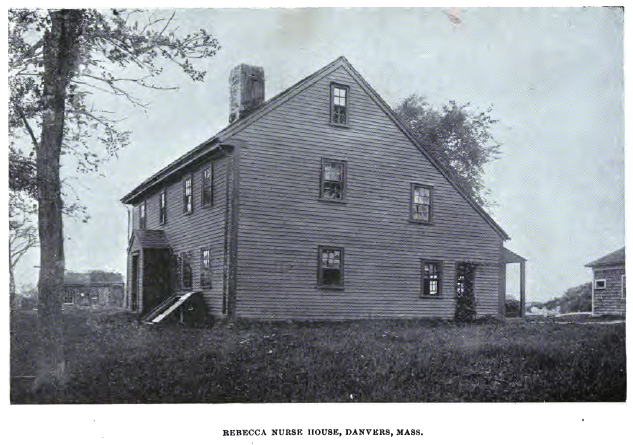
Rebecca Nurse House, Danvers, MA, Source “Witchcraft Illustrated” by Henrietta D. Kimball, Geo. A. Kimball, Publisher, Boston, 1892, Author Henrietta D. Kimball (PD)
WARNING: Graphic Images
Historically speaking, widespread witch hunts took place between 1500 AD and 1650 AD [1A][2][3]. Across Europe, an estimated 100,000 people (the vast majority of them women, most over the age of 40) were tried for the crime of witchcraft, with some 50,000 convicted and brutally executed [1B][4]. Common methods included hanging, burning at the stake, drowning, and pressing to death with heavy stones [5].
Fortune Telling and Herbal Medicine
A belief in the occult had existed since antiquity. Magic was an attempt to harness unseen forces. Astrology, palm reading, and divination were popular in the Middle Ages [1D]. Fortune telling was common as were binding spells dealing with relationships [1E].
At a time when medicine was in its infancy, charms were often combined with prayers and herbal remedies, in a genuine (if misguided) attempt to help the sick or infertile.
The Little Ice Age
“Social and economic problems, changes to the legal system, and religious upheaval all served as necessary preconditions for the age of witch-hunts [1C].”
Perhaps not coincidentally, the witch hunts occurred during the heart of what is known as the “Little Ice Age” (c. 1300 AD – 1850 AD), when cooling temperatures in Europe and elsewhere impacted crops, resulting in famines, food riots, social upheaval, and mass migrations [6].
Confessions by Torture
In the face of these challenges, concern developed that Satan might recruit individuals to undermine society. Witchcraft was consequently outlawed.
Tragically, that occurred just as the secular legal system was placing greater emphasis on confessions, often gained through torture [1F]. The illicit motives of informers (revenge, jealousy, greed, etc.) and misogynistic tendencies of judges were rarely taken into account.
The Hammer of Witches
“The Malleus claimed that witchcraft was the most abominable of all heresies, and gave four reasons as to why. They were the devotion of body and soul to evil, sexual relationships with incubi, the renunciation of the Christian faith, and the sacrifice of unbaptized infants to Satan [7A].”
The most infamous book on witchcraft, the Malleus Maleficarum (“The Hammer of Witches”) by Jacob Sprenger and Heinrich Kramer, was published in 1484 AD [1G][7B]. This claimed to provide guidance on how a witch could be identified, and heavily influenced the witch craze.
Women were thought to be “weaker” and more susceptible to the wiles of the devil [1H]. They could be stripped naked before a panel of men, and their bodies searched for suspicious marks. The assumption from the start was that they were guilty [10A].
Discovering witches became a fever. At least one Puritan clergyman remained skeptical. John Gaule in the 1640s remarked that “every old woman with a wrinkled face, a furr’d brow, a hairy lip, a gobber tooth, a squint eye, a squeaking voice, or a scolding tongue is not only suspected, but pronounced for a witch [8][9].”
Salem Witch Trials
Countless books and plays have been written on the Salem witch trials in America [11]. The most famous of these is “The Crucible” by Arthur Miller.
Religious differences, food shortages, tensions among families in the community, mass hysteria, a legal power vacuum, lyme disease, jimson weed, and ergot poisoning are among the explanations which have been put forth.
Growing skepticism about hearsay and spectral evidence (based on visions and dreams) eventually led to the end of the Salem witch trials. Gov. William Phips of Massachusetts Bay intervened, dissolving the special court of Oyer and Terminer which oversaw the Salem witch trials after accusations extended to several prominent figures including his own wife [10B].
Let us hope we have learned the lesson of how fear and bias can pervert justice.
—
[1A through 1H] Digital Collections for the Classroom (DCC), “Magic and Witchcraft in Early Modern Europe” by Michael Lynn, 2/27/18, https://dcc.newberry.org/?p=14415#:~:text=Although%20magic%20and%20witchcraft%20had,the%20age%20of%20witch%2Dhunts.
[2] Wikipedia, “European witchcraft”, https://en.wikipedia.org/wiki/European_witchcraft.
[3] National Geographic, “Witches: Truth Behind the Trials”, https://www.natgeotv.com/za/shows/natgeo/witches-truth-behind-the-trials.
[4] Wikipedia, “Witch trials in the early modern period”, https://en.wikipedia.org/wiki/Witch_trials_in_the_early_modern_period.
[5] Wikipedia, “List of people executed for witchcraft”, https://en.wikipedia.org/wiki/List_of_people_executed_for_witchcraft.
[6] Science/Smith University, Climate in Global Cultures & Histories, “The Effects of the Little Ice Age (c. 1300-1850)”, https://www.science.smith.edu/climatelit/the-effects-of-the-little-ice-age/#:~:text=The%20Effects%20of%20the%20Little,Climate%20in%20Arts%20and%20History.
[7A and 7B] The Historian, “The ‘Hammer of Witches’: An Earthquake in the Early Witch Craze” by Arran Birks, 1/24/20, https://projects.history.qmul.ac.uk/thehistorian/2020/01/24/the-malleus-maleficarum-an-earthquake-in-the-early-witch-craze/.
[8] Wikipedia, “John Gaule”, https://en.wikipedia.org/wiki/John_Gaule.
[9] WFTV, “Salem witch trials: what you need…”, https://www.wftv.com/news/trending/malleus-maleficarum-ancient-books-offers-ways-identify-witch/B5PRVNGF3BF2JAPEEC4YRM6HGE/.
[10A and 10B] History, “How the Salem Witch Trials Influenced the American Legal System”, 10/4/21 (Updated 5/28/25), https://www.history.com/articles/salem-witch-trials-justice-legal-legacy.
[11] Wikipedia, “Salem witch trials”, https://en.wikipedia.org/wiki/Salem_witch_trials.
Part 2 in this series will be posted next week
READERS CAN FIND MY VIEWS ON ABUSE AND ABUSE-RELATED ISSUES AT ANNA WALDHERR A Voice Reclaimed, Surviving Child Abuse
https://avoicereclaimed.com

 A Lawyer's Prayers
And I believe that behind all this persecution lies misogyny. Hatred of women is deeply intertwined with the history of humanity in every corner of the world. Great post, Anna. 😘😘
Many thanks, Aline.
My pleasure!
Educational, many thanks Anna!
Most of the time the charge was laid either because of a grudge or to kill widows so the rich could then buy their land for a cheap price
Your like of my post of “Isaiah Chapter 49-50” is very kind; thanks for being such a good internet friend.
Your like of my post, ” Isaiah Chapter 47-48;” was very kind. Thank you very much.
I suppose all the witch trials over the centuries also prove that the power of suggestion is indeed a very strong power. We have every reason to be wary today–as they should have been back then.
Too many fall prey to this delusion.
Very interesting!
This great post reminds me that we are not all that far removed from the times when misogyny and mass hysteria and inquisitions took place. It seems as if we are always on the brink of dissolving social ties to pursue our own prejudices and fears. On the brink, for now, restrained by God’s Spirit, and not yet over the edge.
We tell ourselves that society has made progress. And, in some ways, it has. But human nature, itself, does not change.
Sehr gut zusammengefasst!
Vielen Dank.