Transubstantiation, Part 1 – The Roman Catholic and Eastern Orthodox View
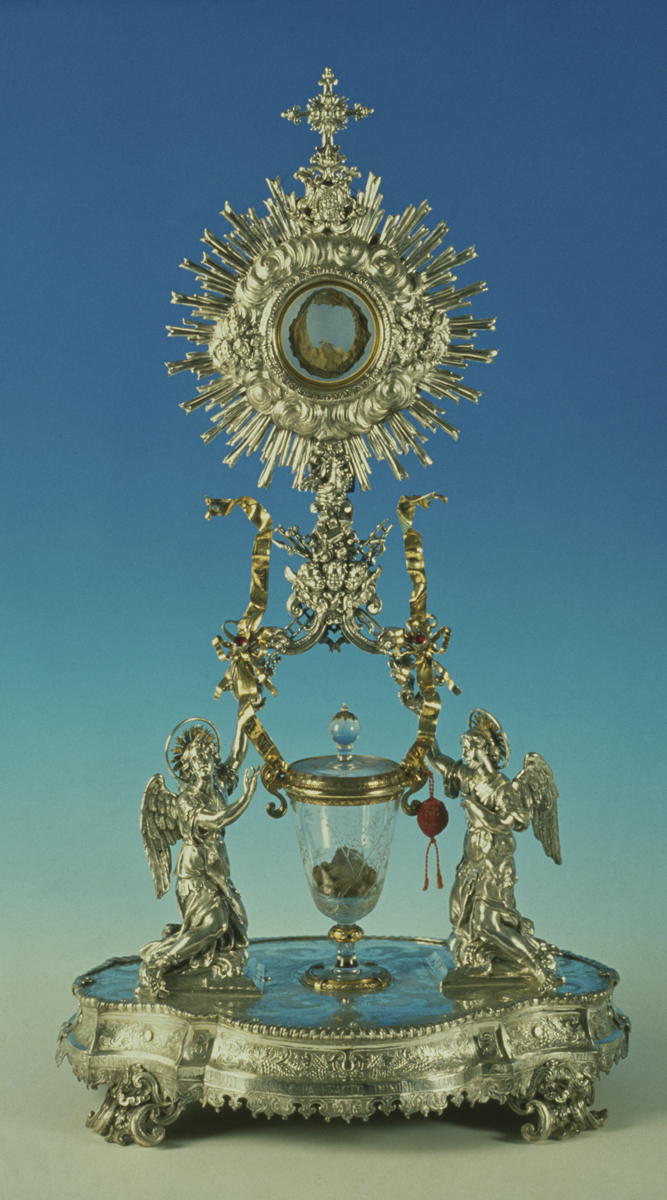
Monstrance holding the consecrated host from the Eucharistic miracle of Lonciano, Image Author AFC photo (CC BY-SA 3.0 Unported)
“And as they were eating, Jesus took bread, blessed and broke it, and gave it to the disciples and said, ‘Take, eat; this is My body.’ Then He took the cup, and gave thanks, and gave it to them, saying, ‘Drink from it, all of you. For this is My blood of the new covenant, which is shed for many for the remission of sins‘” (Matt. 26: 26-28).
Transubstantiation is the doctrine that at consecration the communion bread and wine (also, referred to as the Eucharist) become the body and blood of Christ. Over the centuries, this doctrine has become extremely controversial.
The Roman Catholic and Eastern Orthodox Churches hold that there is a change in substance, while the outward characteristics of the bread and wine (taste, smell, appearance) remain the same [1A]. The various Protestant denominations differ with this view. Generally, they hold that Christ is spiritually present (either in the sacramental elements or the believer), or hold that the communion service is purely a symbolic memorial of the Last Supper.
This series will not attempt to resolve that controversy. Rather, it examines the reasons Christian denominations differ on the issue.
Roman Catholic/Eastern Orthodox Teaching
The Roman Catholic Church teaches that during the mass the whole substance of bread and wine changes into the whole substance of Christ’s body and blood. This is the formal definition of transubstantiation, as set forth by the Fourth Lateran Council (1215) and reaffirmed by the Council of Trent (1545-1563) [1B]. The teaching was explained scholastically by Thomas Aquinas (1225 – 1274) in his Summa Theologica.
The Eastern Orthodox Church shares the belief in the real presence of Christ in the Eucharist, but uses the term “metousiosis” (Greek: “change of essence”), which affirms that the substance of the elements changes into Christ’s body and blood while their accidents remain unchanged [2].
Scriptural Basis
“Then Jesus said to them, ‘Most assuredly, I say to you, unless you eat the flesh of the Son of Man and drink His blood, you have no life in you. Whoever eats My flesh and drinks My blood has eternal life, and I will raise him up at the last day. For My flesh is food indeed, and My blood is drink indeed‘” (John 6: 53-55).
For Jewish listeners, these words would have been shocking, because the Law of Moses strictly forbade consuming blood (Lev. 17: 10-14). Christ knew precisely how His words would be heard, yet He repeated them several times [3]. In other instances, Christ immediately corrected those who misunderstood Him (Matt. 16: 6-12; John 3: 3-5, and 11: 11-14).
The Apostle Paul put it this way: “The cup of blessing which we bless, is it not the communion of the blood of Christ? The bread which we break, is it not the communion of the body of Christ?” (1 Cor. 10: 16).
Throughout the Old Testament, the sacrificial system pointed forward to the sacrifice of Christ as the Paschal Lamb (1 Cor. 5: 7). At the first Passover, the lamb was not only killed but eaten (just as the manna in the desert would be eaten).
As our High Priest, Christ offers Himself perpetually to the Father (Heb. 9: 11-12). We enter the heavenly Holy of Holies through the torn curtain of Christ’s own flesh (Heb. 10: 19-22), sharing communion with the angels and saints (Heb. 12: 22-24).
The phrase “Through Him then let us continually offer up a sacrifice of praise to God” (Heb. 13: 15) is a veiled reference to the Eucharist [4A]. Praise (Hebrew: “yadah”) has the same root as “thank offering”, the Greek counterpart for which is “eucharista” from which we get Eucharist.
Since Christ is present in the Eucharist which is His risen body, the Eucharist is the tangible union of heaven and earth (Heb. 4: 14, 6: 19-20) [4B]. This is seen as the central message of the Book of Hebrews by the Roman Catholic Church [4C].
History
The term “transubstantiation” is not found in the Bible. Early church fathers used strongly realistic language concerning the Eucharist, but did not define the mode of Christ’s presence [1C].
Ignatius of Antioch (c. 35 – 108 AD) wrote, “I desire the bread of God…the bread of life, which is the flesh of Jesus Christ…and I desire the drink of God…His blood, which is incorruptible love and eternal life” [1D]. Of heretics, he wrote that they abstain from the Eucharist because they do not confess it to be the flesh of the Savior.
Justin Martyr (c. 100 – 165 AD) wrote, “Not as common bread and common drink do we receive these, but…the food which is blessed by the prayer of His word, and from which our blood and flesh by transmutation are nourished, is the flesh and blood of that Jesus who was made flesh” [1E].
Both Clement of Alexandria (c. 150 – 215 AD) and Tertullian (c. 155 – 220 AD) used “symbol” and “figure” language for the Eucharist [1F]. Scholars argue that this was not intended to exclude real presence, since “symbol”, “type”, and “figure” were commonly understood at the time as a participating presence rather than a mere sign [1G].
Cyril of Jerusalem (c. 313 – 386 AD) urged believers to trust Christ’s words that the elements had been “changed” despite their appearance [1H]. Ambrose of Milan (339 – 397 AD), too, taught a literal change in the elements: “This bread is bread before the words of the sacraments. When consecration has been added, from bread it becomes the body of Christ” [1I].
Augustine of Hippo (354 – 430 AD) affirmed that the bread once consecrated “becomes” the Body of Christ: “The faithful know what I’m talking about; they know Christ in the breaking of bread. It isn’t every loaf of bread, you see, but the one receiving Christ’s blessing, that becomes the body of Christ” [1J].
Eucharistic Miracles
Since the Third Century there have been a series of miracles around the world surrounding the Eucharist [5A][6A][7][8]. A list of these can be found at https://www.miracolieucaristici.org/en/Liste/list.html.
A number of such miracles have involved what appeared to be bleeding of the host. In 1819, however, Bartolomeo Bizio established a scientific connection between the apparent “bleeding” of starchy foods and the prevalence of red-pigmented bacteria like S.marcescens [5B]. The same result can be produced by fungus like micrococcus prodigiosus [5C].
By comparison, a histological and microchemical examination in 1970 of the relic (bleeding flesh) of the miracle of Lanciano by Prof. Odoardo Linoli and Prof. Ruggero Bertelli reported it in Quaderni Sclavo di Diagnostica to be cardiac tissue, identifying the blood type as AB [6B]. These findings, too, though have come under criticism.
—
[1A through 1J] Wikipedia, “Transubstantiation”, https://en.wikipedia.org/wiki/Transubstantiation.
[2] Catholic Answers, “Do any other faiths believe in transubstantiation?”, https://www.catholic.com/qa/do-any-other-faiths-believe-in-transubstantiation.
[3] Christianity Info, “What Is Transubstantiation? Why Catholics Believe the Eucharist Is Jesus”, https://www.christianityinfo.com/2026/05/what-is-transubstantiation-catholic-teaching-explained.html.
[4A, 4B, and 4C] Andrew Swafford and Jeff Cavins, “Hebrews, The New and Eternal Covenant” (Ascension Press).
[5A, 5B, and 5B] Wikipedia, “Corporal of Bolsena”, https://en.wikipedia.org/wiki/Corporal_of_Bolsena.
[6A and 6B] Wikipedia, “Eucharistic miracle of Lanciano”, https://en.wikipedia.org/wiki/Eucharistic_miracle_of_Lanciano.
[7] Eucharistic Miracles, “Rome, St. Gregory the Great”, https://eucharisticmiracles.faith/miracle/ita-rome-6th-7th.
[8] Wikipedia, “Eucharistic miracle of Santarem”, https://en.wikipedia.org/wiki/Eucharistic_miracle_of_Santar%C3%A9m.
Part 2 The Protestant View will be posted next week.
Wishing You All A Happy Thanksgiving!
READERS CAN FIND MY VIEWS ON ABUSE AND ABUSE-RELATED ISSUES AT A Voice Reclaimed, Surviving Child Abuse and More
https://avoicereclaimed.com


