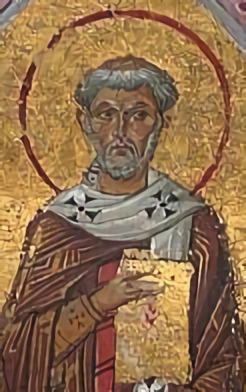
“St. Luke” by James Tissot (1886-1894), Brooklyn Museum (Accession No. 00.159.207), (PD)
St. Luke is the author of one of the canonical gospels, as well as the Book of Acts [1A]. Many consider Luke’s gospel, which focuses on social justice and the poor, the most poetic of the four.
Background
It is widely accepted that St. Luke was a Gentile convert to Christianity, addressing a Gentile audience [1B]. Christian tradition has it that he wrote his gospel in Greece.
St. Luke is thought to have been unmarried, and to have lived originally in Antioch [1C]. DNA testing on what tradition holds to be St. Luke’s body in the Basilica of Santa Giustina in Padua has revealed that he was of Syrian ancestry [1D][2]. He was martyred in Thebes.
Medicine
A faithful companion to the Apostle Paul, Luke is described by the Epistle to the Colossians as a physician, and believed by many scholars to have practiced medicine.
Art
Medieval tradition held that Luke was, also, an artist — the first icon painter.
A number of paintings of the mother of Christ are popularly attributed to Luke. These include the Black Madonna of Częstochowa and Madonna del Rosario a/k/a Maria Advocata or Advocata Nostra, said to be the first depiction of the Virgin Mary [3][4][5].
![]()
“Madonna del Rosario” a/k/a “Maria Advocata” or “Advocata Nostra” (c. 6th Century or earlier), Author Asia (CC BY-SA 4.0 International)
Patron Saint
The Catholic Church and other major Christian denominations venerate St. Luke. His symbol is the winged ox, representing the sacrificial aspect of Christ’s ministry and the spread of the gospel throughout the world.
St. Luke is the viewed as the patron saint of physicians/surgeons, medical students, artists/painters/sculptors, crafts workers, lacemakers, bachelors, and butchers [6].
His feast day is celebrated on October 18.
—
[1A and 1B] Wikipedia, “Luke the Evangelist”, https://en.wikipedia.org/wiki/Luke_the_Evangelist#As_an_artist.
[2] Britannica, “Where is St. Luke buried?”, https://www.britannica.com/question/Where-is-St-Luke-buried.
[3] Wikipedia, “Black Madonna of Cęstochowa”, https://en.wikipedia.org/wiki/Black_Madonna_of_Cz%C4%99stochowa.
[4] Wikipedia, “Maria Advocata (Madonna del Rosario)”, https://en.wikipedia.org/wiki/Maria_Advocata_(Madonna_del_Rosario).
[5] The Marian Room, “A Hidden Icon of Mary, The Advocata Nostra” by Patrician Enk, 6/9/20, https://themarianroom.com/a-hidden-icon-of-mary-the-advocata-nostra/.
[6] Saint Luke Catholic Church, “Our Patron, Saint Luke”, https://slparish.com/history-of-our-patron-st-luke.
READERS CAN FIND MY VIEWS ON ABUSE AND ABUSE-RELATED ISSUES AT ANNA WALDHERR A Voice Reclaimed, Surviving Child Abuse
https://avoicereclaimed.com
“The Left has decided that Jews who are not victims are not true Jews…”
-Rabbi Dr. Gerald Meister, former advisor to Israel’s Ministry of Foreign Affairs [1A]
There was a time that the political Left supported Jews and the idea of a Jewish homeland [2]. But that has since changed.
While strident antisemitism was always prominent on the communist far Left, it has now spread to the liberal mainstream [3].
Media Bias
Liberal bias is most obvious in the media. The Israeli-Palestinian conflict is generally mischaracterized as Western colonialism. Reporting invariably takes a sympathetic view of the Palestinians, a supposedly oppressed people.
This slanted approach not only ignores the true history of the area, but miscasts the current reality.
History
From 1517 to 1917, the West Bank was part of the Ottoman Empire [4]. From 1917 to 1967, the territory was administered first by Britain, then Jordan.
Israel acquired that territory in the defensive Six-Day War the nation fought in 1967 against a coalition of larger Arab states which included Egypt, Syria, and Jordan [5]. Read more…
![]()
Carnival in Xiloxochitla, Mexico, Author YLinaresB
(CC BY-SA 4.0 International)
The following is excerpted from an article by Cole Richards, president of The Voice of the Martyrs.
“The persecution of Christians in rural Mexico is severe, widespread and persistent. Rural Mexican Christians face fierce opposition from varied sources, and their stories remain largely untold…
Mexico City is one of the world’s largest and most prosperous cities, and much of Mexico is beautiful, stable and free. Since these are the parts of Mexico experienced by…nearly all outsiders, the stories of rural Christians are unknown…The persecutors, and ultimately our spiritual enemy, work to prevent the larger body of Christ from knowing about their wicked acts. We must never be unaware of Satan’s scheme to divide, isolate and destroy the church (2 Corinthians 2: 11).”
Marxism
“Marxism — atheistic communist ideology — continues to be one source of persecution in Mexico. Many are surprised to learn that today, decades after the fall of the Soviet Union, this ideology is on the rise in Central and South America. But even those who are aware of communism’s growth in places like Venezuela and Bolivia rarely know that Marxist groups have semi-autonomy in parts of southern Mexico and that they severely persecute Christians.”
![]()
Beggar in Amritsar, India (2009), Source Flickr.com, Author MM of Switzerland (CC BY-SA 2.0 Generic)
The G20 Summit is being held in India this weekend.
Along with the United States, the United Kingdom, and the European Union, the members of the G20 include Mexico, Canada, Australia, France, Italy, Spain, Russia, China, Brazil, Argentina, India, Indonesia, Japan, South Korea, Turkey, Saudi Arabia, and South Africa.
These nations have a major impact on the world’s economy, together comprising 85% of global GDP and 75% of global trade [1].
The G20 meet annually to discuss solutions for global issues from climate change to finance, their goal being to assure worldwide economic stability.
Strangely enough, the poverty so evident in India does not appear to be on the agenda. Indeed, India has gone to great lengths to hide or disguise the destitute status of its citizenry from G20 leaders. The article here https://www.theguardian.com/world/2023/sep/08/ashamed-of-our-presence-delhi-glosses-over-plight-of-poor-as-it-rolls-out-g20-red-carpet?CMP=oth_b-aplnews_d-1 describes those lengths. Read more…
![]()
Before and After: Due to malnutrition, Omar was admitted to Feed My Starving Children, El Salvador, at 8 y.o. weighing only 19 pounds (the weight of an average 10-month old American child). The second photo was taken 6 months later.
Source https://www.flickr.com/, Author Feed My Starving Children https://www.fmsc.org/, (CC BY-SA 2.0 Generic).
The CBS game show “Survivor” — about to begin its 45th season — has become a staple. The program isolates a group of men and women in a tropical locale, who then compete for cash and prizes. The show has been nominated for several Emmy Awards. Potential contestants vie to be on.
The Discovery Channel has a program entitled “Naked and Afraid”. An unclothed couple attempts to locate food and craft shelter. Viewers are offered titillation in the guise of “adventure” and scientific inquiry.
Meanwhile, the History Channel has a program entitled “Alone”. Survivalists live on their own in a wilderness area with limited equipment.
This is so called “reality” television. Apparently, Americans have become so bored (and disconnected from genuine risk) that we must take vicarious pleasure in the artificial challenges set for strangers in quasi-scripted settings.
While we entertain ourselves, there are those in the world who must deal with real challenges.
- Very nearly half the people on earth live on less than $2.50 per day [1].
- 21,000 children worldwide die each day from a combination of poverty, malnutrition, and easily treatable disease [2]. That is one child every four seconds [3]. Some 1.8 million children die each year of diarrhea alone [4].
- More people have access to a cell phone than a toilet [5].
These figures do not take into full account the casualties of war, or the suffering of those made refugees by war.
Greatly blessed, we are numbing ourselves to the needs of the world, to the grim reality others face daily. But that cannot last. Moses warned Israel, too, of approaching judgment.
“For they are a nation void of counsel, Nor is there any understanding in them” (Deut. 32: 28).
—
[1][2][4] Global Issues, “Poverty Facts and Stats” by Anup Shah, 1/7/13, http://www.globalissues.org/article/26/poverty-facts-and-stats.
[3] Global Issues, “Today Around 21,000 children died around the world” by Anup Shah, 9/24/11, http://www.globalissues.org/article/715/today-21000-children-died-around-the-world.
[5] Time, “More People Have Cell Phones than Toilets, UN Study Shows” by Yue Wang, 3/25/13, http://newsfeed.time.com/2013/03/25/more-people-have-cell-phones-than-toilets-u-n-study-shows/.
Originally posted 8/16/15
READERS CAN FIND MY VIEWS ON ABUSE AND ABUSE-RELATED ISSUES AT ANNA WALDHERR A Voice Reclaimed, Surviving Child Abuse
https://avoicereclaimed.com
![]()
Eucharistic stained glass window depicting bread and wine, St. Michael the Archangel Catholic Church, Findlay, OH, Author Nheyob, (CC BY-SA 3.0 Unported)
Transubstantiation — a fundamental belief of the Roman Catholic Church — holds that the Eucharistic elements are sacramentally transformed into the body and blood of Christ at consecration [1]. The substance of the bread and wine changes, though the appearance remains.
The 4th Century martyr Tarcisius is among those who died to prevent desecration of the Eucharist [2]. Cistercian monks Fr. Dominik Zavrel and Fr. Albertin Maisonade died doing this in 1799.
Methodists likewise believe in the real presence of Christ in the bread and wine. However, Anglicans, Presbyterians, and Lutherans do not. The Eastern Orthodox Church has not taken a formal stand.
Origin
“And He took bread, gave thanks and broke it, and gave it to them, saying, ‘This is My body which is given for you;do this in remembrance of Me’” (Luke 22: 19).
Christ instituted the sacrament of the Eucharist at the Last Supper. However, He, also, referred to Himself as the bread of life (John 6: 48).
“I am the living bread which came down from heaven. If anyone eats of this bread, he will live forever; and the bread that I shall give is My flesh, which I shall give for the life of the world” (John 6: 51).
“For My flesh is food indeed, and My blood is drink indeed. He who eats My flesh and drinks My blood abides in Me, and I in him” (John 6: 55-56).
Symbolism and Physicality
Though He did use metaphors in the parables, Christ never said that He was speaking symbolically on this issue. He did clarify that He was not speaking about mere physicality.
“It is the Spirit who gives life; the flesh profits nothing. The words that I speak to you are spirit, and they are life” (John 6: 63).
The Catholic Church interprets this to mean that the presence of Christ in the bread and wine is a sacred mystery. Read more…

Saints vs. Scoundrels by Dr. Benjamin Wiker examines the impact key ideas have had on history. The author does this by crafting a series of lively dialogs between historic figures — one always Christian, the other always atheistic.
Dr. Wiker holds an MA in religion and a PhD in theological ethics from Vanderbilt University. He is a Senior Fellow at the Veritas Center for Ethics and Public Life at Franciscan University, having taught at multiple Catholic colleges and universities during his long career.
The historic figures Dr. Wiker has chosen to pair with one another are:
- St. Augustine and Jean-Jacques Rousseau;
- St. Francis of Assisi and Niccolo Machiavelli;
- Flannery O’Connor and Ayn Rand;
- St. Thomas More and England’s King Henry VIII; and
- Edith Stein (St. Teresa Benedicta of the Cross) and Friedrich Nietzsche.
In each instance, Dr. Wiker provides insight into the influence which the backgrounds and life choices of these historic figures had on their ideas. More than that, he cuts to the heart of the worldly philosophies espoused and the flaws inherent in them.
![]()
Tower of London, Author Bob Collowan (CC BY-SA 4.0 Unported)
Used alternately as a palace, a fortress, and a place of execution, the Tower of London has stood on the River Thames for almost 1000 years. In Jewish history, it has played a paradoxical role [1].
Status as Property of the King
“All Jews, in whichever kingdom they may be, ought to be under the guardianship and protection of the liege king..because the Jews and all their possessions are the king’s…”
-Laws of Edward the Confessor
It is thought that the first Jews arrived in England during the Norman Conquest of 1066 [2].
Under English law, Jews in the Middle Ages were classified as property of the king. This implied a certain protection. It, also, meant that Jews could be taxed, and their possessions confiscated at the king’s pleasure.
Though Jews were not permitted to own land and were barred from most occupations other than medicine, they were allowed to act as moneylenders. This likewise benefited the king, whenever royal funds were in short supply.
Unfortunately, their special relationship with royalty made Jews the targets of mob violence in times of resentment toward the throne, economic downturn, excessive Crusade zeal, or general antisemitism.
Incarceration in the Tower
At least 1000 Jews are believed to have been incarcerated in the Tower of London during the 13th Century.
In 1255, 92 Jews falsely accused of having ritually murdered a 9 y.o. Christian boy (so called “Little Saint Hugh of Lincoln”) were brought to the Tower [3]. Eighteen were immediately hanged on account of this blood libel. The rest were eventually released. Read more…
![]()
The Red State/Blue State Divide (covering national elections in 2008, 2012, 2016, and 2020), Author Angr
(CC BY-SA 3.0 Unported, GNU)
Key:
Red = Republican candidate carried state in all four most recent elections.
Pink = Republican candidate carried state three of the four most recent elections.
Purple = Republican candidate and Democratic candidate each carried state in two of the four most recent elections.
Light blue = Democratic candidate carried state in three of the four most recent elections.
Dark blue = Democratic candidate carried state in all four most recent elections.
As the excerpts (below) demonstrate, the constitutions of all 50 states — even liberal states like Massachusetts, New York, and California — acknowledge the existence of God.
Most state constitutions invoke God’s protection and/or indicate gratitude to Him for their citizens’ civil, political, and religious rights.
That was not a mere turn of phrase, an arcane way of speaking which has since fallen out of fashion. It was a reflection of the American people’s faith, an expression of the general state of mind at the time [1].
Abortion
Today, the constitutions in some 26 states have been amended or interpreted to protect abortion [2][3]. In at least seven of these states, there is no gestational limit placed on abortion.
In only 20 states is abortion banned (whether outright or at an early stage) [4]. These bans allow exceptions for rape or incest. In four more states, bans have been blocked by the courts.
Gay Marriage
A majority of state constitutions did ban gay marriage before the landmark US Supreme Court decision Obergefell v. Hodges in 2015 [5][6]. Gay marriage is now legal in all 50 states.
Gender Reassignment Surgery
The issue of gender reassignment surgery for minors (so called “gender affirming healthcare”) is in process of being litigated nationwide, with many in the Transgender Movement seeking support from state constitutions for their position that biological sex and gender identity can be separated [7].
The question must be asked whether those references to God in our state constitutions are now meaningless vestiges of a bygone era.
—
[1] This is not to say that every American was once Christian, or that Christianity was ever a prerequisite to citizenship.
[2] Center for Reproductive Rights, “State Constitutions and Abortion Rights”, July 2022, https://reproductiverights.org/wp-content/uploads/2022/07/State-Constitutions-Report-July-2022.pdf.
[3] New York Times, “A Volatile Tool Emerges in the Kate Zernike, 1/29/23, https://www.nytimes.com/2023/01/29/us/abortion-rights-state-constitutions.html.
[4] New York Times, “Tracking the States where Abortion Is Now Banned”, 6/30/23, https://www.nytimes.com/interactive/2022/us/abortion-laws-roe-v-wade.html.
[5] Wikipedia, “Same-sex marriage law in the United States by state”, https://en.wikipedia.org/wiki/Same-sex_marriage_law_in_the_United_States_by_state.
[6] University of Missouri-Kansas City (UMKC) Law School, “The Gay Rights Controversy”, http://law2.umkc.edu/faculty/projects/ftrials/conlaw/gayrights.htm.
[7] Washington and Lee Law Review, “Leave Them Kids Alone: State Constitutional Protections for Gender-Affirming Healthcare” by Jessica Matsuda, 2022, https://lawreview.wlulaw.wlu.edu/leave-them-kids-alone-state-constitutional-protections-for-gender-affirming-healthcare/.
—
State Constitutions (Excerpted)
Alabama 1901, Preamble. “We the people of the State of Alabama, invoking the favor and guidance of Almighty God, do ordain and establish the following Constitution…”
Alaska 1956, Preamble. “We, the people of Alaska, grateful to God and to those who founded our nation and pioneered this great land…”
Arizona 1911, Preamble. “We, the people of the State of Arizona, grateful to Almighty God for our liberties, do ordain this Constitution…”
Arkansas 1874, Preamble. “We, the people of the State of Arkansas, grateful to Almighty God for the privilege of choosing our own form of government…”
California 1879, Preamble. “We, the People of the State of California, grateful to Almighty God for our freedom…”
Colorado 1876, Preamble. “We, the people of Colorado, with profound reverence for the Supreme Ruler of Universe…”
Connecticut 1818, Preamble. “The People of Connecticut, acknowledging with gratitude the good Providence of God in permitting them to enjoy…”
Delaware 1897, Preamble. “Through Divine Goodness all men have, by nature, the rights of worshiping and serving their Creator according to the dictates of their consciences.”
Florida 1885, Preamble. “We, the people of the State of Florida, grateful to Almighty God for our constitutional liberty…establish this Constitution…”
Georgia 1777, Preamble. “We, the people of Georgia, relying upon protection and guidance of Almighty God, do ordain and establish this Constitution…”
Hawaii 1959, Preamble. “We, the people of Hawaii, Grateful for Divine Guidance…establish this Constitution…”
Idaho 1889, Preamble. “We, the people of the State of Idaho, grateful to Almighty God for our freedom, to secure its blessings…”
Illinois 1870, Preamble. “We, the people of the State of Illinois, grateful to Almighty God for the civil, political and religious liberty which He hath so long permitted us to enjoy and looking to Him for a blessing on our endeavors…”
Indiana 1851, Preamble. “We, the People of the State of Indiana, grateful to Almighty God for the free exercise of the right to chose our form of government…”
Iowa 1857, Preamble. “We, the People of the State of Iowa, grateful to the Supreme Being for the blessings hitherto enjoyed, and feeling our dependence on Him for a continuation of these blessings establish this Constitution…”
Kansas 1859, Preamble. “We, the people of Kansas, grateful to Almighty God for our civil and religious privileges…establish this Constitution…”
Kentucky 1891, Preamble. “We, the people of the Commonwealth of grateful to Almighty God for the civil, political and religious liberties…”
Louisiana 1921, Preamble. “We, the people of the State of Louisiana, grateful to Almighty God for the civil, political and religious liberties we enjoy…”
Maine 1820, Preamble. “We the People of Maine, acknowledging with grateful hearts the goodness of the Sovereign Ruler of the Universe in affording us an opportunity…and imploring His aid and direction…”
Maryland 1776, Preamble. “We, the people of the state of Maryland, grateful to Almighty God for our civil and religious liberty…”
Massachusetts 1780, Preamble. “We…the people of Massachusetts, acknowledging with grateful hearts, the goodness of the Great Legislator of the Universe…in the course of His Providence, an opportunity…and devoutly imploring His direction…”
Michigan 1908, Preamble. “We, the people of the State of Michigan, grateful to Almighty God for the blessings of freedom. . . establish this Constitution…”
Minnesota 1857, Preamble. “We, the people of the State of Minnesota, grateful to God for our civil and religious liberty, and desiring to perpetuate its blessings…”
Mississippi 1890, Preamble. “We, the people of Mississippi in convention assembled, grateful to Almighty God, and invoking His blessing on our work…”
Missouri 1845, Preamble. “We, the people of Missouri, with profound reverence for the Supreme Ruler of the Universe, and grateful for His goodness…establish this Constitution…”
Montana 1889, Preamble. “We, the people of Montana, grateful to Almighty God for the blessings of liberty…establish this Constitution…”
Nebraska 1875, Preamble. “We, the people, grateful to Almighty God for our freedom…establish this Constitution…”
Nevada 1864, Preamble. “We the people of the State of Nevada, grateful to Almighty God for our freedom establish this Constitution…”
New Hampshire 1792, Part I. Art. I. Sec. V. “Every individual has a natural and unalienable right to worship God according to the dictates of his own conscience…”
New Jersey 1844, Preamble. “We, the people of the State of New Jersey, grateful to Almighty God for civil and religious liberty which He hath so long permitted us to enjoy, and looking to Him for a blessing on our endeavors…”
New Mexico 1911, Preamble. “We, the People of New Mexico, grateful to Almighty God for the blessings of liberty…”
New York 1846, Preamble. “We, the people of the State of New York, grateful to Almighty God for our freedom, in order to secure its blessings…”
North Carolina 1868, Preamble. “We the people of the State of North Carolina, grateful to Almighty God, the Sovereign Ruler of Nations, for our civil, political, and religious liberties, and acknowledging our dependence upon Him for the continuance of those…”
North Dakota 1889, Preamble. “We, the people of North Dakota, grateful to Almighty God for the blessings of civil and religious liberty, do ordain…”
Ohio 1852, Preamble. “We the people of the state of Ohio, grateful to Almighty God for our freedom, to secure its blessings and to promote our common…”
Oklahoma 1907, Preamble. “Invoking the guidance of Almighty God, in order to secure and perpetuate the blessings of liberty…establish this…”
Oregon 1857, Bill of Rights, Article I Section 2. “All men shall be secure in the Natural right, to worship Almighty God according to the dictates of their consciences…”
Pennsylvania 1776, Preamble. “We, the people of Pennsylvania, grateful to Almighty God for the blessings of civil and religious liberty, and humbly invoking His guidance…”
Rhode Island 1842, Preamble. “We the People of the State of Rhode Island grateful to Almighty God for the civil and religious liberty which He hath so long permitted us to enjoy, and looking to Him for a blessing…”
South Carolina 1778, Preamble. “We, the people of the State of South Carolina…grateful to God for our liberties, do ordain and establish this Constitution…”
South Dakota 1889, Preamble. “We, the people of South Dakota, grateful to Almighty God for our civil and religious liberties…establish this.”
Tennessee 1796, Art. XI.III. “That all men have a natural and indefeasible right to worship Almighty God according to the dictates of their conscience…”
Texas 1845, Preamble. “We the People of the Republic of Texas, acknowledging, with gratitude, the grace and beneficence of God.”
Utah 1896, Preamble. “Grateful to Almighty God for life and liberty, we establish this Constitution…”
Vermont 1777, Preamble. “Whereas all government ought to…enable the individuals who compose it to enjoy their natural rights, and other blessings which the Author of Existence has bestowed on man…”
Virginia 1776, Bill of Rights, XVI. “Religion, or the Duty which we owe our Creator…can be directed only by Reason and that it is the mutual duty of all to practice Christian Forbearance, Love and Charity towards each other…”
Washington 1889, Preamble. “We the People of the State of Washington, grateful to the Supreme Ruler of the Universe for our liberties, do ordain this Constitution…”
West Virginia 1872, Preamble. “Since through Divine Providence we enjoy the blessings of civil, political and religious liberty, we, the people of West Virginia reaffirm our faith in and constant reliance upon God…”
Wisconsin 1848, Preamble. “We, the people of Wisconsin, grateful to Almighty God for our freedom, domestic tranquility…”
Wyoming 1890, Preamble. “We, the people of the State of Wyoming, grateful to God for our civil, political, and religious liberties…establish this Constitution…”
READERS CAN FIND MY VIEWS ON ABUSE AND ABUSE-RELATED ISSUES AT ANNA WALDHERR A Voice Reclaimed, Surviving Child Abuse
https://www.avoicereclaimed.com