
Homeless tents in Albuquerque, NM, Author Cyanidethistles (CC BY-SA 4.0 International)
Congress in 1999 directed that the US Dept. of Housing and Urban Development (HUD) devote 30% of its budget toward the policy of Housing First to combat homelessness [1]. HUD mandated that homeless service providers across the country adopt the same approach regardless of the specific needs of their communities, in order to qualify for funding.
Around the same time, the US Interagency Council on Homelessness took the view that efforts by local governments to regulate street camping or implement other policies seeking to enforce basic norms “criminalized” homelessness.
The traditional Emergency Response Model had relied on emergency shelters and street outreach to provide immediate basic services (shelter, food, hygiene, health care, and crisis mental health intervention).
These services were provided with low-barrier access, and generally supported by “rapid exit” planning to help the homeless get into stable housing of some kind quickly. With funds limited and homelessness on the increase, that last often included Single Room Occupancy (SRO) hotels, sometimes substandard. A better option was needed.
But Housing First had major flaws. There was no requirement that occupants stop the use of drugs or alcohol and go into treatment. Contrary to 2 Thessalonian 3: 10, there was no requirement of employment by the able-bodied.
“Politicians, homeless advocates, the media and especially academics widely held that the best way to help people living on the street was to give them keys to a subsidized apartment and expect nothing else of them other than to stay inside. This approach simply ignored their addictions, severe mental illnesses and sometimes even criminal activity. This philosophy pervaded strategic plans in every level of government [2]”.
With shelters and other short-term arrangements sidelined, the homeless who declined offers of housing were left living on the street. In Philadelphia alone, 69% did not accept help. Communities were without recourse as homeless encampments swamped parks and neighborhoods.
Nor has an increase in subsidized housing had much effect on homelessness which is now at the highest levels ever [3]. Perhaps even worse than that, the percentage of homeless with mental illness has increased from 39% to 50%, while the percentage of homeless with addictions has increased from 39% to 60%. Read more…
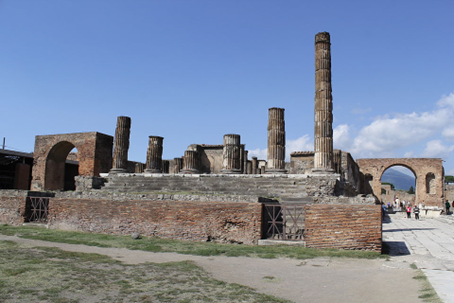
Temple of Jupiter, Pompeii, Author Carla Brain (CC BY-SA 2.0 Generic)
On February 14, 1387 AD Lithuanian Grand Duke Jogaila shut down the last temple to the Roman god Jupiter, so ending state-sponsored paganism in Europe [1]. On October 9, 2025 Latvia reinstated it.
Latvia’s Dievturi Community Law goes further than allowing neo-pagan groups to register their places of worship, operate as charities, and receive state recognition for the marriages they perform (rights several European nations have extended). Though the Latvian constitution does not permit the establishment of religion, the new law proclaims Dievturiba the traditional religion in Latvia, and commends it to the populace as preserving the nation’s spiritual heritage.
Christianity was imposed on Latvia by the Teutonic Knights during the Livonian Crusade in the 12th and 13th Centuries [2]. Their successors then ruled Latvia as a German-speaking noble class for seven centuries.
Dievturiba was actually devised in 1925 by Ernests Brastinş̌ and Kārlis Marovskis-Bregži, as a protest against Christianity. Tragically, it was associated with the ultranationalist Thunder Cross Movement of Gustavs Celmiņš which later collaborated with the Nazis in the Latvian Holocaust [3].
With birthrates in the Baltic states falling, the revival of pagan religion may be a reaction to the marginalization of indigenous culture. Or it may reflect desires for leadership by a strongman who will at least promise (if not deliver) prosperity and safety. Since 1993, emphasizing the need for a strong Latvia and fanning the fear of minorities have been central to the far right agenda of For Homeland and Freedom.
These developments do not bode well either for the Christians of Latvia or the ethnic minorities living there. We can only wait and see what the New Year will bring.
—
[1] The Hill, “The return of the strong gods?” by Francis Young, 10/28/25, https://thecritic.co.uk/the-return-of-the-strong-gods/.
[2] Wikipedia, “Northern Crusades”, https://en.wikipedia.org/wiki/Northern_Crusades.
[3] Wikipedia, “Perkonkrusts”, https://en.wikipedia.org/wiki/P%C4%93rkonkrusts.
[4] Transform! Europe, “The extreme right in the Baltic states: Latvia” by Matgorzata Kulbaczewska-Figat, 6/4/20, https://transform-network.net/blog/analysis/the-extreme-right-in-the-baltic-states-latvia/.
Federal funds have been pulled from Catholic Charities of the Rio Grande Valley for alleged incomplete/inaccurate recordkeeping. While Catholic Charities maintains it provides nothing more than humanitarian aid to migrants, some contend it has contributed to chaos on the Southern border.
See, https://www.ncronline.org/news/federal-funds-pulled-catholic-charities-usmexico-border.
Wishing you all a Happy New Year!
READERS CAN FIND MY VIEWS ON ABUSE AND ABUSE-RELATED ISSUES AT ANNA WALDHERR A Voice Reclaimed, Surviving Child Abuse
https://avoicereclaimed.com
Wishing you all a Merry Christmas!
READERS CAN FIND MY VIEWS ON ABUSE AND ABUSE-RELATED ISSUES AT ANNA WALDHERR A Voice Reclaimed, Surviving Child Abuse
https://avoicereclaimed.com
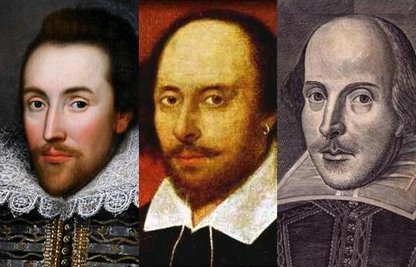
Comparison between Cobbe portrait, Chandos portrait, and Droeshout engraving of William Shakespeare, Source http://shakespeareportrait.freehosting.net/index.html, Author Brice Stratford (PD)
The spiritual will of John Shakespeare – William Shakespeare’s father – has long been among the evidence strongly suggesting that William Shakespeare was raised a Catholic [1][2][3]. Multiple eminent scholars have affirmed this including EK Chambers, GB Harrison, John Henry de Groot, and Edmond Malone [4].
The handwritten will was found in 1757 during renovation of the home in which William Shakespeare was born. It is thought to have been written around 1581, when William Shakespeare was 17 y.o.
The will, itself, is a declaration of faith, expressing the strong desire to receive the Last Rites and die a Catholic in good conscience. It was a crime in Elizabethan England punishable by death to harbor a priest within one’s home. Consequently, there was every likelihood a priest would not be available at the time of a believer’s death.
Charles Borromeo
In 1923, a scholar discovered a comparable spiritual testament attributed to Cardinal Charles Borromeo, a central figure at the Council of Trent (1545-1563) and Counter-Reformation reformer [5][6][7][8]. In fact, the spiritual will of John Shakespeare corresponds phrase for phrase with Borromeo’s Testament of the Soul (Il Testamento dell’Anima ) from the middle of Item 3 to the end.
Borromeo was initially thought to have authored the Testament of the Soul in response to a plague which killed some 17,000 in Milan between 1576-1578. Because of the large number of deaths, priests were not often available to provide Last Rites. The Testament of the Soul would have been a way to circumvent this.
Actually, an earlier version of Barromeo’s Testament of the Soul (dated December 1560 with his own name on it) was listed among his possessions at the time of his death. The same form may have been revised and re-used during the plague in Milan. Read more…

High-resolution, near-infrared image of vertical cloud known as L483 captured by NASA/ESA/CSA James Webb Space Telescope, Source Actively forming star system Lynds 483 (NIRCam image) https://esawebb.org/images/weic2503a, Author NASA, ESA, CSA, STScI (CC Attribution 4.0 International)
“Beauty is truth, truth beauty,” – that is all Ye know on earth, and all ye need to know.”
—Ode on a Grecian Urn, John Keats [1]
In his Ode on a Grecian Urn the poet John Keats examined the relationship of beauty in art, nature, and human experience to truth.
Keat raised the profound question of whether beauty and truth are subjective or objective. Since the Enlightenment and more so in the postmodern world, the belief has been that beauty is merely a matter of taste and objective truth entirely unknowable.
But that has not always been the case.
Plato identified a just community as one living in harmony with objective reality, and in accord with eternal beauty, truth, and goodness.
“He has made everything beautiful in its time. Also He has put eternity in their hearts…” (Eccl. 3: 11).
Many Scriptures demonstrate God’s concern for beauty. That concern is reflected in the creation, the building of the temple, and descriptions of the new heavens and new earth. Moreover, God made mankind to experience and appreciate beauty. We need only look up at the stars to recognize this. Read more…
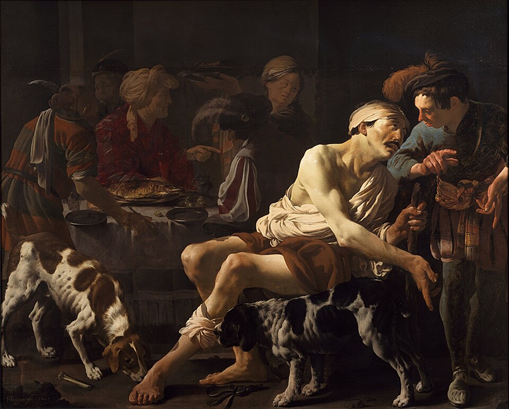
“The Rich Man and the Poor Lazarus” by Henrick ter Brugghen (1625), Centraal Museum (Accession No. 11241), Netherlands, Source/Photographer https://artsandculture.google.com/asset/nwGdfR1Asi9YSQ, (PD)
“There’s a place in the world for the angry young man
With his working class ties and his radical plans
He refuses to bend, he refuses to crawl
And he’s always at home with his back to the wall
And he’s proud of his scars and the battles he’s lost
And he struggles and bleeds as he hangs on his cross
And he likes to be known as the angry young man”— “Angry Young Man”, Billy Joel
The plight of the poor should concern anyone with a conscience. But the means available to alleviate that plight – or purportedly alleviate it – are not all equally valid in the eyes of God.
Conflict
The activist Saul Alinsky has been lionized by the political left (even in Christian circles) as a champion for the poor and disenfranchised [1][2].
Alinsky emphasized community organization and conflict as key strategies for social justice. But he advocated the use of any means necessary to achieve the ends he considered laudable – means which included deceit, fraud, and character assassination, in an effort to motivate the “have-nots” and demonize his adversaries.
Alinsky began his best-known work, Rules for Radicals, with the following statement:
“Lest we forget at least an over-the-shoulder acknowledgment to the very first radical: from all our legends, mythology, and history…the first radical known to man who rebelled against the establishment and did it so effectively that he at least won his own kingdom – Lucifer.”
In an interview with Playboy Magazine, he stated:
“Hell would be heaven for me. All my life I’ve been with the have-nots. Over here, if you’re a have-not, you’re short of dough. If you’re a have-not in hell, you’re short of virtue. Once I get into hell, I’ll start organizing the have-nots over there [3].”
These remarks may sound clever to some, cheeky. But they are extremely revealing.
Satan, the Father of Lies, is motivated by pride and an icy hatred of mankind. Alinsky, too, was motivated by hatred, in his case for all those he viewed as unjust. But it is a lie that we must be motivated by hate to overcome injustice. Read more…
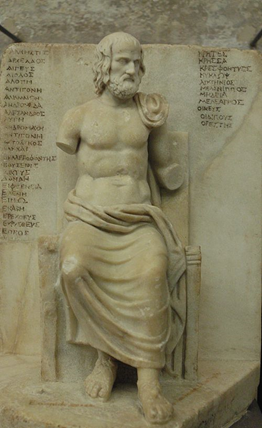
Euripides, Louvre Museum (Accession No. Ma 343 – LL 15), Paris, France, Source/Author Jastrow (PD)
The great tragedian Euripides, now acclaimed worldwide, was not beloved in Athens during his lifetime [1][2A]. He held a mirror up to society, exposing its many flaws rather than glorifying its achievements.
Ancient Athens is today lauded as the cradle of democracy, much as America (actually a republic) is celebrated as its powerful proponent. But Athenian democracy lasted only around 200 years, and was restricted to free males over the age of 18 [3][4]. Women and slaves (who outnumbered citizens) had no voice.
Like modern day America, Athens was beset by political turmoil, social discontent, and vehement debates about everything under the sun. Athens had endured military defeats, and a plague. But the city still believed itself chosen by the gods to reign over the world. Read more…
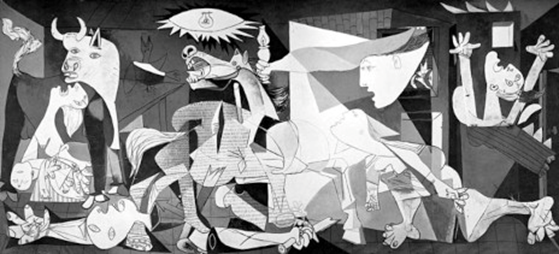
“Guernica” by Pablo Picasso (1937), Museo Reina Sofia, Madrid, Spain, Source https://www.wikiart.org, Copyright © Pablo Picasso
Pablo Picasso painted “Guernica” both to memorialize civilians massacred by German Nazis and Italian Fascists during the strafing and bombing which destroyed a small town by that name during the Spanish Civil War, and to protest the atrocities of war [1][2]. Sadly, Guernica was far from the last such destruction.
Indeed, another genocide is in progress in Sudan…the second there in our lifetimes [3][4A].
Background
A military coup in 1989 destroyed democracy in Sudan, with dictator Omar al-Bashir suspending the constitution and dissolving parliament [4B]. A 30 year reign under strict Sharia Law, countless human rights abuses, and a 22 year civil war followed.
Infrastructure (including the country’s critical oil pipeline) was decimated by scorched earth tactics on all sides during this time. As a result, the country’s economy cratered. All the while, safe haven was given to terrorist organizations like Al-Queda and ISIS.
After the bloodless removal of al-Bashir by the military in 2019, inflation increased by 300%. Another coup followed in 2021. However, the authoritarian structures al-Bashir had put in place remained. A second civil war then broke out in 2023 after a power struggle within the military government.
Humanitarian Crisis and War Crimes
Millions are helpless victims of the world’s largest humanitarian crisis, as the Sudanese Armed Forces (SAF) and paramilitary Rapid Support Forces (RSF) now wrestle over territory. The RSF, it should be noted, is linked to human rights violations such as the systematic murder of men and boys (including infants) on an ethnic basis, and the use of rape as a weapon of war [4C][5]. These are nothing less than war crimes.
Some 24.6 million face starvation; 19 million lack safe water; 12 million have been displaced [6][7A]. The horrors being perpetrated parallel the pattern in Darfur 20 years ago [7B]. As many as 150,000 have already been killed in this second brutal civil war [4D]. Some believe that total may be as high as 400,000 [8]. Read more…

Architectural model of Abrahamic Family House, Abu Dhabi, Author US Embassy Jerusalem, (Creative Commons Attribution 2.0 Generic)
Chrislam is a syncretic religion which combines the teachings and practices of the Abrahamic faiths of Christianity and Islam [1][2A].
Chrislam represents an attempt to bridge the gap between Christianity and Islam. The goal (laudable on its face, but misleading) is to build tolerance, trust, and mutual understanding, in order to foster peace and justice [3].
Historically, Chrislam arose in Nigeria in the 1970s. The God of the Judeo-Christian Bible and the Allah of the Quran are considered to be the same deity by Chrislam.
Consequently, Chrislam recognizes both the Bible and Quran as holy books, and reads from both during services. Both Christian and Muslim holidays are celebrated equally, including Eid al-Adha, a feast commemorating Abraham’s supposed sacrifice of his son Ishmael at Allah’s command (a false claim) [4A].
Syncretic Religions
Other examples of syncretic religions include Santeria which blends West African Yoruba traditions with Catholicism; Rastafarianism which combines Christianity with Ethiopianism and pan-Africanism; and Unitarian Universalism which combines elements of Christianity, Judaism, Buddhism, paganism, humanism, and other belief systems.
The House of One in Berlin has three separate sections under a single roof where worshipers can pray (a church, a mosque, and a synagogue) [4B]. These are linked by a communal room where worshipers and members of the public can come together, and learn more about one another.
The Abrahamic Family House in Abu Dhabi has a comparable arrangement, with a courtyard between buildings. Read more…

Prison Bars, Author Michael Coghlan of Adelaide Australia, (CC BY-SA 2.0 Generic)
The Marshall Project is a non-profit news organization covering the US criminal justice system [1]. Its purpose is to raise awareness about the system’s failings, and promote a more fair, effective, and humane system through journalism.
Death in Custody Data
The Death in Custody Reporting Act (DCRA) mandates that the Dept. of Justice collect information from the states about everyone who dies in law enforcement custody. Before 2000, such data was not systematically tracked by the federal government.
Unfortunately, there are still flaws in the system.
The Marshall Project earlier this year identified by name 681 individuals who died in law enforcement custody, but were not present in the database [2A]. Read more…

 A Lawyer's Prayers