
Joseph Stalin (1937), Author Unknown (PD)
Charles Darwin’s theory of evolution contends that men were not created by God, but rather that they evolved. What is less often mentioned these days is that the theory contends some men are more evolved than others.
Darwin influenced Karl Marx, Friedrich Engels, Vladimir Lenin, Joseph Stalin, Adolf Hitler, Mao Zedong, Pol Pot, Margaret Sanger, and others whose totalitarian regimes and eugenic policies enslaved, tortured, killed, or aborted untold millions [1A].
The following excerpts are taken from a presentation by historian William Federer regarding Darwin [1B]:
Racist Ideology
Darwin published On the Origin of Species in 1859, and The Descent of Man in 1871, expounding:
“With savages, the weak in body or mind are soon eliminated…We civilized men, on the other hand… build asylums for the imbecile, the maimed and the sick…Thus the weak members propagate their kind. No one who had attended to the breeding of domestic animals will doubt that this must be highly injurious to the race of man…Hardly anyone is so ignorant as to allow his worst animals to breed …”
Darwin continued:
“Civilized races of man will almost certainly exterminate and replace the savage races throughout the world…The break between man and his nearest allies will then be wider, for it will intervene between man in a more civilized state, as we may hope, even than the Caucasian, and some ape as low as a baboon, instead of as now between the negro or Australian and the gorilla.”
Karl Marx
“Darwin’s Origin of Species was read and reread by Karl Marx, who saw ‘survival of the fittest’ as validating his ‘dialectical conflict,’ where labor and community organizers would create domestic chaos to enable communist dictators to usurp power.”
“Karl Marx wrote to Lassalle, January 16, 1861: ‘Darwin’s book is very important and serves me as a basis in natural selection for the class struggle in history.’ “
“Karl Marx dedicated a personal copy of his book, Das Kapital, to Charles Darwin, inscribing that he was a ‘sincere admirer’ of Darwin.”

Across the globe, there is a sharp gap between the health care available to the rich and that available to the poor [1A].
Measuring the Global Health Gap
Since the 1950s, national governments and international organizations have committed to eliminating disparities, and improving the health of the disadvantaged, albeit with mixed success. Disparities persist. These can be measured in terms of access to care (or lack thereof), quality of care, mortality rates, life expectancy, and prevalence of chronic illness among the population.
As of 2012, mortality rates were still more than twice as high among black South Africans as white South Africans [1B]. One in four cancers in developing countries is attributable to infection, therefore, largely preventable [1C]. Diphtheria immunization ranges from 32% to 98% across countries [1D]. Read more…

Legal gavel, Author Blogtrepreneur (CC BY-SA 2.0 Generic)
Since the coronavirus pandemic, health concerns have moved eviction hearings online. At least 43 states now allow virtual evictions; 7 states mandate that eviction proceedings take place online.
Unfortunately, online evictions often deprive tenants of their rights [1].
CDC policy bans residential evictions for non-payment of rent through June 2021. Many landlords have though continued to file evictions.
The CDC eviction moratorium can only be raised as a defense at an eviction hearing. The CDC eviction moratorium (enacted under the Public Health Service Act of 1944) has, itself, been struck down at least four different times [2]. And CDC policy does not apply when a lease has expired (a fact unscrupulous landlords exploit).
During virtual evictions on video platforms like Zoom, internet connection issues are common; multiple tenants may appear on screen at the same time; and participants are often muted.
Depending on the state, electronic filing procedures may prohibit all but lawyers from filing critical documents online. Just 10% of tenants facing eviction have such legal representation.
As a consequence, virtual eviction hearings can take as little as 30 seconds. This eliminates any semblance of equal justice for the poor.
“Speak up for those who cannot speak for themselves, for the rights of all who are destitute. Speak up and judge fairly…” (Prov. 31: 8-9 NIV).
—
[1] CNBC, “30 Second Trials. Judges Muting Tenants. The Problems with Virtual Evictions” by Annie Nova, 5/1/21, https://www.cnbc.com/2021/05/01/virtual-eviction-hearings-often-deprive-renters-of-their-rights.html.
[2] New York Times, “Federal Judge Strikes Down Moratorium on Evicting Renters” by Glenn Thrush, 5/5/21, https://www.nytimes.com/2021/05/05/us/politics/eviction-moratorium-biden.html.
READERS CAN FIND MY VIEWS ON ABUSE AND ABUSE-RELATED ISSUES AT ANNA WALDHERR A Voice Reclaimed, Surviving Child Abuse
https://avoicereclaimed.com

Liberty Bell with Independence Hall in the background, Philadelphia, PA, Author National Park Service Digital Archives (PD)
Readers of this blog will by now be familiar with Christian Legal Clinics of Philadelphia https://www.clcphila.org/, a non-profit whose predecessor I had the privilege of co-founding.
CLCP provides the poor of Philadelphia with quality legal services at no cost. This is accomplished with the assistance of Christian attorneys and paralegals who selflessly volunteer their time and expertise for the love of God.
By His grace and their devotion, CLCP has grown from humble beginnings in a single room at the Salvation Army in West Philadelphia to 8 clinics across the city.
The story below is from Peter Hileman, Esq., Director Emeritus of CLCP:
“Yvonne came to our Germantown clinic…for a will and power of attorney. She is a nurse at Temple University Hospital and has been treating COVID patients for months. It has been a very challenging time for her, physically, emotionally and spiritually.
A woman of deep faith, she says she trusts in Jesus every day to enable her to keep going to work and staying healthy so as not to become infected herself and possibly infect her family…
She never had a will before and she heard about our clinic from a friend and wanted to be responsible.”
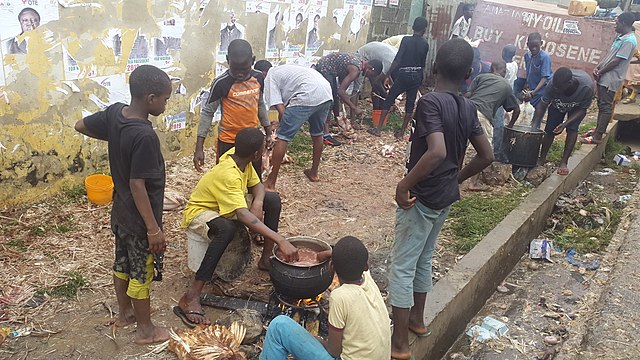
Child labor in Africa, Author Amk-Ámmar (CC BY-SA 4.0 International)
“ ‘As long as the earth endures, seed time and harvest, cold and heat, summer and winter, day and night will never cease’ ” (Genesis 8: 22).
Hundreds of thousands of children under the age of 18 work in agriculture in the US. Precise figures are difficult to come by. But the 2018 Child Agricultural Injury Survey put the number of those under the age of 20 employed on farms at 719,582 [1].
Federal Regulation
The federal Fair Labor Standards Act governs US child labor. Children from the age of 12 on may legally work for any farm with parental consent. No survey could be located re: the number of children age 12 and under illegally engaging in farm work.
There are no legal limits on the hours children can work in agriculture when school is not in session. Farm workers are not, however, entitled to overtime, and they generally do not receive job benefits.
Child farm workers often make less than minimum wage, with pay reduced still further when employers under-report hours and force children to purchase the gloves, tools, and drinking water that employers are actually required by law to supply.
Child Injury and Mortality [2]
“About every three days a child on a U.S. farm dies from an agriculture-related incident. Every day some 38 children are injured on a US farm [3].”
If those statistics are not sufficiently shocking, the National Institute for Occupational Safety and Health estimates that 907 young people died on US farms between 1995 – 2002. That averages an astonishing 130 deaths per year.
Human Rights Watch over a decade ago reported on the grave health and educational risks children employed in agriculture face. Farm workers (children and adults) often work with or in vicinity of dangerous equipment. Again, the 2018 Childhood Agricultural Injury Survey estimated that 11,942 injuries occurred to young people on farms.
Both adults and children regularly work in fields treated with chemicals, some carcinogenic. According to the EPA, children ages 3 – 15 may experience three times the cancer threat the same level of chemicals would pose for adults. Simply put, children are more vulnerable to harm. Read more…

Hand-woven bag on rigid heddle loom with cotton threads, Author/Source SEN Heritage Looms – Sophia Tsourinaki (CC BY-SA 4.0 International)
“ Like wild donkeys in the desert, the poor go about their labor of foraging food; the wasteland provides food for their children. They gather fodder in the fields and glean in the vineyards …” (Job 24: 5-6).
King Cotton
No one can say for certain when cotton was first utilized in textiles.
Fragments of cotton bolls and cotton cloth have been found in Mexico dating to about 5800 BC. Cotton clothed ancient Egypt, India, and China. When Columbus arrived in the Americas, cotton was already growing in the Bahamas.
By the mid-19th Century cotton formed the basis of the South’s economy. Fortunes were made in the lucrative cotton trade, as an outgrowth of slave labor.
Americans continue to wear and use cotton daily.
We are clothed in cotton, soothed and pampered by cotton, and take cotton for granted. Terrycloth robes, jeans and T-shirts, corduroy slacks and chambray work shirts, socks, underwear, cosmetics, swabs, and coffee filters are among the myriad products containing or derived from cotton. Luxury bath towels are graded by cotton thread count.
By the Labor of Their Hands
Until 1943, cotton was laboriously picked by hand. This meant long, backbreaking hours in the sun – first by African American slaves, then share croppers (black and white), then migrants and their children. A grown man was expected to pick about 90 lbs. per day.
Much has changed with the advent of heavy machinery, but migrant workers continue to play an important role in agriculture.
Children continue to work by their parents’ sides. For one thing, cotton has been genetically modified to incorporate the genetic coding for Bt toxin, a natural insecticide produced by the bacterium Bacillus thuringiensis (Bt). This has reduced the reliance on pesticides. As it turns out though, children are just the right height to pollinate Bt cotton seeds artificially. Read more…

Gdansk railway station and Warsaw Ghetto burning (May 1943), Author Unknown (PD)
An obscure Polish libel case may have a chilling effect on research regarding the Holocaust worldwide [1][2].
Genocide
Nazi genocide took the lives of 3 million Polish Jews during the Holocaust [3]. No doubt exists about this.
At least 90% of Poland’s Jews were exterminated. Hundreds of synagogues were destroyed [4]. No less than 457 concentration and death camps were located in German-occupied Poland during WWII [5]. These included the infamous Auschwitz, Birkenau, Sobibor, and Treblinka [6].
National Responsibility Denied
Despite this, Poland has remained adamant that the nation did not participate in persecution of the Jews [7]. In 2018, an Amendment to the Act on the Institute of National Remembrance criminalized any public statements attributing collective responsibility to the Polish nation for crimes related to the Holocaust.
Pogroms and Complicity
Statutory religious tolerance notwithstanding, antisemitism in Poland long pre-dated the Holocaust [8]. Pogroms were not uncommon.
While individual Poles did risk their lives to hide and aid Jews during WWII, others were complicit in – or apathetic to – the fate of the Jews. In multiple instances, the same person both saved and denounced Jews.
Alleged Libel
Which brings us to the case of Leszczynska v. Engelking.
Historians Barbara Engelking and Jan Grabowski only briefly mention the deceased Edward Malinowski in their 1600 page tome titled “Night Without End: The Fate of Jews in Selected Counties of Occupied Poland.” Malinowski, a village elder and uncle of the 81 y.o. plaintiff, Filomena Leszczynska, is alleged both to have robbed and saved Estera Siemiatycka by finding her work as a forced laborer. Read more…

Tian Tan Buddha (also known as the Big Buddha) on Lantau Island, in Hong Kong, Author Beria Lima de Rodgriquez @ Wikimedia Commons https://commons.wikimedia.org/wiki/User:Beria (CC BY-SA 3.0 Unported)
The following is excerpted from the October 2020 edition of Voice of the Martyrs Magazine:
“Buddhism is more than 2500 years old, but it came to widespread prominence in Europe and the US only about 50 years ago. Since then, Buddhist thought has become deeply rooted in American popular culture through music, books and films. Many Americans encounter the teachings of Buddhism’s founder, Siddhartha Gautama, when seeking a way to empty themselves of desire and attachment while embracing peace of mind through meditation.
Gautama is called the Buddha (enlightened one) by his followers. The simple response God’s word gives to the notion of human enlightenment is that our Lord Jesus Christ is the true light and life. Without Him, there is only darkness and death (see John 1: 1-13). Read more…

“Resurrection of Christ” by Emile Signol (c. 1856), Church of Saint Eustache, Petit Palais (Accession No. PPP4792), Source Paris Musees (PD)
“He is not here; for He is risen, as He said” (Matt. 28: 6).
Wishing you all a blessed Easter!
READERS CAN FIND MY VIEWS ON ABUSE AND ABUSE-RELATED ISSUES AT ANNA WALDHERR A Voice Reclaimed, Surviving Child Abuse
https://avoicereclaimed.com

“Christ Crucified” by Gian Lorenzo Bernini (c. 1655), Basilica of Escorial, Madrid, Spain (CC0 1.0 Universal Public Domain Dedication)
As we enter Spring and finally begin to turn the corner in the fight against coronavirus, it is only fitting that we acknowledge the suffering this pandemic has caused.
During the 25 years I practiced law, I witnessed a great deal of suffering. It took many forms: brain damage; paraplegia; rape; child molestation; death by cancer, by explosion, by decapitation, by fire, by scaffolding collapse, by head-on collision; loss of an eye, of an arm, of a leg, of a child.
Some of the most heart wrenching cases for me were the ones involving poverty issues – eviction, foreclosure, consumer fraud, unsafe housing, denial of public benefits.
Those issues meant fathers unable to keep a roof over their children’s heads; mothers driving themselves to exhaustion, in an effort to put food on the table; children already deprived of hope; lives destroyed by drugs and despair. The working poor, running hard just to stay in place.
How can a good and loving God allow such suffering? Read more…

 A Lawyer's Prayers