
Ruins of Byzantine fortress of Nymphea (“Frourio Nimfaias”), Greece, Author User:Gia (CC BY-SA 3.0 Unported)
Some readers may be offended by this post, because of its political content. For that I extend my sincere apologies. But I do not write this in an effort to advance a political agenda or support a particular party.
I am neither an expert on border security, nor an advocate of “open” borders. Certainly, the traffic in illegal drugs, weapons, and human beings is a grave concern. For all I know, a wall may, in certain locations, constitute as legitimate an element of border defense as electronic surveillance and increased patrols.
Unfortunately, the demand for a wall has come to mean something more.
The demand for a wall is a demand for security at all costs; for protection against change, and an invading hoard of barbarians; for exclusion of all those “different”, therefore, dangerous. The demand for a wall has racist overtones, acknowledged or not.
The demand for a wall is prompted by fear, and belief in a zero sum game. One side must lose, for the other to win. That both might derive benefit is not a possibility. So we are told.
Ours is a wealthy nation in a world of poverty. We can turn our backs on those in need, or find a way to share our resources. The choice is ours.
The poem I have reblogged here captures my anxiety – for the welfare of the poor and the welfare of this nation, should we forget them.
“It was snowing that night the wall was completed, not many noticed, tired of the fight.
Yet some…rejoiced in their victory, believing the Enemy was defeated and that they could rest in their holiness once again.
However, the angels in Texas, bowed their heads with tears in their eyes,
began praying for all those stuck inside the Fortress, for those believing that somehow,
in some way, they were righteous, and so having turned their backs
on the poor.”
-Reblogged courtesy of Nicodemas Plus Three https://nicodemasplusthree.wordpress.com/
“Speak up for those who cannot speak for themselves, for the rights of all who are destitute. Speak up and judge fairly; defend the rights of the poor and needy” (Prov. 31:8-9).
“The wicked go down to the realm of the dead, all the nations that forget God. But God will never forget the needy; the hope of the afflicted will never perish” (Ps. 9: 17-18).
READERS CAN FIND MY VIEWS ON ABUSE AND ABUSE-RELATED ISSUES AT ANNA WALDHERR A Voice Reclaimed, Surviving Child Abuse
https://avoicereclaimed.com
A sixth grader has fed over 2000 homeless men and women in Cambridge, MA. Liam Hannon makes and distributes lunches, including a handwritten message of encouragement with each [1].
“Jesus said to him, ‘You shall love the Lord your God with all your heart, with all your soul, and with all your mind.’ This is the first and great commandment. And the second is like it: ‘You shall love your neighbor as yourself.’ On these two commandments hang all the Law and the Prophets” (Matt. 22: 37-40).
—
[1] CBS Boston, WBZ News 4, “12-Year-Old Delivering Lunches, Message Of Kindness To Homeless In Cambridge” by Tashanea Whitlow, 1/13/19, https://boston.cbslocal.com/2019/01/13/liam-hannon-liams-lunches-of-love/.
READERS CAN FIND MY VIEWS ON ABUSE AND ABUSE-RELATED ISSUES AT ANNA WALDHERR A Voice Reclaimed, Surviving Child Abuse
https://avoicereclaimed.com

Little Red Schoolhouse on Route 662, Talbot County, Maryland, Author Nyttend (PD)
The First Amendment to the Constitution guarantees both freedom of speech and freedom of religion. However, the right to express Christian beliefs in a public school setting is often misunderstood.
In interpreting that right, courts frequently rely on the following [1]:
The Equal Access Act of 1984 – This Act requires public secondary schools to allow students to meet for religious speech (including prayer, Bible study, and worship) on the same basis as other student groups which do not relate to curriculum. The Act is triggered if a school permits at least one such group to meet. Though the Act by its terms applies only to secondary schools, the Supreme Court in 2001 extended the equal access principle, also, to elementary schools. Read more…

Bete Giyorgis (Church of St. George), Lalibela, Ethiopia, Author Bernard Gagnon (CC BY-SA 3.0 Unported)
Christianity did not come to Africa as the result of European colonialism. Its presence on the continent dates to the time of the Apostles.
Christianity is thought to have been brought to Alexandria, Egypt by Mark around 60 AD [1]. Christian communities existed there by the year 100 AD, if not earlier [2]. The Septuagint (the earliest Greek translation of the Old Testament) was begun there. The Church Fathers Clement, Origen, and Athanasius all resided there [3].
The so called Desert Fathers – early monks, hermits, and ascetics – are known to have lived in the Egyptian desert from the 3rd Century onward [4]. Monasticism was, in fact, developed in Africa under St. Anthony. Read more…

Earliest depiction of St. Francis of Assisi, Benedictine Abbey of Subiaco, Italy (Free Art License)
That most humble of men, St. Francis of Assisi — the 13th Century friar who exchanged a life of luxury for one of abject poverty — had a remarkable capacity to recognize the glory of God in all creation. This is one of his prayers.
“You are holy, Lord, the only God,
and Your deeds are wonderful.
You are strong. You are great.
You are the Most High.
You are Almighty.
You, Holy Father are King of heaven and earth.
You are Three and One, Lord God, all Good.
You are Good, all Good, supreme Good, Lord God, living and true.
You are love. You are wisdom.
You are humility. You are endurance.
You are rest. You are peace.
You are joy and gladness.
You are justice and moderation.
You are all our riches, and You suffice for us.
You are beauty.
You are gentleness.
You are our protector.
You are our guardian and defender.
You are our courage. You are our haven and our hope.
You are our faith, our great consolation.
You are our eternal life, Great and Wonderful Lord,
God Almighty, Merciful Savior.”
READERS CAN FIND MY VIEWS ON ABUSE AND ABUSE-RELATED ISSUES AT ANNA WALDHERR A Voice Reclaimed, Surviving Child Abuse
https://avoicereclaimed.com

“The Star of Bethlehem” by Frederic Leighton (c. 1860), Dahesh Museum of Art (Accession No. 2013.8), NY, Source/Photographer Sotheby’s Auction House (PD-Art, Old-100)
With the last leaf fallen and fields bare, we are confronted by the Christmas season. In truth, we can hardly avoid it. Carols blare an invitation to spending orgies. The Hallelujah Chorus trumpets sales.
There is arguably some precedent for this extended extravagance. The Wise Men may have traveled as long as two years before reaching their destination. Throughout, they followed the star. All to bring birthday gifts.
As Christians, we know, of course, that Jesus was the gift. The challenge for us, also, is to follow that star; to keep it in sight despite trials and distractions. It burns brightly still, if we will only choose to see. He is, after all, the Light of the world. Read more…

Youth Center at Shaw Air Force Base, SC, Author Airman 1st Class Diana Cossaboom, Source Defense Visual Information Distribution Service (ID 140225-F-OG534-916), (PD as work product of federal govt.)
“And behold, a leper came and worshiped Him, saying, ‘Lord, if You are willing, You can make me clean’ ” (Matthew 8: 2).
Once the way out of poverty, education is no longer seen as paving the road to a viable future.
With inner city schools devastated, children are no longer provided the tools necessary to cope with an adult world. Basic math and language skills (vocabulary, grammar, punctuation) are foreign, as is the idea of gradual, steady improvement.
This is a poor start for anyone.
Few Skills
As a result, young people raised in poverty possess few marketable skills. This includes the “soft” skills of regular attendance and punctuality, associated with job readiness.
Without the means of acquiring such skills, inner city youth are condemned to menial jobs offering few opportunities for advancement. Indeed, genuine opportunities may go unrecognized, since they would require time and patience which the young feel they cannot afford.
Work Ethic Undermined
The work ethic is, also, undermined by the fact inner city youth see few models of success around them. It is the drug dealer on the street corner who has cash.
Some choose to limit their options to public assistance. But children are not born with such limitations on their dreams.
Crime and Drugs
Certainly, some are drawn to crime. The streets offer the appeal of “fast money” in contrast to the time and effort required by legitimate employment. Many more individuals fall victim to crime, beaten into senselessness by the tragedy pervading their lives.
Mothers protest against the violence that has robbed them of their children, while daily still more children are gunned down or lost to the downward spiral of drugs.
The appeal of partying and drugs lies not only in the excitement they promise, but the temporary relief from reality they provide. Some individuals choose this bleak road.

“Head of St. John the Baptist” by Alexander Andreyevich Ivanov (c. 1847), Tretyakov Gallery, Moscow, Photographer Yorck Project (PD-Art, Old-100)
“…[T]he Dayspring from on high has visited us; to give light to those who sit in darkness and the shadow of death, to guide our feet into the way of peace” (Luke 1: 78-79).
The prophet, Isaiah, spoke of the Messiah as opening the eyes of the blind, and bringing the prisoners from darkness out into the light (Is. 42: 7). Jesus healed the blind (John 9: 6-7), intentionally referring to Himself as the light of the world (John 9: 5). The apostle, John, pointed out that no one since the beginning of the world had restored sight to those born blind (John 9: 32).
You may remember that John the Baptist, before he was beheaded, asked of Jesus from prison:
“ ‘Are You the Coming One, or do we look for another?’ ” (Matt. 11: 3). Read more…

Vietnamese women, Author Bernard Gagnon (GNU Free Documentation License, CC BY-SA 3.0 Unported, 2.5 Generic, 2.0 Generic, and 1.0 Generic)
“Every weekend, Linh and her husband travel five hours by motorcycle to take the gospel to a village…known as a ‘Communist hero village’… [once] home to …soldiers who died fighting against the United States in the Vietnam War. The villagers take great pride in the fallen heroes from their community and deeply treasure the communist way of life…
In country where most of the population practices ancestor worship, the veneration of those who fought and died for communism is considered a sacred duty. The fallen heroes are viewed by some to be guardian spirits of the village, and their memory is invoked to promote nationalism and communist pride…
Linh’s family has…ties to communism. Her father was a loyal Communist Party member and colonel in the Vietnamese military. But when he and Linh’s mother became followers of Jesus, the military kicked him out…
On weekends, Linh goes house to house…sharing the gospel with everyone, male or female, young or old. She works to establish and build relationships with them, understanding that she is not selling something but rather sharing Someone — Jesus Christ…
Since 2007, when Linh started visiting the village, more than 300 people …have accepted Jesus.
‘Before, nobody in that village accepted the Lord,’ Linh said. ‘…That is why God moved me to go there. Even though I was scared, I saw many lost people there so I knew I must sacrifice myself to preach the gospel.’
…Linh varies the times and days of her visits so authorities won’t know when to expect her. She does her best to avoid villagers who oppose her and report her to the authorities, but she remains kind and loving when confronted.
‘Through persecution my faith in the Lord has become stronger,’ she said…”
-Excerpt from “Sharing Jesus in the Land of Fallen Heroes”, The Voice of the Martyrs Magazine, November 2018
READERS CAN FIND MY VIEWS ON ABUSE AND ABUSE-RELATED ISSUES AT ANNA WALDHERR A Voice Reclaimed, Surviving Child Abuse
https://avoicereclaimed.com
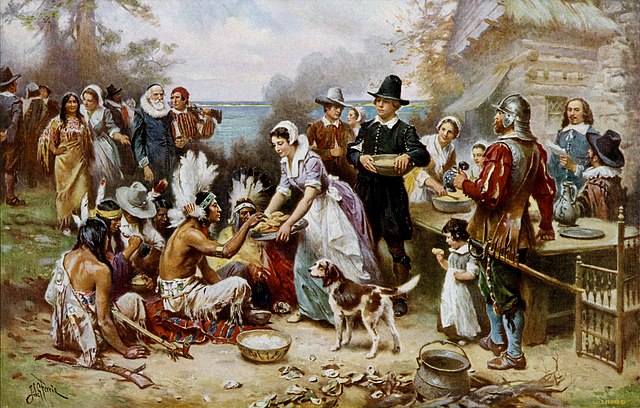
“The First Thanksgiving” by Jean Leon Gerome Ferris (c. 1913), Library of Congress/Prints and Photographs Division (digital ID cph.3g04961) (PD-Art, Old-80; copyright not renewed)
A foundation stone for democracy on this continent, the Mayflower Compact was the first document under which the Plymouth Colony was governed. The agreement, which established an elected authority all would obey, was signed in 1620 as the Mayflower rode at anchor in Cape Cod Harbor.
For the Sake of Freedom and Equality
The Pilgrims were actually comprised of two groups: Separatists and non-Separatists.
The Separatists sought religious liberty, specifically the right to separate from the Church of England. They had initially emigrated to the tolerant Netherlands, but found the Dutch culture at odds with their own.
The non-Separatists — like many to follow them — sought economic and social opportunity, and the chance for a better life in America.
In the broadest terms, all risked their lives for the sake of freedom and equality. Read more…


