
Credit card terminal with a Visa credit card inserted, Author Basile Morin, (CC BY-SA 4.0 International)
There was a time not long ago when the poor were criticized for taking out credit cards in their children’s names. Desperate people do desperate things. Nonetheless, this was considered identity theft, and viewed as despicable [1].
By contrast, wealthier parents are now urged to add their young children – even toddlers – as authorized users on their credit and debit cards [2][3]. This is being marketed as a way to teach children the value of money, and develop a strong credit score for them early on.
Bank of America, Chase, and TD Bank are among the financial institutions that allow parents to add children as authorized users on parental credit card accounts. Several such banks (including the three named) have no minimum age requirement.
Theoretically, parents who give their children access to credit will closely monitor their children’s spending and, also, teach their children to repay the money borrowed [4][5][6]. However, this is by no means guaranteed.
Approximately 70% of American adults carry some form of debt. That includes credit card debt, mortgages, auto loans, and student loans [7A]. Nearly 48% of credit card holders report carrying a credit card balance from month to month [7B].
A Debtor Class
Though young children do not understand money, they can be trained to spend it. A two year old will happily swipe a credit card while her mother cheers her on. Read more…

“Old Woman Singing” by Gerard van Honthorst (1620s), National Museum in Warsaw (Accession No. Rys.Ob.d.834/1), Source/Photographer cyfrowe.mnw.art.pl, (PD)
In Greek mythology, the Hyperboreans were thought to be a people who lived in a state of constant happiness, youth, and vitality – immune to disease and aging [1][2]. This is still the goal of many today.
There is a serious debate underway among scientists and ethicists as to the potential of anti-aging therapies, and their social consequences [3A].
Thanks to modern medicine, sanitation, and improved food supplies, those in the developed world can expect to live much longer than their ancestors [3B]. However, the Human Genome Project identified new targets for pharmaceuticals that could slow aging or prevent age-related diseases [3C].
- Some researchers are, for instance, attempting to use the enzyme telomerase to overcome the inherent number of times somatic (non-reproductive) cells can divide [3D].
- Others are searching for substances that can mimic the effects of caloric restriction (something that has extended the lifespan of mice by up to 30% in the laboratory) [3E].
Cryogenics remains under active investigation [4]. An increasing number aspire to live on after physical death by building a virtual identity in the Metaverse, and transferring their consciousness to that avatar [5].
While not all of us are obsessed with living longer, there is a clearly a fascination with health, fitness, and the appearance of youth in our culture. The millions spent on plastic surgery annually attest to that.
Much of this effort is driven by the fear of death, and a belief mankind can create a Paradise on earth through science and technology. That, of course, ignores the “sin nature” of mankind and the moral perils posed.
The pressure on natural resources would undoubtedly increase, if lives were extended indefinitely. Moves to limit the allowable number of births, and euthanize the elderly and disabled (already nascent) would likely follow [6]. Read more…
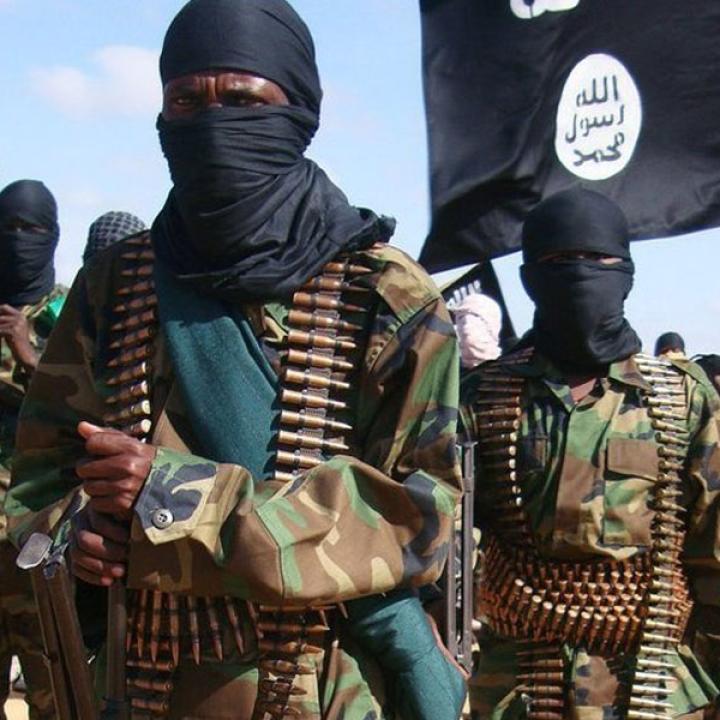
ISIS fighter, Somalia, Image courtesy of Washington Institute https://www.washingtoninstitute.org/policy-analysis/somalia-new-frontline-islamic-states-global-expansion
WARNING: Graphic Images
Tradition has it that the evangelist Mark first brought Christianity to Alexandria, Egypt in 60 AD [1]. Islam reached Africa in the 7th Century through Arab conquests [2]. European missionary efforts in West Africa began in the late 15th Century [1B][3].
The history of Islamic-Christian relations in Africa is complex and nuanced, with periods both of conflict and peaceful co-existence [4A]. But there is widespread Islamic persecution of Christians in Africa today [5A]. This can be found in the Central African Republic, Ethiopia, Nigeria, Sudan, Burkina Faso, Mali, Niger, Cameroon, Kenya, Somalia, Mozambique, and elsewhere [5B][6]. Victims may be tortured and mutilated, before they are killed. Millions have been displaced.
Rape as a Weapon
“…[T]he violence interrupts their ability to eat and sleep…They suffer from nightmares and panic attacks. They may be unable to perform basic tasks at work or home. They may struggle to parent their children, who are themselves often victims of the same incidents. They may struggle to attend church or even talk with others. These effects – especially if not cared for appropriately – can last for years.”
–Cole Richards, Pres. of Voice of the Martyrs [7]
Though a number of verses in the Quran call for treating Christians and Jews with respect, many Muslims find it difficult not to see Christians as polytheists because of the doctrine of the Trinity [4B]. Sexual violence is used as a tactic of terror by radical Islamists [5C]. Women and girls are captured, enslaved, and systematically raped. This is religiously justified as treatment of the “infidel”.
Where Is God?
Suffering so severe is shattering. It interrupts core aspects of healthy living. Where then is God in such suffering? Read more…

Gnostic Mass Temple (2011), New Orleans, Author Alombrados (CC BY-SA 3.0 Unported)
We examine this week the attraction of the heresy of Gnosticism for the modern world [1A][2]. Ecclesia Gnostica, for example, has parishes across the United States, including Austin, Portland, and Los Angeles [3].
False Authenticity
Many have accepted as fact the false claim by author Dan Brown in his best-selling novel, The Da Vinci Code, that the Gnostic gospels were supposedly earlier and more accurate than the Gospels of Matthew, Mark, Luke and John, but were suppressed by the Emperor Constantine [4A][5A]. They mistake the current Gnostic revival for reform, based on texts supposedly more valid than the original canon.
Those unfamiliar with Scripture and history may even mistake Gnosticism for fresh revelation.
Sin Excused
“One part of Gnosticism that appeals to people is that it reduces sin to a necessary function of the material body, which is in any case ‘not the real me’. It provides a convenient way to escape the reality and the guilt of sin…” [4B].
Gnostic ideas are expressed in Rosicrucianism and Scientology [5B]. Scientologists, for instance, do not view humanity as fundamentally sinful, or in need of Salvation through atonement and grace.
The psychoanalyst Carl Jung, also, drew on ancient Gnostic teaching in his work [5C]. Jung felt the traditional catalog of sins was simplistic [6]. He did acknowledge a “shadow” within the psyche, but considered this a negative aspect of personality that needed to be integrated.
Elitism
“By assuring its adherents that they are specially enlightened people, Gnosticism panders to human pride. The appeal of being part of an elite must not be underestimated…Gnosticism, with its teaching of salvation by secret knowledge, appealed to the same desires as the ancient mystery cults… The Gnostic could look down his nose at…ordinary Christians…” [4C].
The same is true today.
Escape
“This world, it [Gnosticism] tells its adherents, is a mistake; it ought not to be. I should not be in this world, the Gnostic says, and the real me is a fragment of divinity” [4D].
The Gnostic belief that the physical world is innately evil holds special appeal to those wounded by this fallen world [7]. In reality, the Gnostic heresy offers only superficial relief for despair, alienation, and fear. Christ alone can comfort and heal us.
Sexuality
“Therefore God also gave them up to uncleanness, in the lusts of their hearts, to dishonor their bodies among themselves, who exchanged the truth of God for the lie, and worshiped and served the creature rather than the Creator…” (Rom. 1: 24-25).
And Gnostic thought is at the root of the modern debate about sexuality [8][12A].
Gnostics view the male-female distinction as part of the evil creation order, therefore, something to be rejected [12B]. Androgeny is the ideal [12C]. Since the “real you” is presumed to be inside, what is felt overrides all external factors, including biological reality [12D].
Gnostic thought promotes feminine characteristics, such as love and nurture, as positive “spiritual” traits in contrast to masculine “physical” qualities such as aggression and strength [5D]. Mary Magdalene is often an important figure in Gnostic thought [5E].
By contrast, in keeping with Gnostic contempt for the body, the so called Gospel of Thomas states, “For every woman who makes herself male will enter the Kingdom of Heaven [5F].” This holds great appeal for those in the Transgender Movement suffering from gender dysphoria.
We have already discussed the Gnostic underpinning for homosexuality.
Again, one can clearly sees Satan’s hand in this. Satan seeks to undermine the natural order God established, and destroy the image of God in mankind by leading us into sin [13]. But God made us male and female (Gen. 1: 27; Matt. 19: 4-5).

Gnostic texts of Gospel of Thomas and The Secret Book of John a/k/a Apocryphon of John, Codex II The Nag Hammadi manuscripts, Source https://manuscritoseneltiempo.blogspot.com/, (PD)
Gnosticism is a distorted form of Christianity again gaining popularity [1A][2A][3][4A][12A]. This post is not equipped to explore all the nuances of Gnosticism (which is not a single, standardized belief system), but rather highlights the principal areas where Gnosticism deviates from Christianity.
Gnosticism (which asserts that the natural realm was created by an evil lesser god or demiurge, and emphasizes an elite spiritual knowledge over faith as necessary for Salvation) has been considered a heresy by mainstream Christianity from the outset, as historic creeds reflect [5A][6A].
The Catholic, Presbyterian, Lutheran, and Baptist churches still see Gnosticism as heretical [6B][13]. The Methodist and Episcopal churches for centuries did recognize Gnosticism as a heresy but are currently equivocating, in response to cultural pressures [7A][8].
Scripture, itself, warns against Gnostic influence at 1 Tim. 6: 20, 1 Cor. 8: 1-3, 1 John 4: 1-3 and elsewhere.
Background
A blend of Christian and pagan beliefs, Gnosticism arose in the 2nd Century, incorporating elements of Judaism and Greek philosophy with religions from Syria, Asia Minor, Persia, and India. The name Gnostic comes from the Greek gnosis, meaning “knowledge”.
Like most heresies, Gnosticism was founded on a twisted version of the truth, a partial truth taken as the whole [4B].
“The Gnostics believed there was a…secret knowledge reserved for those with true understanding, leading to the salvation of the soul. Spiritual salvation was of preeminence to the Gnostics because they thought the human spirit was naturally good and was entrapped or imprisoned in the body, which was naturally evil or merely an illusion. Their goal, therefore, was to free the spirit from its embodied prison…” [1B].
Gnostics, for example, considered sex and marriage evil, since procreation merely produces more “evil” bodies [5B]. As a result, by warped logic, some sects considered contraception, adultery, fornication, and homosexuality good [5C].
Because of this spirit-matter dualism, Gnostics generally rejected the Old Testament, viewing it as false [4C]. Cain and the inhabitants of Sodom and Gomorrah were the real heroes, from the Gnostic perspective. This was all the more ironic, since Gnostics have always prided themselves on seeking knowledge, and the Bible – Old and New Testaments – is the revealed word of God, Himself.
Early church fathers like Ignatius of Antioch (c. 35 – 108 AD), Justin Martyr (c. 100 AD – 166 AD), Irenaeus (c. 130 AD – c. 200 AD), and Tertullian (c. 160 AD – 225 AD) condemned Gnostic beliefs as inconsistent with Christian doctrine [9A][12B].
Doctrine, in the sense used here, is not meant to suggest a rigid set of rules, but rather the best and most accurate reading of Scripture, as guided by the Holy Spirit (John 14: 26, 15: 25, 16: 8, and 16: 13). Many Gnostic texts, for instance, do not deal with sin and repentance. Rather, they focus on illusion and enlightenment, offering the allure of secret knowledge.
The Manichees, a Gnostic sect founded by the Persian teacher Mani, continued into the 13th Century [6C]. The Albigenses and Cathars (12th and 13th Centuries), also, followed Gnostic thought [6D].
A renewed interest in Gnosticism developed after the discovery in 1945 of Egypt’s Nag Hammadi library, a collection of 50 rare Gnostic texts, including the so called Gospel of Thomas, Gospel of Philip, Secret Book of John a/k/a Apocryphon of John, Apocryphal Epistle of James, Apocalypse of Paul, Letter of Peter to Philip, Gospel of Truth, Gospel of the Egyptians, On the Resurrection, Dialogue of the Redeemer, and Apocalypse of Adam [10][11].
The so called Gospel of Judas was found separately. This portrays Judas Iscariot, who betrayed Christ, instead as the most enlightened disciple, who received secret instructions from Christ [9B].
Most scholars today agree that the Gnostic texts are later than the canonical sources. Read more…

“The Crossing of the Red Sea” by Nicolas Poussin (1634), National Gallery of Victoria, Melbourne, Australia (Accession No. 1843-4), Source/Photographer http://www.1st-art-gallery.com/Nicolas-Poussin/The-Crossing-Of-The-Red-Sea,-C.1634.html (PD)
This week we conclude our examination of the archaeological evidence for Moses.
Yam Suf
“Then Moses stretched out his hand over the sea; and the Lord caused the sea to go back by a strong east wind all that night, and made the sea into dry land, and the waters were divided. So the children of Israel went into the midst of the sea on the dry ground, and the waters were a wall to them on their right hand and on their left” (Ex. 14: 21-22).
Yam Suf (also spelled Yam Suph) refers to the body of water the Israelites crossed during the Exodus [1].
But Yam Suf (generally translated as the “Sea of Reeds”) is used in the Bible to refer to two different locations: the Gulf of Aqaba a/k/a the Red Sea and the Gulf of Suez [2]. Some scholars, also, suggest it may refer to the El-Ballah lake region between the Gulf of Suez and the Mediterranean forming a defensive barrier on the eastern frontier of Egypt [3].
Controversy, therefore, remains as to where the Exodus crossing actually took place.
The existence of a sandbar perpendicular to shore or a raised plateau on the sea floor which the wind could have temporarily revealed has been put forward as one explanation for how the miracle may have taken place [4]. Wind setdown is a natural phenomenon in which strong, persistent winds blowing offshore cause a temporary drop in water levels, exposing submerged areas [5].
Again, however, the timing would have had to be precise to allow the Israelites to pass, yet drown the Egyptian troops following them.
Mount Sinai
The Bible does not give the exact location of Mount Sinai which most biblical scholars agree was another name for Mount Horeb. There are several candidates.
Of these, Jabal Musa (translated from the Arabic as the “Mountain of Moses”) on the Sinai Peninsula is a leading contender based on oral tradition [6]. Located at its base is the Greek Orthodox Monastery of St. Catherine founded in 527 AD [7].
There is evidence of encampment in what is thought to be the area of Rephidim in Saudi Arabia where the Israelites camped on their way to Mount Sinai, as the Bible says [8][9][10]. Rephidim is where Moses first struck the rock and water gushed forth. Read more…

“Lamenting the Death of the Firstborn of Egypt” (1877) by Charles Sprague Pearce, Source https://artvee.com/dl/lamentations-over-the-death-of-the-first-born-of-egypt-2#00, (PD)
We continue our examination of the archaeological evidence for Moses.
Brickmaking
We know from the Bible that the Hebrew slaves were pressed into was making bricks (Ex 5: 6-18). Egyptian tomb paintings depict slaves making bricks. The Egyptian papyri Anastasi IV and V highlight the importance of straw as a binder in brickmaking [1A]. This is consistent with the dismay the Bible indicates the Israelites felt when the pharaoh stopped supplying it, yet required the same number of bricks (Ex 5: 18-21).
Note that the Bible does not describe the Hebrew slaves as constructing the pyramids, but rather as building the cities of Pithom and Rameses (Ex. 1: 11). (Skilled Egyptian craftsmen are known to have built the pyramids, cinematic depictions notwithstanding.)
Avaris
According to the biblical text, the Israelites settled “in the land of Rameses” (Gen. 47: 11) sometime in the 19th Century BC. Use of the word “Rameses” is an update of the biblical text by later editors to replace an archaic place-name with one that was more recognizable [1B].
Because of extensive excavation, we now know that Tell el-Dab‘a in the eastern Nile Delta was the site of the city Rameses, built over the previous city Avaris [1C]. The site is most famous as the Hyksos capital (the Hyksos being Semitic traders who ruled lower Egypt c. 1660 BC to 1550 BC) [2]. Pottery and weapons found indicate the site was originally settled by a group of non-Egyptians from Canaan in the 19th Century BC, the time of Joseph [1D].
There is, also, evidence of a four-roomed house in the village (the same layout as houses typical in Israelite settlements during the later Iron Age) [1E]. A palace complex dates to the time of Moses.
Interestingly, the site was suddenly abandoned after the reign of Amenhotep II, suggesting that a plague may have been the reason. Read more…
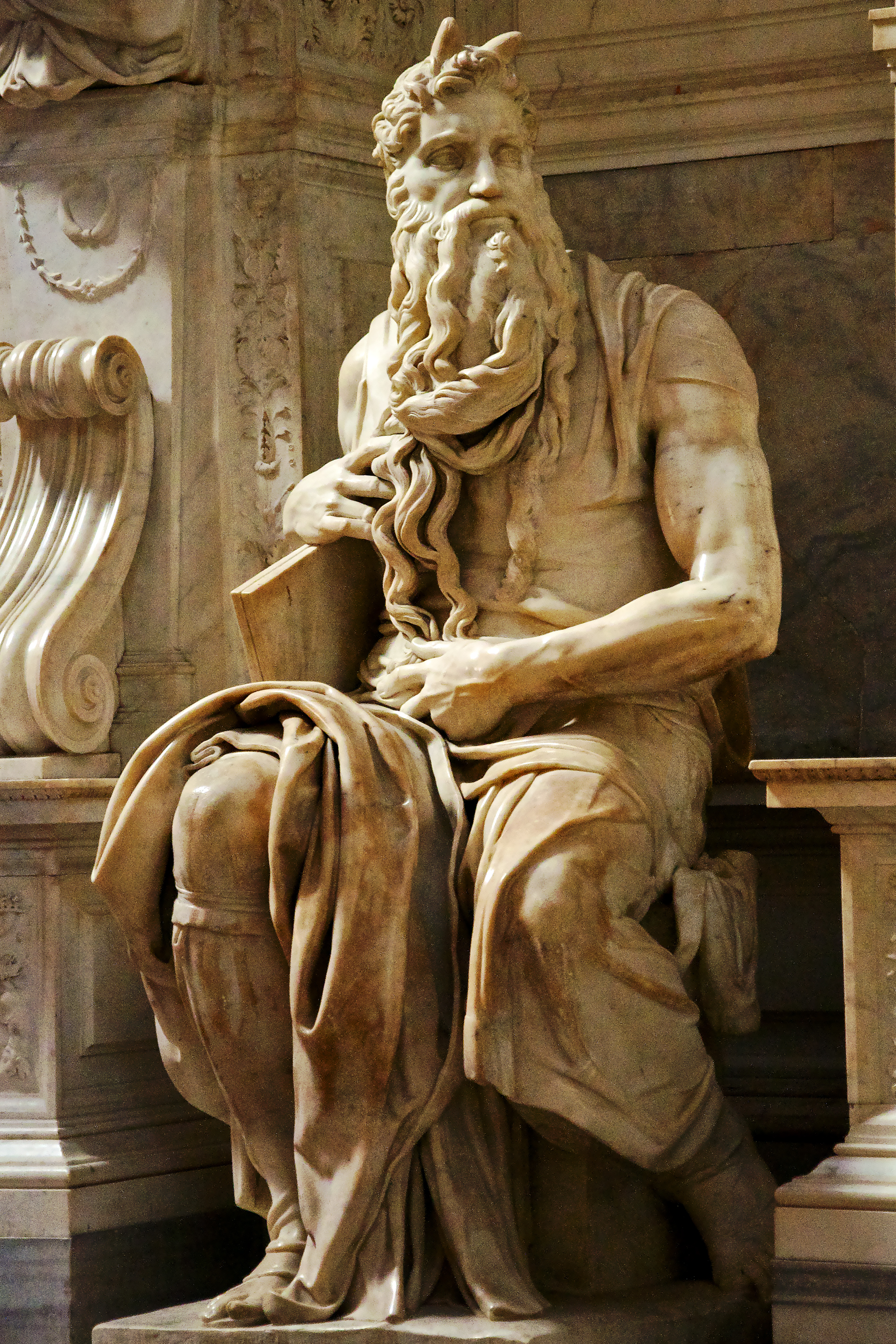
Michelangelo’s Moses, Author Goldmund100 (Luca Volpi), (CC BY-SA 3.0 Unported)
Moses is a monumental figure in the Bible – a Hebrew prophet, leader, and lawgiver [1].
This is the man who heard God from the burning bush, who demanded that the pharaoh let God’s people go, who witnessed the plagues of Egypt, who parted the Red Sea, who received the Ten Commandments from the hand of God, who led the Israelites for 40 years in the desert, and who wrote the Torah (the first five books of the Bible a/k/a the Pentateuch). He is honored by Judaism, Christianity, and Islam.
While the Bible and 3500 years of Passover observance testify to the truth of Moses’ existence, secular scholars continue to search for archaeological evidence.
Timing
A central issue relating the search for such evidence concerns the dating of Moses’ life. Traditionally, scholars have claimed he lived in the 13th Century BC, and that the pharaoh he confronted was Rameses II a/k/a Rameses the Great. However, the Bible suggests otherwise [2A].
First Kings 6: 1 indicates that Solomon built the first temple “in the four hundred and eightieth year after the children of Israel had come out of the land of Egypt.” This would place the Exodus in 1446 BC. That time frame is consistent with other biblical passages: Judges 11: 26, the number of generations listed at 1 Chronicles 6: 33-38, and Acts 13: 19-20.
Authorship
A. Proto-Sinaitic Script (Alphabet)
Some contend that Moses did not write the Torah, but that it was instead written a thousand years later by priests living in exile in Babylon who were attempting to invent a glorious past for Israel [3].
As a member of the Egyptian court, Moses would have been literate. Hieroglyphics would, however, have been a lengthy and cumbersome way of transcribing the biblical text.
What we know now is that an alphabetic script, also, existed [2B]. Sir Flinders Petrie discovered examples of this alphabet, known as Proto-Sinaitic, inscribed on stones at Serabit el-Khadim, an Egyptian turquoise mine in the Sinai. Dating from the 19th Century BC to 15th Century BC, Proto-Sinaitic script was invented by Semites working at the mine and gave rise to the alphabet we use today.
B. Name “Moses”
Douglas Petrovich more recently presented evidence that these inscriptions were written by Israelites, and that Hebrew was the language behind the script [4]. His translation of one inscription (Sinai 361) appears to contain the name Moses, though this is contested.
Some scholars, like Abraham Yehuda, suggest that the name “Moses” could be a shortened form of an Egyptian name like “Ah-meses,” “Tutmose,” or “Rameses” – all of which incorporate the element “meses” meaning “born of”, then the name of a god. Moses, having rejected the gods of Egypt, could have intentionally shortened his name [5A].
The Hebrew version of the name “Mosheh” (meaning “drawn out”) places emphasis on the act of drawing the infant from the Nile (Ex. 2: 10) [5B].
C. Egyptian Words
It should not be overlooked that there are numerous Egyptian words in the biblical text [2C]. For instance, the word “river” in the account of the infant Moses is not the usual Hebrew word “nahar”, but a transliteration of the Egyptian word for the Nile. Read more…

Timeline of generations in the Western world, Author Cmglee, (CC BY-SA 4.0 International, GNU Free Documentation License)
Indications are that Gen Z is finding religion [1]. There seem to be multiple reasons for this [2].
- Loneliness has become an epidemic in America – among young people, in particular. The social aspect of church is appealing. Cancel culture has negative consequences. By contrast, the assumption is that “no one can reject you” in church.
- Millennials (born between 1981 and 1996) have as a whole moved away from religion. Some 30% of Americans now view themselves as atheists or agnostics (the so called “nones” on surveys about religion). The move toward religion by Gen Zers (those born between 1997 and 2012) may reflect the younger generation’s rebellion.
- Covid raised the issue of mortality. The young tend to believe they will live forever. Covid cast some doubt on that.
There is a gender gap in this trend. More men than women are returning to church. Nearly 2 of every 3 Gen Z women believe religious institutions do not treat men and women equally [3]. Almost 1 in 3 Gen Z women now identify as LGBTQIA+ [4]. Read more…

We continue our examination of Psalm 23, and the tools of a shepherd.
The Staff
“The staff [or crook] is essentially a symbol of the concern, the compassion that a shepherd has for his charges…
Just as the rod of God is emblematic of the Word of God, so the staff of God is symbolic of the Spirit of God…
The first…[use of the staff] lies in drawing sheep together into an intimate relationship. The shepherd will use his staff to gently lift a newborn lamb and bring it to its mother if they become separated. He does this because he does not wish to have the ewe reject her offspring if it bears the odor of his hands upon it…
But in precisely the same way, the staff is used by the shepherd to reach out and catch individual sheep, young or old, and draw them close to himself for intimate examination…
Similarly in the Christian life we find the gracious Holy Spirit, the Comforter, drawing folks together into a warm, personal fellowship with one another. It is also He who draws us to Christ…” Read more…

 A Lawyer's Prayers