
Church of St. Michael (nave north window), Essex, England, Author Acabashi (CC BY-SA 4.0 International)
This eloquent post by Dr. Lloyd Stebbins began life as a comment on an earlier post of mine. Dr. Stebbins’ insights are always wise and welcome. Regrettably, I did not give his comment the attention it deserved. Today’s republication is an effort to correct that oversight.
Dr. Stebbins is the author of “Wake Up America – Or Die! YOU Must Save America and the Family”. He blogs at Dr. Lloyd Stebbins – Deliberate Joy https://lloydstebbins.com/.
“And the light shines in the darkness, and the darkness did not comprehend it” (John 1: 5).
“It is interesting to notice church windows. They vary from stained glass to clear, large and small, a lot of windows or just a few—or even no windows at all. As churches have migrated from traditional Christian music to contemporary Christian music or Christian rock music, there has been a growing trend to build churches without windows.
The church leaders claim that the windowless churches, sanctuaries, or auditoriums enable better control of the lighting, absolute control if the inside walls are black or a dark color. Indeed, the churches are becoming increasingly theatrical. Could it be that the increasingly theatrical nature of ‘worship’ services tends to place more emphasis on man and less emphasis on God, despite the very best of intentions and the clearly Christian lyrics of the contemporary or Christian rock music?
The dark-walled, windowless churches provide the pastors and other leaders of the Sunday morning ‘production’ absolute, godlike control of the lighting. Yet, scripture says that, ‘God is light.’ A long time ago, Lucifer wanted to be like God. It clearly did not work out well for him. Is it really a good idea to shut out ALL of the light?
By shutting out all of the light are we literally, figuratively, or symbolically, shutting out God? Is there an affordable architectural compromise that would allow professional control of lighting for Christmas and Easter productions, but allow God’s wonderful physical and spiritual light to shine, at least while the pastor is preaching?
The type, size, and number of windows are largely a matter of personal and congregational preference. But can zero windows become problematic? The abundance of windows in many older churches suggests a clear intent to let in as much light as possible. What has changed? What do you think?”
READERS CAN FIND MY VIEWS ON ABUSE AND ABUSE-RELATED ISSUES AT ANNA WALDHERR A Voice Reclaimed, Surviving Child Abuse
https://avoicereclaimed

The “rose” window of Notre Dame Cathedral, Paris, Author Krysztof Mizera (changed by Chagler and MathKnight), Source File Rozeta Paryz notre-dame chalger.jpg (CC BY-SA 4.0 International, 3.0 Unported, 2.5 Generic, 2.0 Generic, and 1.0 Generic)
Using little more than a set of compasses, a T-square, and a rope marked off at regular intervals, medieval masons crafted masterpieces in stone – places of worship filled with light.
The construction of Gothic cathedrals began with the laying of a cornerstone. Completion of these soaring structures could, however, take hundreds of years.
At a time when higher mathematics was largely unknown in Europe, masons (responsible for actually laying the stone) combined the modern roles of architect, engineer, builder, designer, and craftsman. With little or no formal education, stonecutters shared tips with one another, learning through trial and error. Maker’s marks can still be seen on the stone in some locations.
Many Gothic cathedrals stand to this day, attesting both to the faith and skill of their builders. But the real monuments were – as they are today – the lives of the men and women who worshiped in them. God wants our stony and battered hearts. He has set His mark upon them for all to see.
“The stone which the builders rejected has become the cornerstone” (Ps. 118: 22).
Lord Jesus, You are the Stone the builders rejected, and our Cornerstone. You are the Rock upon which we build our lives. Help us to make You central to all our endeavors, that they may rest on a firm foundation.
We place our faith in You.
Amen
Originally posted 5/1/13
READERS CAN FIND MY VIEWS ON ABUSE AND ABUSE-RELATED ISSUES AT ANNA WALDHERR A Voice Reclaimed, Surviving Child Abuse
https://avoicereclaimed

Detail of gold menorah, Jewish Quarter, Jerusalem, Photo zeevveez (CC BY-SA 2.0 Generic)
“I said to the almond tree, ‘Sister speak to me of God.’ And the almond tree blossomed.”
— Nikos Kazantzakis, Report to Greco
The almond tree, a relative of the peach, is native to the Levant, but has been cultivated as far north as Iceland. It was among the first trees domesticated, thought to have sprouted initially on pre-historic garbage heaps.
Domesticated almonds were in use by the Bronze Age (3300-2000 BC). They were found amid other treasures in the pharaoh, Tutankhamen’s tomb.
Almond blossoms have been said to symbolize hope, perseverance, and justice, among other things. For the Israelites, they signified watchfulness, specifically God’s vigilance on their behalf. The Hebrew word “almond” and the phrase, “I am ready” (or “I am watching”) sound similar. The almond, also, flowers in early Spring.
It was for these reasons that God instructed the Israelites to make a golden lampstand shaped like an almond tree, for the sanctuary (Ex. 25:31-40). Three branches were to extend from each side, decorated with flowers in the form of almond blossoms and buds. The Jewish menorah (a candelabra with seven branches) was the result.
The staff Moses’ brother, Aaron, carried was made of almond wood, as well. The same staff bloomed and brought forth almonds overnight, in validation of Aaron’s claim to the priesthood (Num. 17).
The Book of Revelation describes Christ as surrounded by seven golden lampstands, thus, portraying His central relationship to the seven churches (Rev. 1: 12-13, 20). He is, in effect, the stem of a greater lampstand (a reference, also, to the vine and branches symbolism at John 15: 1-7). Read more…
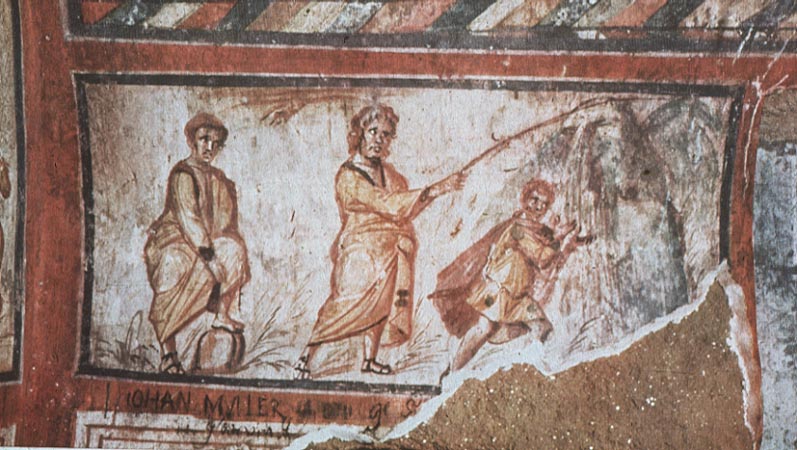
“Moses Striking the Rock in the Desert”, wall painting in an early Christian catacomb, Author Leinad-Z (PD)
“Then the Lord spoke to Moses, saying, ‘Take the rod; you and your brother Aaron gather the congregation together. Speak to the rock before their eyes, and it will yield its water…’ ” (Num. 20: 7-8).
“You can’t get blood from a stone.” It is an idiomatic phrase we have heard countless times. There is more than a hint of anger conveyed by the expression. The source, in other words, is unyielding or has been bled dry.
“You can’t get blood from a stone.” Why would anyone try to get blood from a stone? How could that even to be done? Surely, the outcome is a foregone conclusion.
Short of water for thousands of thirsty people he had led into the desert, Moses must have thought the same. “Why did you make us leave Egypt?” they whined. “Why did you bring us to this evil place to die?” they complained to him.
Weary, angry, doubtful, Moses struck the rock twice and water gushed out. Yet for this disobedience, for this failure of faith, he was barred from the Promised Land after decades of faithful service. Wait! Hadn’t Moses just performed a miracle? Why did God treat him so harshly?
God had instructed Moses to speak to the rock. It was Moses who took it upon himself to strike the rock. Wasn’t that a distinction without a difference? Read more…
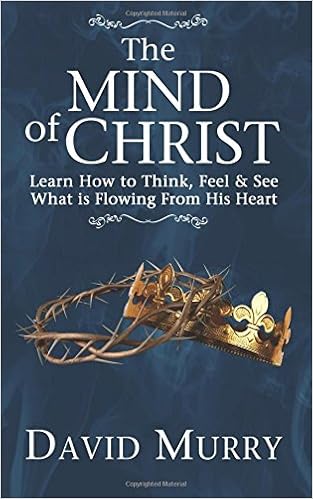
With The Mind of Christ David Murry has given us a passionate declaration of Christ’s love for us, a powerful indictment of the American church, and a moving statement of his own experiences with God.
Written in a conversational style, The Mind of Christ examines these interrelated topics from a biblical perspective.
Murry begins by exploring the relationship believers have with God. The author distinguishes between believers’ positional righteousness (earned for us at the cross), and our relational righteousness (the result of sanctification, and the depth of our communion with God).
Positional Righteousness
“We died to our sin nature. We are new creatures in Him, with His mind, His righteousness, and the greatest gift of all, His raging river of love…”
-David Murry, The Mind of Christ
By the cross, we were given the mind of Christ and a new identity, as Murry puts it. Our self-worth was established here. It is separate from our function within the Body of Christ.
Relational Righteousness
“Relational righteousness, or said another way, a life lived seeking to walk in holiness is meant to be the natural response to the revelation of His love toward us. We can only do this if we first understand our position in Christ.”
-David Murry, The Mind of Christ
As Murry explains, our self-worth is not dependent on the depth of our relationship with God. We choose how far to allow God into our hearts and our lives.
God’s Unconditional Love
Throughout the book, David Murry emphasizes God’s boundless and unconditional love for us.
The author explains that if we do not turn to God and Kingdom truth, in any area of our lives, then we believe a lie about ourselves. Murry goes so far as to say that:
“If in any way, an action of ours or an action of others, affects the way we view ourselves, it is an idol [1].”
-David Murry, The Mind of Christ
Murry, in this connection, explores fear of rejection and fear of failure, along with pride and mysticism. He, also, discusses in the book manhood, as defined by the Bible, and the purpose of trials.
Impact of Sin
The author explains that God’s love never waivers. Our sin does, however, grieve God’s heart, interfering with our relational righteousness.
Only “…when we begin to accept how much He loves us…[do] we begin to feel…His heart,” the author points out. Ultimately, it is God’s love that transforms us, setting the captives free.
The Body of Christ
David Murry then turns his attention to the American church – criticizing its worldly attitude toward worship, temporal goals and concerns, materialism, compromise with sin, and failure to care adequately for the persecuted church abroad. He pleads, in particular, for the needy. Read more…

Pater Noster Chapel, Jerusalem, with multiple translations of the Lord’s Prayer on chapel walls, Author Magrietha Knight (CC BY-SA 4.0 International)
My prayer life is no model for anyone. Prayer can bring me to tears. But I sometimes abandon it altogether, overwhelmed by the emotion it can evoke. Other times, I avoid prayer out of a feeling of abject unworthiness.
Snippets
During the day, I pray most often in short snippets: “Jesus, bless those boys over there with the basketball. Keep them from harm.” “Would You help me find my glasses, Lord? I’ve managed to lose them again.” “Draw their hearts back to You, Lord. I beg You.” “Father, forgive my impatience, my anger. Will I never learn?” “Oh, my God!? Please, protect the Syrian refugees, and civilians being bombed. Please, please, watch over our troops.” “Tell me what to do, Lord!”
I do not know what the Lord makes of these pleas. However, if I delay in addressing Him, I fall immediately prey to perfectionism. That only serves as an obstacle, interfering with prayer.
Confession
Growing up in the Catholic faith, I could confess my deficiencies to a priest, and be absolved of them. God, of course, knew them already.
But an examination of conscience is as necessary as weeding. It roots out the thoughts and behaviors competing with God for our time and attention, the thoughts and behaviors gradually drawing us away from God.
Brokenness
I pray when the world has taken its toll, and I am broken. I pray when old, familiar demons plague me – anxiety, depression, migraines to name a few.
Night Watches
Most of my profound communication with God takes place during the stillness of the night watches. It helps that I have insomnia (LOL).
I pray for friends and loved ones, and for those who write to me. World events frequently move me to pray about people or issues. And inspiration, for which I have no way to account, at times flows through my pen (these days, my computer). Read more…

Statue of St. Andrew by Camillo Rusconi (c. 1714), Archbasilica of St. John Lateran, Author Marie-Lan Nguyen (PD, Art-100; CC-BY 2.5 Generic)
Google has made it easy to compile lists. Go online, and you can find all kinds. The top 10 horror flicks, the top 10 gadgets in history, the top 10 songs of all times, the top 10 cities for liberals (!), the top 10 government boondoggles. The lists go on and on.
One list that comes in countless varieties is that of the top 10 people who changed the world. A few of the names that frequently come up include Leonardo da Vinci, Abraham Lincoln, Winston Churchill, Albert Einstein, Helen Keller, and Mother Teresa. And fine names they are.
Christians though have a top 10 of their own – a baker’s dozen, in fact. At the very top of our list, of course, would be Jesus Christ. That goes without saying.
But there were only 12 apostles, at the outset (11 after Judas Iscariot committed suicide). Apart from John, all were martyred including Judas’ substitute, Matthias, and the 13th apostle, Paul. Many Christians today do not so much as remember their names.
As a refresher, there were three sets of brothers:
Simon Peter and Andrew – These two, we know, were fishermen. Andrew introduced Peter to Jesus. It was Peter who stepped out of the boat on the Sea of Galilee, when Christ walked on the water (Matt. 14: 27: 30). It was to Peter that Jesus said, “…and upon this rock I will build My church…” (Matt. 16: 18) [1]. Peter betrayed Jesus three times before the crucifixion. But it was Peter whom Jesus instructed, “Feed my lambs…Feed my sheep” (John 21: 15-17).
The sons of Zebedee, James and John, whom Jesus called the Sons of Thunder for the hot-tempered disposition they shared – John, known as “the disciple whom Jesus loved” (John 13: 23), was one of the Gospel writers. James was the first of the apostles to be put to death; John the last to die, in old age.
The sons of Alphaeus, James and Matthew – James is referred to as “the Less” to distinguish him from James, the son of Zebedee. Matthew was a tax collector, therefore, considered a collaborator with the Romans. He, too, was a Gospel writer.
The “other” Simon held political views diametrically opposed to Matthew’s. Simon, referred to as “the zealot” or “the Canaanite”, believed the Romans had to be overthrown by force. Read more…

“Martyrdom of St. Stephen” by Bernardo Cavallino (c. 1645), Prado Museum (Accession No. P07466), Source Web Gallery of Art (PD)
There is a popular series on the History Channel called “Vikings”. Historical fiction, the series attempts to re-create the Viking worldview, as it existed before the adoption of Christianity.
The series treats the pagan beliefs of the Vikings with respect. It goes to great lengths to portray pagan rituals (including human sacrifice) accurately, and in a positive light. By contrast, scripts tend to portray Christian characters as weak, hypocritical and/or corrupt.
Interestingly, Ragnar, a central character, privately describes himself as an atheist toward the end of his life. This is far outside the Norse sagas from which the series claims to derive.
It should come as no surprise that Christian beliefs are often attacked by non-believers. On the scale of offense, “Vikings” barely registers. We are routinely labeled as ignorant, backward, foolish, and deluded; our beliefs as derivative, misleading, even cruel [1].
Our Existence an Offense
Why should it matter to atheists what Christians believe? What would it matter, if we believed in “little green men” [2]? Yet our very existence is offensive to atheists.
“For we are unto God a sweet savor of Christ, in them that are saved, and in them that perish: To the one we are the savor of death unto death; and to the other the savor of life unto life” (2 Cor. 2: 15-16).
The answer, of course, is simple. Satan attacks the truth. He does not bother to attack the lies he, himself, has fostered and spread.
The Reason for Our Hope
Many of those responding to such public attacks on Christianity are knowledgeable; their arguments, intelligent and well-reasoned. All this is to the good.
We should be ready to defend our faith, when needed:
“Always be prepared to articulate a defense to everyone who asks you to give the reason for the hope that you have. But respond with gentleness and respect, keeping a clear conscience, so that those who slander you will be put to shame by your good behavior in Christ” (1 Peter 3: 15-16).
A Superior Attitude
Unfortunately, a superior attitude often creeps in. This may feel justified, in human terms. There may be Christian readers cheering on the sidelines. But that is not how it should be. Read more…
“Then all the elders of Israel gathered together and came to Samuel at Ramah, and said to him, ‘Look, you are old, and your sons do not walk in your ways. Now make us a king to judge us like all the nations.’
But the thing displeased Samuel…So Samuel prayed to the Lord. And the Lord said to Samuel, ‘Heed the voice of the people…for they have not rejected you, but they have rejected Me…However, you shall solemnly forewarn them, and show them the behavior of the king who will reign over them’ “ (1 Sam. 8: 4-7, 9).
When the nation of Israel demanded a king, it got the petulant ruler, Saul – a man who was rash and mercurial; vain and jealous; suspicious and insecure.
The United States has elected a president who is remarkably similar. Many voters felt they had no other choice.
Economic Motivation
For some, their reasons were economic:
These voters felt overlooked by Washington insiders, their feckless representatives; excluded from the table, when trade deals and treaties were negotiated for the benefit of corporate giants.
These Americans were left out of the equation, when the benefits of technology were calculated – mere numbers on a page, when jobs were outsourced; casualties of globalization, so that fortunes could be made by a select few.
Racist Motivation
“Before the election, I went to Pennsylvania…and sat in the homes of Trump voters…I saw mixed motives and some blind spots…But I also found incredible…decency and honor among the Trump voters. Many of them were holding their nose to vote for Trump. They were not endorsing every crazy thing that he said…There are definitely some Trump voters who are energized by…the inflammatory comments against Muslims and Mexican immigrants and black protestors. But there’s a much larger group that find those comments distasteful, just not disqualifying.”
– Esquire Magazine, “Van Jones Refuses to Give Liberals a Free Pass” by Britt Julious, 12/6/16, http://www.esquire.com/news-politics/a51206/van-jones-interview/
The majority of those who voted to elect Pres. Donald J. Trump may not hold racist beliefs [1]. But the campaign disclosed a deeper racial rift among Americans than had previously been acknowledged. Read more…

“The valley of the shadow of death” (1855), Photo of Crimean War by Roger Fenton, Library of Congress (Reproduction No. LC-DIG-ppmsca-35546) (PD)
“For the resolutions of the just depend rather on the grace of God than on their own wisdom; and in Him they always put their trust, whatever they take in hand. For man proposes, but God disposes; neither is the way of man in his own hands.”
– Of the Imitation of Christ by Thomas a Kempis (c. 1425)
There are those who will loudly proclaim we have only to ask for God’s blessing on our plans to see them fulfilled [1]. I am not among these.
Those who hear God audibly or on a regular schedule have led very different lives from mine. I do not doubt their experience; I do not contest their claims. I can only say that some of us have known the valley of the shadow [2].
Impassable
Despite the best of intentions, despite the most sincere prayers, we may start out with Plan A only to find the road impassable, our way blocked. To our surprise, we learn that God has Plan B in mind for our development.
How we respond will determine our progress on the path toward sanctification.
Detours
The Apostle Paul understood that his mission was ultimately to witness in Rome (Acts 23: 11). But during his ministry Paul was shipwrecked at least four times, stoned, beaten three times with rods, and five different times received 40 lashes (2 Cor. 11: 23-28).
Surely, the will of the Almighty was not thwarted when these events occurred. One must assume that these “detours” were part of God’s plan – events subject to what some term His permissive will, if not His perfect will (Rom. 12: 2) [3] [4]. They have served as inspiration to the faithful for the past 2000 years.
At great personal risk, Corrie ten Boom and her family courageously aided Jews in escaping the Holocaust. Corrie, also, watched her beloved sister, Betsie, die in a concentration camp.
Surely, that was not the outcome this great woman of faith would have chosen, either for her sister or herself. Yet Corrie ten Boom continued to trust her life to God.
God’s Silence
Many of us have longed for God’s voice, and His direction for our lives. Most of us have cried out to Him in our distress.
We may occasionally have been tone deaf; may have overlooked the signs. But that was not for lack of trying. God is, at times, simply silent. He may choose not to reveal His plans to us, or choose not to reveal them in all their fullness.
This does not mean that He is absent from our lives. Read more…

 A Lawyer's Prayers