
The Chevrolet Camaro used to portray “Bumblebee” in the TRANSFORMERS films, Author Kevin Ward, Source flickr (CC BY-SA 2.0 Generic)
TRANSFORMERS, all associated names, terms, phrases, and slogans are Copyright 2003 Hasbro. All related characters and toys are registered trademarks of Hasbro and Takara Tomy. All rights reserved.
Chevrolet is a division of General Motors Company.
NOTE: Neither Hasbro, Takara Tomy, nor Chevrolet (GM) have any relation to this blog or the posts it contains.
I sat in a darkened theater with a wonderful little boy whose father is not present in his life, and thought about fathers everywhere.
We were at another in the series of TRANSFORMERS ® movies. For those who may not be familiar with them, the Transformers are a race of giant robots from a distant galaxy. They engage in a war of good against evil, some of which takes place on earth.
Sometimes beaten and broken, abandoned and uncared for, these robots can assume different shapes, as the need arises. Though not immortal – some perish – the Transformers personify heroism while the human beings in the plot often fail or fall short, at times even betraying individual Transformers whose desire is to help them.
What the little boy with me could not see, but I did, was that the Transformers were as much pictures of real human beings as the human characters in the story were.
It is a thrilling story, this war of good against evil. And we all play a role, whichever side we choose to take. At times, we struggle against impossible odds, unbeatable foes – the challenges of heart disease or breast cancer, grief and loss. We stagger forward under loads no one should have to bear – the burdens of single motherhood, the daily toil of a thankless job to which we remain faithful for the sake of our children.
In the process, we are transformed. Oh, our parts may rust, become worn and broken. But our hearts become something else, something shining. Read more…

“Salvator Mundi” (Latin: Savior of the World) by Leonardo da Vinci (c. 1500) (PD-Art l Old-100)
This is Part 2 of a review of the book God’s Undertaker – Has Science Buried God? by John Lennox. The rational intelligibility of the universe, and its fine-tuning were discussed last week in Part 1.
In Favor of a Creator (Continued)
C. Limitations of Evolution
“…the Darwinian theory is correct in the small, but not in the large. Rabbits come from other slightly different rabbits, not from either [primeval] soup or potatoes.”
-Fred Hoyle
John Lennox willingly concedes microevolution (variation within already existing species, body plans, and structures), but distinguishes it from macroevolution (the introduction of qualitatively new genetic material, as reflected in new species, body plans, or structures).
Natural selection simply cannot account for the extent of genetic variation. Indeed, paleontologists admit that evidence for macroevolution is sadly lacking from the fossil record – something not much publicized.
Lennox points out that the time frame required for the evolution of complex structures like the human eye by random chance is far in excess of scientifically recognized estimates for the age of the entire universe.
In an attempt to explain away this deficiency, some atheists have sought to modify the theory of evolution. They now contend that evolution is not an undirected process. Rather, it is said to seek out the “best” outcome, and proceed in that direction by a faster pathway.
This runs counter to the original concept of natural selection, and is wholly unsupported by scientific evidence.
John Lennox, also, examines so called molecular evolution (the claim that living cells emerged from non-living material, across the vast chasm that separates the two). Molecular evolution provides no explanation for the origin of information which is not, itself, material. Moreover, the statistics against it are staggeringly large. No amount of typing monkeys will suffice. Read more…
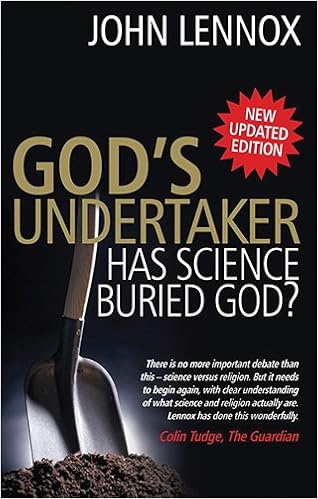
Despite the advances in science, nagging questions remain as relating to origins and meaning. “How did the world begin?” “How did life arise?” “What are we doing here?”
Renowned Christian apologist and Oxford University Professor of Mathematics, John Lennox, explores these questions and the ongoing debate between science and religion in God’s Undertaker – Has Science Buried God?
Atheists tend to view believers as ignorant, deluded, or intellectually lazy. Lennox contests this. He begins by pointing out that:
- God, as Christians understand Him, is far more than a “God of the gaps” (an explanation supplied when natural explanations are not readily available). He is the source of all explanations.
- Christianity is not a “blind” faith. Rather, it is evidence-based.
- Many famous scientists were inspired by their belief in a Creator [1].
- Many respected scientists are believers, even today.
Lennox makes a compelling case that the fine-tuned universe we inhabit; the complexity of the biosphere; and the emergence of life from non-life (and mind from mindlessness) are not fully explained by unguided natural processes.
Science v. Philosophy
John Lennox cautions from the outset that scientists when speaking about God are not speaking about science at all; that science and the philosophy of naturalism are not one and the same.
Carl Sagan’s well-known statement, “The cosmos is all there is, or was, or ever shall be” illustrates this. It is actually a statement of personal belief, not science. Read more…

Member of US 15th Marine Expeditionary Unit atop amphibious assault vehicle in Somalia, during Operation Restore Hope (1992), Author Photographer’s Mate/Petty Officer First Class Joseph Dorey (PD as work product of fed. govt.)
The “greatest generation” is a term journalist, Tom Brokaw, popularized in his book by the same name. The term refers to the men and women raised during the Depression who went on to fight World War II, in great and obscure battlefields across the globe and on the home front.
That generation, rapidly fading now, was defined by the obstacles it faced. Too often, the generations since – however we may label them – have been defined by self-indulgence, greed, apathy, and the harm they will leave behind.
Wars may be won or lost by weapons and generals. Those with servicemen and servicewomen in their families know it is the corporals and privates who bleed. They are standing guard in nameless locations even now. Ever vigilant, willing to give their lives for ours. Read more…

School lunch display at Oregon State University, Author Stephanie Grutzmacher, Source Flickr (CC BY-SA 2.0 Generic)
The National Center for Educational Statistics reported in 2013 that 22% of children were bullied during the school year [1][2].
Whether or not we lost our lunch money to a bully as children, most of us are aware of the negative and long-term impact bullying can have on victims [3]. Bullying has actually been a factor in school shootings [4].
For that reason, it is shocking to learn schools, themselves, make it a practice to bully children over lunch money.
Lunch Shaming
The Department of Agriculture in 2016 determined that nearly half of all school districts use a form of shaming to induce parents to pay their children’s lunch bill [5A].
Approximately 45% of such school districts withhold a hot meal from the child (replacing it with a cold sandwich or, in a few cases, denying food entirely). Many discard the hot food.
Some not only call children out publicly for overdue food bills, but use stamps or felt tip markers to label these children. The experience can be traumatic.
Unpaid Meal Debt
In a review of nearly 1000 school lunch programs, the School Nutrition Association in 2016 found that 71% had unpaid meal debt [6A]. In urban areas, this can run into millions. Read more…

Detail from “Madonna and Child with St. Anne and Young St. John” by Leonardo da Vinci (c. 1507), National Gallery, London (PD-Art, Age-100)
There is evidence to suggest that babies can recognize the faces of their mothers within weeks of birth. At first the baby’s vision is only clear enough to let him see his mother’s face as he is feeding. By 6 months of age, however, the baby will be able to pick his mother’s photo out of a group.
It is our mother’s face we seek out. Hers is the approval for which we first yearn. She is the source of our sustenance – both physical and emotional. Not only does she feed, burp, and change us. She bathes, powders, dresses, soothes, tickles, carries, and cuddles us.
She sings us lullabies. She reads to us. She ties our shoes, then teaches us how. She tells us why the sky is blue. She sacrifices for us, and keeps us from harm.
In this relationship, we can see reflected our relationship with God. Read more…

Opium den, Chinatown, San Francisco, CA (c. 1885),Source Library of Congress/Prints and Photographs Division (Digital ID cubcic.brk3062) (CC BY-SA 3.0 Unported)
“O my poor head! I makes my [opium] pipes of old penny ink-bottles, ye see, deary – this is one – and I fits-in a mouthpiece, this way, and I takes my mixter out of this thimble with this little horn spoon; and so I fills, deary. Ah, my poor nerves!”
– Charles Dickens, The Mystery of Edwin Drood (1870)
Opium dens were present in many areas of the world in the 19th Century, including the West Coast. These dens – some opulently decorated, others seedy – supplied opium and opium paraphernalia, allowing patrons to recline while inhaling the drug’s vapors.
Patrons could remain in a drug-induced stupor at an opium den as long as their funds lasted.
San Francisco in 1875 enacted the nation’s first anti-drug law, banning opium dens. Heroin addiction is such a widespread problem today that some are proposing a return to this dark option.
A Cautionary Tale
The Chinese experience with opium should serve as a cautionary tale.
For 1000 years, the drug (derived from the poppy plant) was taken orally, in small amounts, for pain and tension. Then smoking the drug (and opium dens) gained popularity. Consumption and addiction rapidly soared [1]. This greatly impacted China’s productivity, draining resources.
Prohibitions against the sale and smoking of opium proved ineffective. The practice was not eradicated until the Communists came to power in 1949.
The High Cost of Heroin
Like opium, heroin is derived from the poppy plant. Some addicts begin experimenting with the drug in their teens. Others may start after their prescription painkillers (for example, oxycontin) become too expensive or their prescriptions run out. But there is a high price to pay.
The street or online cost of heroin varies, depending on its purity and availability. The average price for a single dose (0.1 g) is roughly $15 – $20 [2A]. At those prices, a heroin habit can run $150 – $200 per day or $1,050 – $1,400 per week.
Heroin causes immediate and lasting brain damage. Exposure to the drug changes brain circuitry involving motivation, memory, and the ability to inhibit behavior.
Users develop a tolerance, requiring more and more of the drug. There is a constant danger of overdose, and fatality from unknown contaminants in the drug.
Medical care ranges in price based on the insured status of users [2B][3]:
- Ambulance $1,000 – $3,000 uninsured ($200 – $260 insured)
- Emergency Room $740 – $3400 uninsured ($150 – $320 insured)
- Doctor’s Visit $38 – $396 uninsured ($32 insured)
- Hospital Stay $10,000 uninsured ($2,000 – $5,000 insured)
- Heroin Abuse Facilities $1,000 – $3,000 uninsured (0 – $1,000 insured)
Addiction lowers the desire and capacity to find and keep employment. The cost to employers and taxpayers from medical treatment and lost productivity are estimated at $590 billion annually [4]. Read more…

Author Roxe (CC BY-SA 3.0 Unported)
“Likewise, urge the younger men to be self-controlled. Show yourself in all respects to be a model of good works, and in your teaching show integrity, dignity…” (Titus 2: 6-7).
So called “gangsta” culture, also, feeds into the problem of absent fathers in the inner city.
Gansta culture (no longer confined to a single race) embraces a super-macho image which prizes male power and gang loyalty above all else. For many, gangs take the place of family which is one of the reasons they command such fierce loyalty.
The merest slight, even if unintended, may be perceived as disrespect. Disputes are resolved by violent means. The domination of women is glorified, which is why misogynistic lyrics are common in gansta rap.
The truth is that the boys fathering children never knew a father either. The grown men acting like boys are displaying their immaturity – not their strength. A large ego is a fragile one.
The victimization of women has always been a way for men to vent their frustration with a society they felt robbed them of their due.
Community Impact
There is a negative impact from absent fathers, not only on individual lives, but the whole community.
“For a variety of reasons, including the lack of jobs, equal education and crime, many of those communities are now gripped in deep violence and fear. Strong, positive, hard working men are there, but in too many situations are not as visible or engaged with their kids or the other kids in the community. It is as if they leave home, go to work, come home and lock themselves inside their homes in front of TV sets. Not as many are walking the streets in the evenings, standing at the corner by the school bus stop, sitting in the church, or volunteering at the park or school.”
– Michael Knowles, “The Need for Male Role Models in African-American Communities” [1]
Make no mistake. There are good black fathers, men who want to be involved in the lives of their sons and daughters. Men who are sober, employed, and devout. Read more…

Controversial billboard campaign to reduce teen pregnancies (Photo courtesy of Daily Mail 5/15/13; Content copyright Human Resources Administration/Flickr)
- “Black Man Fathers 34 Children With 17 Different Women”
- “Man who fathered THIRTY kids with 11 different women says he needs a break from child support”
- “Man who fathered 23 children with 14 women sent to prison after missing more than $500,000 in child support payments”
Tragically, these headlines are not fictional [1][2][3]. The problem of absent fathers is caused not only by the sexual mores now prevalent and the vanishing nuclear family, but by children having children.
“Fathers, do not exasperate your children, so that they will not lose heart” (Col. 3: 21).
Contraception
The availability of contraception increased the number of teenage girls having sex, and pushed back the age at which girls became sexually active.
Lack of information about sex and birth control became less an issue, as high schools worked the subjects into their curriculum. Unfortunately, that did not address the real obstacle.
Condoms are readily available for purchase. But girls can be dissuaded from insisting they be used. The next girl will not be so difficult, they are told by their partners. In a world where sexting is a casual pastime, that argument carries some weight.
Needless to say, inner city high schools now come equipped with nurseries, while not books.
AIDS
If nothing else, the AIDS epidemic should have frightened men into using condoms. Instead, in the inner city they began having sex with girls as young as 9 or 10 years of age. Since these girls were virgins (unlikely to be infected by HIV), the dilemma was neatly, if callously, resolved.
The well-being of the young girls in question did not enter the picture. Their desire to be loved actually set the trap into which they fell.
Statutory Rape
Impoverished, overlooked, and neglected, these girls suddenly basked in the attention of men anywhere from 5 to 20 years their senior. Willing victims of statutory rape join their numbers everyday.
Unprotected sex is the passport to gifts and status. Pregnancy is an achievement. A baby will provide unconditional love. So these children think, assuming they think at all.
Their naïve hopes are soon enough dashed. Rarely does the “honeymoon” period last beyond the pregnancy. Babies cry. They have to be fed, have to be changed. And diapers cost money. So do cribs, strollers, car seats, safety gates, and the rest.
Abortion is often used as a belated form of birth control, when romance sours. Grandmothers (when they are available) can wind up raising these babies [4].
Serial Exclusivity
Meanwhile, “fathers” who may be 15 y.o., themselves, move on to the next girl. She has to promise to be exclusive, at least while he remains interested – the inner city version of faithful. That he might be faithful does not even cross his mind.
The babies that result may never know all their siblings. The girls left behind retain the honorific of “baby mama”. Read more…

Father and son learning to ride a bike, Author dadblunders, Source flickr (CC BY-2.0 Generic)
“ ‘Or what man is there among you who, when his son asks for a loaf, will give him a stone?’ ” (Matt. 7: 9).
With the change in sexual mores stemming from the 1960s and the impact of divorce on the nuclear family, many children grow up in single parent households who might otherwise have had a father actively involved in their lives [1A].
Single Parent Households
According to the US Census Bureau, twelve million households in the US are headed by single parents, 80% of these by single mothers. And that number is growing [2].
All too often, children become pawns in the power struggle that can ensue in a divorce. When child support payments are late, women (who may feel powerless to do anything else) at times deny men access to their children. Unfortunately, this can erode the parental bond to a child’s detriment.
A 2011 study found that non-custodial parents – whether male or female – made only 61% of required child support payments to the parent with custody of their children [7].
As a practical matter, the income of single parent homes is greatly reduced [1B]. One in four American children under the age of 18 is being raised without a father, 45% of these children below the poverty level [3].
Poverty and No Father
The problems associated with poverty, and the absence of a father in the home are significant. These can range from poor school performance, and high drop-out rates, to emotional and physical abuse or neglect, drug and alcohol use, and delinquent behavior [4].
Child abuse has, in fact, been called the dark underside of cohabitation [5]. A mother’s boyfriend can pose a real threat to the life of a child not his own [6].
Love and Security
None of this is meant to suggest that divorced dads do not love their children. While some men do abandon a first family and “trade up” to a second, many more fight for custody when a mother is drug addicted, violent, or otherwise incapable of caring for the children.
The point is that a great many children do not experience a father’s love, a father’s example, or the comfort and security of a father’s “day to day” presence.
Divorced dads need to make a special effort to remain full-time fathers.
—
[1A][1B] Huffington Post, “The Disappearing Nuclear Family and the Shift to Non-Traditional Households Has Serious Financial Implications for Growing Numbers of Americans” by Sandra Timmerman and Debra Caruso, 3/27/13, http://www.huffingtonpost.com/debra-caruso/retirement-plan-the-disappearing-nuclear-family_b_2534622.html.
[2] Pew Research Center, Social Trends, “1. The American Family Today”, 12/17/15, http://www.pewsocialtrends.org/2015/12/17/1-the-american-family-today/ .
[3] Single Mother Guide, Single Mother Statistics, https://singlemotherguide.com/single-mother-statistics/.
[4] Princeton University, Future of Children, “The Effects of Poverty on Children” by Jeanne Brooks-Dunn and Greg Duncan, https://www.princeton.edu/futureofchildren/publications/docs/07_02_03.pdf.
[5] NBC News, Children’s Health, “Children at higher risk in non-traditional homes”, 11/18/07, http://www.nbcnews.com/id/21838575/ns/health-childrens_health/t/children-higher-risk-nontraditional-homes/.
[6] The Daily Beast, “Why Are Mothers’ Boyfriends So Likely to Kill?” by Samantha Allen, 9/25/15, http://www.thedailybeast.com/articles/2015/09/25/why-are-mothers-boyfriends-so-likely-to-kill.html.
[7] Time, “How Deadbeat are Deadbeat Dads, Really?” by Belinda Luscombe, 6/15/15, http://time.com/3921605/deadbeat-dads/.
This series will continue next week with Absent, Part 3 – Children Having Children
Wishing You All A Happy Easter!
READERS CAN FIND MY VIEWS ON ABUSE AND ABUSE-RELATED ISSUES AT ANNA WALDHERR A Voice Reclaimed, Surviving Child Abuse
https://avoicereclaimed


