In Uncommon Poems for the Common People Charly Priest has penned a book of poetry for the rest of us.
Charly Priest, for those who do not know him, is a funny and irreverent blogger with a zest for life. A Spanish veteran, a man of faith and courage, and a devoted son, Charly writes free verse on topics ranging from war to romance.
Like Mark Twain before him, Charly calls things as he sees them, deftly using irony to highlight the ridiculous. This approach and occasional coarse language may offend some readers. But Charly Priest’s purpose is not to offend. It is to open minds to new ideas and different viewpoints.
While Charly enjoys playing with words and ideas, his most outstanding quality may be his honesty. Charly fearlessly confronts difficult subjects, employing dark humor to deflate enlarged egos, pillory hypocrites, and undermine political correctness. Read more…

Small waterfall at Furnas Dam, Brazil, Author Marilia0102 (CC BY-SA 4.0 International)
“Whoever desires, let him take the water of life freely” (Rev. 22: 17).
“Jesus says, ‘Take freely.’ He wants no payment or preparation. He seeks no recommendation from our virtuous emotions. If you have no good feelings, if you be but willing, you are invited; therefore come! You have no belief and no repentance — come to Him, and He will give them to you.
Oh, how many there are who are rich in their own good works, and cannot therefore come to Christ! ‘I will not be saved,’ they say,’in the same way as the harlot or the swearer. What? Go to heaven in the same way as the chimney sweep. Is there no pathway to glory but the path which led the thief there? I will not be saved that way.’ Such proud boasters must remain without the living water; but ‘whosoever will, let him take the water of life freely.’ ”
–Charles Spurgeon
READERS CAN FIND MY VIEWS ON ABUSE AND ABUSE-RELATED ISSUES AT ANNA WALDHERR A Voice Reclaimed, Surviving Child Abuse
https://avoicereclaimed.com
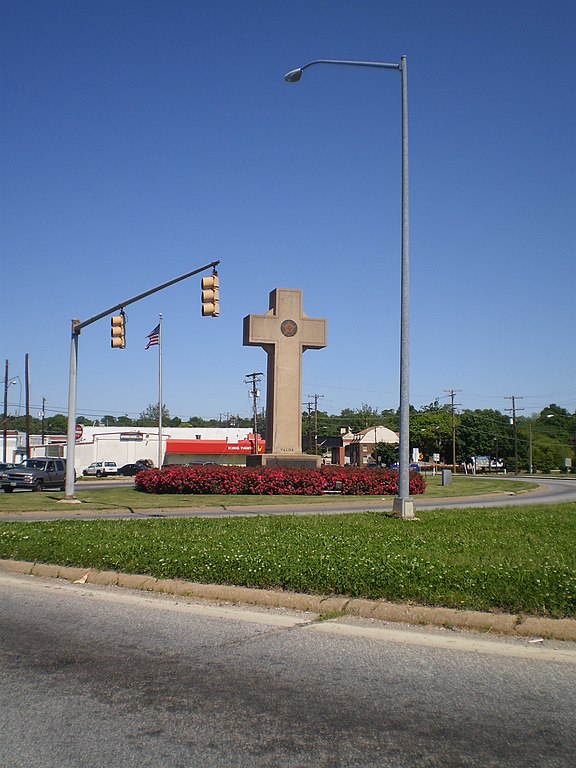
The Peace Cross, Bladensburg, MD, Author Ben Jacobson (Kranar Drogin) (CC BY-SA 3.0 Unported)
The Peace Cross (a 40 foot cross of concrete and granite displaying the words courage, valor, endurance, and devotion) is a memorial in Bladensburg, MD honoring those from Prince George’s County who died in WWI. A cross-shape was chosen to echo the grave markers of servicemen buried overseas. The names of 49 local men are inscribed.
Although the cross was originally built on private property using private funds, the land and monument were acquired by the State of Maryland in 1961 by reason of traffic concerns.
In 2017, the Fourth Circuit Court of Appeals ruled that public maintenance of the cross was contrary to the separation of church and state [1]. Read more…

Philadelphia from South Street Bridge, Author King of Hearts/Wikimedia Commons (CC BY-SA 3.0 Unported)

Below is one of countless stories from Christian Legal Clinics of Philadelphia https://www.clcphila.org/, the organization which is the successor to a small faith-based legal clinic a handful of other Christian lawyers and I founded years ago.
Christian Legal Clinics of Philadelphia (which now has seven locations) does great work in the inner city, spreading the Gospel as well as providing free legal assistance to the poor. Please, consider donating, if you can.
“My time at Christian Legal Clinics of Philadelphia has taught me a valuable lesson about human resolve. Through our clients, I have seen how the desire for a happier life will serve as the catalyst to overcoming a host of challenges.
For Ms. Cooper, a happier life meant marrying her longtime fiancé. In order to achieve that goal, she needed a divorce. The problem was that she had no contact information for her estranged spouse in over twenty years.
During our initial consultation, I could see that Ms. Cooper was not helpless. I would later learn the number of obstacles she was fighting on a daily basis. That knowledge confirmed my initial observations…
Early on, I knew that my clients would struggle with health, finances, and even family. I also knew I would not be able to help every person. But, I knew in my spirit that Ms. Cooper did not need me to fix it. She needed me to show her that she had the power to do it on her own. I was thrilled to be able to help Ms. Cooper by drafting the appropriate petition and providing her with an advice letter that walked her though each step of the process.” Read more…

Eleanor Roosevelt holding poster of Universal Declaration of Human Rights, Source flickr, Author FDR Presidential Library and Museum (CC BY-SA 2.0 Generic)
The Universal Declaration of Human Rights was adopted by the UN General Assembly in 1948. Its drafters appealed to the “common intuition that every person, regardless of circumstances, challenges, privileges, or merits, has an inherent value, equal to that of all other persons” [1A].
The document was, however, a product of consensus. It represented an attempt to reconcile wildly divergent worldviews by using ambiguous language [1B].
“It is not surprising that much of the fight over human rights concerns our core physical and existential needs…Freedom, understood as the absence of any limitations, represents the pinnacle of our modern ambitions, and anything that stands in the way is branded an illegitimate shackling of the person and denial of human rights. ‘Sexual rights’, abortion, the elimination of parental rights, and radical sexuality education for children thus constitute the prevalent social issues in dispute at the UN today” [1C].
–Elyssa Koren, UN Counsel, and Paul Coleman, Exec. Dir. of ADF International
Modern slavery, sex-trafficking, religious persecution, and ethnic cleansing demonstrate how far the world is from implementing the ideals of the Universal Declaration of Human Rights. The problem is that ethical and moral obligations do not derive from the natural world [2A].
Charles Darwin believed that morality emerged from the evolution of human social instincts. Even he, however, acknowledged the shortcomings of this belief.
“If…men were reared under precisely the same conditions as hive-bees, there can hardly be a doubt that our unmarried females would, like worker-bees, think it a sacred duty to kill their brothers, and mothers would strive to kill their fertile daughters; and no one would think of interfering.”
–Charles Darwin, The Descent of Man, pp. 102-103
“Whichever characteristic we choose to ground human dignity, some human beings will not possess the characteristic at all, and some will possess it to a higher degree than others…” [2B].
–Angus Menuge, Chair of Philosophy Dept. at Concordia University
The Bible does not base human dignity on such variable qualities.
“Human beings are the center of God’s creation and nature…Our creation in the image of God ‘forms the deep ontological foundation of a Christian theory of human dignity, human worth, and human rights’…Our dignity is found in our having been created, that is, on our dependence on God…We have dignity not because we have willed, evolved, or merited it, but because God has graciously chosen to confer it upon us, when he did not need to do so…Because all human beings have been created by God with inherent worth (dignity), no one may decide whether or not another human being has human rights…Ultimately, the proper understanding of human nature, and consequent treatment of each person…depends on love of neighbor. Human rights are not simply about individual rights claims, but rather ‘what we have a duty to give to, or protect in, others. Rights thus become an obligation of justice and mercy…’ ” [3].
–Andrew DeLoach, Dir. of the Center for Human Rights at Trinity Law School and of the International Human Rights Program at the Hague
—
[1A, 1B, and 1C] Journal of Christian Legal Thought, Vol. 9, No. 2 (2019), pp. 8-10, “The Universal Declaration and the Distortion of Human Rights” by Elyssa Koren and Paul Coleman.
[2A and 2B] Journal of Christian Legal Thought, Vol. 9. No. 2 (2019), pp. 11-17, “Human Rights and Their Counterfeits” by Angus Menuge.
[3] Journal of Christian Legal Thought, Vol. 9, No. 2 (2019), pp. 1-6, “Human > Rights” by Andrew DeLoach.
READERS CAN FIND MY VIEWS ON ABUSE AND ABUSE-RELATED ISSUES AT ANNA WALDHERR A Voice Reclaimed, Surviving Child Abuse
https://avoicereclaimed.com

“Moses Viewing the Promised Land” by Frederic Church (1846), Photographer/Source Art Renewal Center (PD-Art, PD-Old)
“Exiled from Eden eons ago
Sojourning with Abraham
Delivered from slavery
Wandering around the world’s wilderness
Taken into captivity in Babylon
Till we return from whence we came
Each of us is called to leave
Behind familiar faces and places
And go forth to foreign lands
To find our way back home
To God.We follow in the footsteps
Of him who left heaven’s glory
To dwell among the poor
And oppressed of the earth
And set them free with the truth
That they as sons and daughters
Of God in whose image they were made
Are thus deserving of all help, hope
And dignity, for they too are called
To go forth from poverty and despair
To dwell in the Promised Land.”
READERS CAN FIND MY VIEWS ON ABUSE AND ABUSE-RELATED ISSUES AT ANNA WALDHERR A Voice Reclaimed, Surviving Child Abuse
https://avoicereclaimed.com

Aramaki Rose Park, Itami, Japan, Author 663highland (CC BY-SA 3.0 Unported)
Below is an excerpt from Barriers by Ann Aschauer who blogs at Seeking Divine Perspective https://seekingdivineperspective.com.
Barriers examines prayer from a biblical perspective. I recommend the book to anyone who wants a closer relationship with God.
“…when roses…[are] watered just a little every day, their roots spread out just under the surface of the ground. Then when winter …[comes] and the top soil…[freezes], the roots …[freeze] with it and the roses…[die]. However beautiful they were during the warm weather, because their roots were shallow, they couldn’t survive the winter.
However…when roses are soaked heavily just once a week, the water sinks deep into the ground. Then when the weather gets hot and dry between waterings, the roses will stretch their roots down to where the water is. When winter comes and the top of the ground freezes, the roses’ roots remain safe deep underground, ready to send up new shoots in the spring.
In other words, the dry spells are what help the roses survive the winters.”

Map of signatories to International Convention for the Protection of All Persons from Enforced Disappearance, Author IdiotSavant (PD)
The following is excerpted form “Healing wounds one story at a time” by Maria-Pia Negro Chin, published in the August 2019 edition of Maryknoll Magazine.
“One morning a man wakes up, hugs his children and kisses his wife goodbye before walking to work. But, he does not come back home. His wife calls her husband’s job and hospitals…Finally, the family goes to the police. Then they start an uncertain journey, fearing they will never see him again.
Maryknoll Sister Marya Zaborowski [who is 86] says the families of people like this man often struggle to find answers as they desperately search for their loved ones. ‘The government does not know who took him. You don’t know whether they were taken as a slave, they are being tortured or if they were killed,’ says Sister Zaborowski…
Once she started working for the Asian Human Rights Commission (AHRC), an independent non-governmental organization based in Hong Kong, Sister Zaborowski realized that the situation described above was an all too-common reality. According to the UN Working Group on Enforced or Involuntary Disappearances, countries in Asia account for over 25,000 outstanding cases of disappearances, about half of the disappearances worldwide.” Read more…

“Punishment of Haman” by Michelangelo (1508-1512), Sistine Chapel, Vatican (PD).
On October 16, 1946 a group of Nazi war criminals was hanged as a result of the Nuremburg trials [1].
Included in the group were Alfred Rosenberg, one of the primary authors of Nazi racial policy with its persecution of the Jews; Julius Streicher, publisher of the anti-Semitic newspaper Der Sturmer, an essential vehicle of Nazi propaganda; and Hans Frank, the governor of occupied Polish territories following the German invasion in WWII, and directly involved in the mass murder of Jews.
Hermann Goring, creator of the Gestapo secret police and Nazi concentration camp system, as well as an infamous “collector” of valuable artwork confiscated from Jews during the Holocaust; and Martin Bormann, the commandant of Auschwitz, had already committed suicide.
Individually and together these powerful political and military leaders had formulated and implemented the so called Final Solution, its goal the extermination of every Jewish man, woman, and child on earth.
With the help of God, that goal was not accomplished. Read more…

Urban decay in Camden, NJ, Author Phillies1fan777, Source English Wikipedia https://en.wikipedia.org/wiki/Urban_decay (PD)
“The rich rules over the poor, And the borrower is servant to the lender” (Prov. 22: 7).
There are financial traps into which the poor routinely fall.
Affordable Housing Crisis
Over the first of these traps, excessive housing costs, the poor have little or no control. The lack of affordable housing is at crisis levels, nationwide [1][2]. Low income families (already living paycheck to paycheck) run the constant risk that a single unexpected expense will topple their fragile financial structure.
Recurring Bills
Even recurring bills such as those for gas and electricity must frequently be paid in part or on a rotational basis. The gas bill is paid this month, the electrical bill next month, the water bill the following month.
Despite the federal government’s Low Income Home Energy Assistance Program (LIHEAP), many of the poor spend 25% – 30% of their income on utilities [3]. Interruptions in service are common. Meanwhile, debt from overdue bills and associated late fees mounts.
Phone Bills
The poor may be forced to relocate frequently, so cell phones are viewed as an essential means of maintaining contact. Phone bills, however, can run as high as rent.
Vehicular Expenses
The argument that the poor should not own a vehicle is likely to fall on deaf ears. A vehicle is often viewed as housing of last resort.
With a vehicle, of course, come maintenance and repair costs. In an effort to economize, some will “scrimp” by failing to pay vehicle insurance and/or registration. This can result in substantial fines.
Unexpected Expenses
Unfortunately, life regularly throws curveballs. The washer breaks down. The roof develops a leak. The car needs a new transmission. There is downsizing at the factory, and the primary breadwinner in a family is laid off. These events can be catastrophic for the poor.
Predatory Lending
It goes almost without saying that the poor are targets for predatory lending [4].
- Payday loans with their exorbitant interest rates are a great temptation to those living paycheck to paycheck.
- High late charges are common on the credit cards marketed to the poor. The “teaser” rates on such cards routinely skyrocket after a single late payment.
- The poor are lured into signing installment contracts and balloon mortgages they do not properly understand and cannot afford.

 A Lawyer's Prayers