
Storm clouds, Author NOAA Photo Library/National Severe Storms Laboratory (Image No. NSSl0111) (PD-fed. govt.)
“Thus says the LORD of hosts, ‘Behold, evil is going forth From nation to nation, And a great storm is being stirred up From the remotest parts of the earth’ ” (Jer. 25: 32).
The Daily Stormer is the most popular white supremacist website in America today [1A]. Over 400,000 visit the site monthly.
Readers are known to have included three killers: Dylann Roof who calmly murdered nine at Emanual AME Church in Charleston, SC, after a prayer meeting; Thomas Mair who fatally shot and stabbed a British member of Parliament; and James Jackson who stabbed a homeless man in New York City to death with a sword [1B].
Consciously derivative of the Nazi newspaper Der Sturmer, the Daily Stormer exists to spread racism and antisemitism [2]. Andrew Anglin, founder of the Daily Stormer, said about Pres. Donald Trump’s election, “Our Glorious Leader has ascended to God Emperor” [7].
If that does not send a chill down your spine, a brief lesson on poisons will:
- White Supremacy is a belief in the racial superiority of whites over all others, based on 19th Century ideas [3A]. Dating from Reconstruction, the Ku Klux Klan is the oldest white supremacist organization in the nation [4A]. White supremacist groups include the Neo-Nazis (discussed below); Aryan Nations and other racist skinheads; Aryan Brotherhood and other Aryan prison gangs; Odinism (sometimes known as Wotanism), the racist offshoot of neo-Nordic paganism; and so called Christian Identity, a pseudo-Christian hate group [4B][5].
- Neo-Nazism, a particular form of white supremacy, is the successor to historic Nazism, focusing heavily on antisemitism [3C]. Neo-Nazis revere the original Nazis, and blame Jews for America’s ills. They either deny that the Holocaust took place, dispute its severity, or applaud its outcome.
- White Nationalism is an ideology whose radical goal is a wholly white America [3B]. Members differ on how this might be achieved.
- Alt-Right (alternative right) is the label applied to a fringe political movement, whose largely anonymous online members support any or all of the above [3D]. Elevated in importance by the right-wing media outlet Breitbart, the alt-right rejects mainstream conservative policies. In a notorious incident last year, alt-right leader, Richard Spencer – who denies he is a Nazi – concluded a speech with the words, “Hail Trump! Hail our people! Hail victory!” while some attendees gave the Nazi salute [6].
There are radical right-wing parties worldwide. These range from the National Democratic Party of Germany, Pro Germany Citizens’ Movement (“Pro Deutschland”), and Alternative for Germany (“Alternative fur Deutschland” or AfD) to France’s Front National (FN), Hungary’s Jobbik, Greece’s Golden Dawn, Sweden Democrats, and Italy’s North League (“Lega Nord”).
What will come of all this, God only knows. But indications are there is a storm of major proportions building. Christians should not assume that storm will pass them by.
—
[1A and 1B] Southern Poverty Law Center (SPLC) Report, “Three killers who used Daily Stormer”, Summer 2017, Vol. 74, No. 2.
[2] Der Sturmer (“stormer” or “attacker”) was a weekly Nazi newspaper, a propaganda vehicle known for its vicious anti-Semitism. The paper favored negative caricatures of Jews, advocating Jewish extermination as early as 1933.
[3A, 3B, 3C, 3D] USA Today College, “The difference between ‘alt-right’ and ‘neo-Nazi’, explained” by Olivia Dimmer, 11/23/16, http://college.usatoday.com/2016/11/23/difference-between-alt-right-neo-nazi/.
[4A and 4B] Slate, “The Six Flavors of White Supremacy” by Nina Rastogi, 5/5/09, http://www.slate.com/articles/news_and_politics/explainer/2009/05/the_six_flavors_of_white_supremacy.html.
[5] ThinkProgress, “The New Religion of Choice for White Supremacists” by Jack Jenkins, 11/13/15, https://thinkprogress.org/the-new-religion-of-choice-for-white-supremacists-8af2a69a3440.
[6] CNN, “Alt-right leader: ‘Hail Trump! Hail Our People! Hail Victory’ ” by Eric Bradner, 11/22/16, http://www.cnn.com/2016/11/21/politics/alt-right-gathering-donald-trump/index.html.
[7] Southern Poverty Law Center (SPLC) Intelligence Report, “The Year in Hate and Extremism” by Mark Potok, Spring Edition, 2/15/17, https://www.splcenter.org/fighting-hate/intelligence-report/2017/year-hate-and-extremism.
READERS CAN FIND MY VIEWS ON ABUSE AND ABUSE-RELATED ISSUES AT ANNA WALDHERR A Voice Reclaimed, Surviving Child Abuse
https://avoicereclaimed.com
The nightingale is a migratory songbird native to Europe and Southwest Asia. Not a beautiful bird, the nightingale is brown above and light below, with a reddish tail.
Despite its drab appearance, the nightingale sings liltingly, day and night. The bird’s ancient name derives, in fact, from the Anglo-Saxon for “night songstress”.
It is actually the male bird that sings. Not to be outdone, nightingales sing more loudly in urban environments, presumably to offset competing noise.
Nightingales have inspired poets, musicians, and sweethearts since time immemorial. The great poet, John Milton, wrote of the nightingale in Paradise Lost: “…as the wakeful Bird Sings darkling, and in shadiest Covert hid Tunes her nocturnal Note [1].”
“The Lord will command His lovingkindness in the daytime, and in the night His song shall be with me — a prayer to the God of my life” (Ps. 42: 8).
Father, we seek You out as deep calls unto deep. Our hearts were made to long for You. Yet when the waves roll over us, we fear at times we are lost.
Forgive our lack of faith, Father. How can we doubt when You sent us Your Son?
Your mercies are unending. Your beauty surrounds us. We will hope in You and praise Your name…as does the humble nightingale.
Amen
—
[1] This quote can be found in Book III of Paradise Lost, at lines 38-39.
Originally posted 5/22/13
READERS CAN FIND MY VIEWS ON ABUSE AND ABUSE-RELATED ISSUES AT ANNA WALDHERR A Voice Reclaimed, Surviving Child Abuse
https://avoicereclaimed.com

Statue of Liberty, New York, NY, Author featherboa, Source http://www.flickr.com/photos/featherboa/43040507/ (CC BY-SA 2.0 Generic)
“Give me your tired, your poor,
Your huddled masses yearning to breathe free,
The wretched refuse of your teeming shore.
Send these, the homeless, tempest-tost to me,
I lift my lamp beside the golden door!”-Emma Lazarus, “The New Colossus”
We often refer to the Statue of Liberty as “Lady Liberty” – an endearment, a statement of pride. But it is not enough that the words from Emma Lazarus’ poem momentarily quicken our hearts.
Since Alexis de Toucqueville first described America as exceptional in 1831, this nation has been recognized by the world as unique. While we are not exempt from the forces of history, we are at this moment a political and economic powerhouse, a colossus bestriding the world.
America has been greatly blessed – with natural resources, with a Judeo-Christian foundation, with a hard-won heritage of freedom and equality, with a diverse population, with a legal system accessible to all, with a classless society and a culture that encourages individuality.
With these blessings comes great responsibility.
We have the capacity to teach democracy to the world. Too often, however, we have squandered opportunities to live out the ideals we say we cherish. We are squandering them now. Read more…

Oklahoma City homicide detectives survey a crime scene, Author/Source Oklahoma City Police Dept. (CC0 1.0 Universal Public Domain Dedication)
The number of homicides is tracked in every major city in America.
- Baltimore, Maryland 161 homicides in 2017 YTD [1]; 28 homicides in the last 30 days [2]
- Philadelphia, PA 142 homicides in 2017 YTD (up 17%) [3]
- Chicago, IL 762 homicides in 2016 (more than NYC and LA combined) [4A][5A]; 130 homicides (700 shootings) as of 4/1/17 [5B]
- Houston, TX 302 homicides in 2016 [6][7]
- Detroit, MI 302 homicides in 2016 [8A]
- New York, NY 334 homicides in 2016 [4B]
- New Orleans, LA 175 homicides in 2016 [9A]; 92 homicides 2017 YTD [9B]
- Memphis, TN 214 homicides in 2016 [8B]
- Los Angeles, CA 294 homicides in 2016 [4C]
Philadelphia provides a convenient interactive map. You can outline your neighborhood, and find out how many were killed there in the past week, month, or 6 months.
Victims drive cars or vans, walk, or ride bicycles; frequent fast food joints, and abandoned buildings, back alleys, houses, and apartments. They are talented artists, and former marines, rappers, homeless, and blind; teens, transgender, aged, and children. Death plays no favorites.
Victims are shot, stabbed, or beaten to death singly, in pairs, by threes, fours, and more. Death takes no vacations. The frequency of death spikes in summer, the heat a catalyst. Read more…
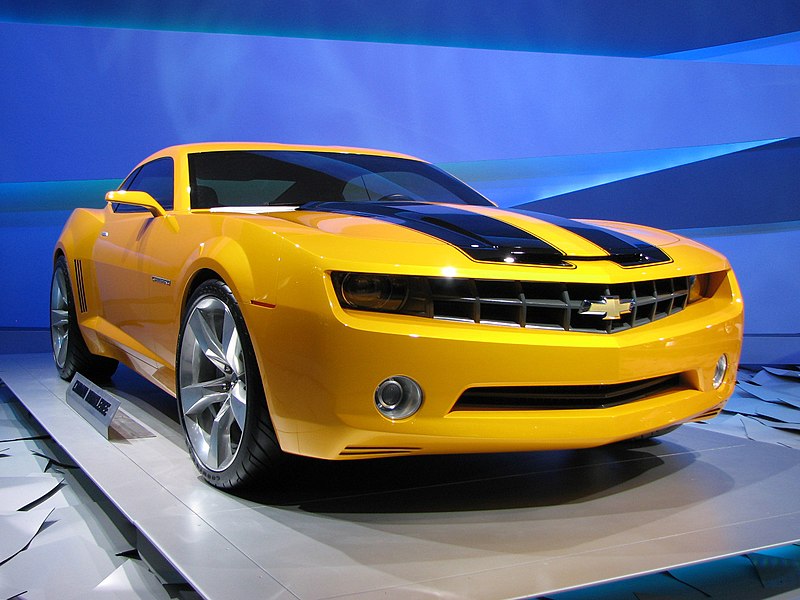
The Chevrolet Camaro used to portray “Bumblebee” in the TRANSFORMERS films, Author Kevin Ward, Source flickr (CC BY-SA 2.0 Generic)
TRANSFORMERS, all associated names, terms, phrases, and slogans are Copyright 2003 Hasbro. All related characters and toys are registered trademarks of Hasbro and Takara Tomy. All rights reserved.
Chevrolet is a division of General Motors Company.
NOTE: Neither Hasbro, Takara Tomy, nor Chevrolet (GM) have any relation to this blog or the posts it contains.
I sat in a darkened theater with a wonderful little boy whose father is not present in his life, and thought about fathers everywhere.
We were at another in the series of TRANSFORMERS ® movies. For those who may not be familiar with them, the Transformers are a race of giant robots from a distant galaxy. They engage in a war of good against evil, some of which takes place on earth.
Sometimes beaten and broken, abandoned and uncared for, these robots can assume different shapes, as the need arises. Though not immortal – some perish – the Transformers personify heroism while the human beings in the plot often fail or fall short, at times even betraying individual Transformers whose desire is to help them.
What the little boy with me could not see, but I did, was that the Transformers were as much pictures of real human beings as the human characters in the story were.
It is a thrilling story, this war of good against evil. And we all play a role, whichever side we choose to take. At times, we struggle against impossible odds, unbeatable foes – the challenges of heart disease or breast cancer, grief and loss. We stagger forward under loads no one should have to bear – the burdens of single motherhood, the daily toil of a thankless job to which we remain faithful for the sake of our children.
In the process, we are transformed. Oh, our parts may rust, become worn and broken. But our hearts become something else, something shining. Read more…

“Salvator Mundi” (Latin: Savior of the World) by Leonardo da Vinci (c. 1500) (PD-Art l Old-100)
This is Part 2 of a review of the book God’s Undertaker – Has Science Buried God? by John Lennox. The rational intelligibility of the universe, and its fine-tuning were discussed last week in Part 1.
In Favor of a Creator (Continued)
C. Limitations of Evolution
“…the Darwinian theory is correct in the small, but not in the large. Rabbits come from other slightly different rabbits, not from either [primeval] soup or potatoes.”
-Fred Hoyle
John Lennox willingly concedes microevolution (variation within already existing species, body plans, and structures), but distinguishes it from macroevolution (the introduction of qualitatively new genetic material, as reflected in new species, body plans, or structures).
Natural selection simply cannot account for the extent of genetic variation. Indeed, paleontologists admit that evidence for macroevolution is sadly lacking from the fossil record – something not much publicized.
Lennox points out that the time frame required for the evolution of complex structures like the human eye by random chance is far in excess of scientifically recognized estimates for the age of the entire universe.
In an attempt to explain away this deficiency, some atheists have sought to modify the theory of evolution. They now contend that evolution is not an undirected process. Rather, it is said to seek out the “best” outcome, and proceed in that direction by a faster pathway.
This runs counter to the original concept of natural selection, and is wholly unsupported by scientific evidence.
John Lennox, also, examines so called molecular evolution (the claim that living cells emerged from non-living material, across the vast chasm that separates the two). Molecular evolution provides no explanation for the origin of information which is not, itself, material. Moreover, the statistics against it are staggeringly large. No amount of typing monkeys will suffice. Read more…
Despite the advances in science, nagging questions remain as relating to origins and meaning. “How did the world begin?” “How did life arise?” “What are we doing here?”
Renowned Christian apologist and Oxford University Professor of Mathematics, John Lennox, explores these questions and the ongoing debate between science and religion in God’s Undertaker – Has Science Buried God?
Atheists tend to view believers as ignorant, deluded, or intellectually lazy. Lennox contests this. He begins by pointing out that:
- God, as Christians understand Him, is far more than a “God of the gaps” (an explanation supplied when natural explanations are not readily available). He is the source of all explanations.
- Christianity is not a “blind” faith. Rather, it is evidence-based.
- Many famous scientists were inspired by their belief in a Creator [1].
- Many respected scientists are believers, even today.
Lennox makes a compelling case that the fine-tuned universe we inhabit; the complexity of the biosphere; and the emergence of life from non-life (and mind from mindlessness) are not fully explained by unguided natural processes.
Science v. Philosophy
John Lennox cautions from the outset that scientists when speaking about God are not speaking about science at all; that science and the philosophy of naturalism are not one and the same.
Carl Sagan’s well-known statement, “The cosmos is all there is, or was, or ever shall be” illustrates this. It is actually a statement of personal belief, not science. Read more…

Member of US 15th Marine Expeditionary Unit atop amphibious assault vehicle in Somalia, during Operation Restore Hope (1992), Author Photographer’s Mate/Petty Officer First Class Joseph Dorey (PD as work product of fed. govt.)
The “greatest generation” is a term journalist, Tom Brokaw, popularized in his book by the same name. The term refers to the men and women raised during the Depression who went on to fight World War II, in great and obscure battlefields across the globe and on the home front.
That generation, rapidly fading now, was defined by the obstacles it faced. Too often, the generations since – however we may label them – have been defined by self-indulgence, greed, apathy, and the harm they will leave behind.
Wars may be won or lost by weapons and generals. Those with servicemen and servicewomen in their families know it is the corporals and privates who bleed. They are standing guard in nameless locations even now. Ever vigilant, willing to give their lives for ours. Read more…

School lunch display at Oregon State University, Author Stephanie Grutzmacher, Source Flickr (CC BY-SA 2.0 Generic)
The National Center for Educational Statistics reported in 2013 that 22% of children were bullied during the school year [1][2].
Whether or not we lost our lunch money to a bully as children, most of us are aware of the negative and long-term impact bullying can have on victims [3]. Bullying has actually been a factor in school shootings [4].
For that reason, it is shocking to learn schools, themselves, make it a practice to bully children over lunch money.
Lunch Shaming
The Department of Agriculture in 2016 determined that nearly half of all school districts use a form of shaming to induce parents to pay their children’s lunch bill [5A].
Approximately 45% of such school districts withhold a hot meal from the child (replacing it with a cold sandwich or, in a few cases, denying food entirely). Many discard the hot food.
Some not only call children out publicly for overdue food bills, but use stamps or felt tip markers to label these children. The experience can be traumatic.
Unpaid Meal Debt
In a review of nearly 1000 school lunch programs, the School Nutrition Association in 2016 found that 71% had unpaid meal debt [6A]. In urban areas, this can run into millions. Read more…

Detail from “Madonna and Child with St. Anne and Young St. John” by Leonardo da Vinci (c. 1507), National Gallery, London (PD-Art, Age-100)
There is evidence to suggest that babies can recognize the faces of their mothers within weeks of birth. At first the baby’s vision is only clear enough to let him see his mother’s face as he is feeding. By 6 months of age, however, the baby will be able to pick his mother’s photo out of a group.
It is our mother’s face we seek out. Hers is the approval for which we first yearn. She is the source of our sustenance – both physical and emotional. Not only does she feed, burp, and change us. She bathes, powders, dresses, soothes, tickles, carries, and cuddles us.
She sings us lullabies. She reads to us. She ties our shoes, then teaches us how. She tells us why the sky is blue. She sacrifices for us, and keeps us from harm.
In this relationship, we can see reflected our relationship with God. Read more…

 A Lawyer's Prayers